In Praise of Organic Tourism

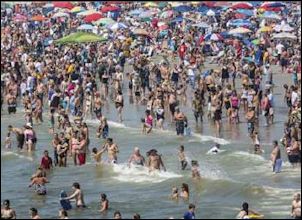
Which would you rather have in your community.... massive crowds of drunken, puking college kids like Fort Lauderdale....

Which would you rather have in your community…. massive crowds of drunken, puking college kids like Fort Lauderdale….

by James A. Bacon

Promoting tourism is a major part of Virginia’s economic development strategy for good reason. Tourism supports jobs, expands the tax base and helps pay for amenities — restaurants, arts, cultural institutions — that can be enjoyed by the whole community. But it can create problems, too, such as crowding, traffic congestion, noise and tacky, haphazard development. Handled poorly, tourism actually can degrade a community’s quality of life.

It is critical to differentiate between mass-market tourism and what Edward T. McMahon, writing in the May issue of Virginia Town & City, calls “responsible” tourism. Mass market-tourism is all about putting “heads in beds.” It is high volume, high impact but low yield. Think Fort Lauderdale, the “spring break capital” of the United States, which attracted millions of college kids who slept six to a room and spent money on little but beer and t-shirts.

... or a recreational amenity like the beautiful Virginia Creeper Trail?

… or a recreational amenity like the beautiful Virginia Creeper Trail?

“Mass market tourism is … about environments that are artificial, homogenized, generic and formulaic,” writes McMahon. By contrast, “responsible tourism is about quality. Its focus is places that are authentic, specialized, unique and homegrown. … Think about unspoiled scenery, locally owned businesses, historic small towns and walkable urban neighborhoods.”

The challenge for Virginians, suggests McMahon,  a senior resident fellow at the Urban Land Institute, is to promote tourism without losing our soul. There is more to building a tourism industry than spending marketing dollars to lure visitors. It involves making destinations more appealing. “This means identifying, preserving and enhancing a community’s natural and cultural assets, in other words protecting its heritage and environment.” Continue reading

When States Should Blow the Whistle

by Michael Lewyn

Generally, states limit local governments’ means of raising tax revenue. Both Democratic and Republican governors consider it their duty to micromanage the property tax rates of local governments, and local governments can rarely institute a new type of tax without state consent. On the other hand, local governments tend to have free rein in land use matters; even relatively activist state governments tend to allow cities to choke off housing supply without state interference. Is this really the right way to do things?

Just as we ask ourselves, “When does the state have any business interfering with individual rights?”, we should also ask ourselves, “When does the state have any business interfering with a municipal government?” And just as states are most likely to get involved where an individual hurts other individuals, a state should be most willing to get involved where a city’s action affects people living outside the city—for example, the “tragedy of the commons” situation where a policy is rational for each individual city, but is not rational for the region as a whole.

Applying this principle, I am not sure why states should limit municipal taxing powers. When a city raises taxes, it only hurts itself, because it takes the risk that people will flee that city in search of less restrictive cities. And if several cities and towns in a region raise taxes, such tax increases become even less rational for a town that refuses to raise taxes, since that town can gain residents by being a tax haven.

By contrast, environmental issues are especially well suited for state (and for that matter, federal) regulation, because one city’s policies might harm residents of nearby municipalities. For example, suppose that a suburb allows unlimited development of wetlands within its borders. If the absence of wetlands causes increased flooding, the resulting damage may cross municipal borders and harm residents of nearby towns. Or if a suburb decides to build high-speed stroads and starve public transit so that its jobs are inaccessible by public transit, reverse commuters in other municipalities will have to drive to reach those jobs, causing pollution not just in the suburb in question, but also in their own neighborhoods. Thus, states should be responsible for wetlands regulation, and should perhaps play some rule in ensuring that suburban employment centers are transit-accessible. Continue reading

Land, Density and Resilience

Flood-prone areas of south Hampton Roads. Source: Virginiaplaces.org.

Flood-prone areas of south Hampton Roads. Source: Virginiaplaces.org. (Click for detail.)

One more takeaway from the Resilient Virginia launch conference yesterday: All other things being equal, more compact communities are more resilient communities.

Like Bacon’s Rebellion, Cooper Martin, program director of the Sustainable Cities Institute, is a big fan of Joe Minicozzi and his maps and graphics showing how dramatically land value-per-acre varies between core urban areas, suburbs and the countryside. Densely settled urban cores have land values that are literally a hundred times higher per acre than low-density shopping centers and large-lot subdivisions.

In my commentary, I have focused mainly upon the fiscal folly of building disconnected, low-density development. The infrastructure — the roads, utilities, sidewalks and other amenities — are more expensive per household to maintain. But Martin added a new dimension when addressing the Resilient Virginia conference yesterday. Low-density development makes it more expensive to harden homes and businesses against disruption and catastrophe. When the taxable value of land is high, it’s easier to support expensive investments to protect that land than when the value of the land is low. Continue reading

Don’t blame the Koch Brothers (for low gas taxes)

After a variety of conservative groups (including some funded by the Koch brothers) sent a letter to Congress opposing gas tax increases, the liberal and urbanist blogospheres were chock full of stories like this one, complaining that Congress can’t reach a transportation deal because (in the words of grist.org)  “of the right-wing and Koch network’s coordinated national attack on transit.”  There is certainly an element of truth in these stories; indeed, conservatives don’t like tax increases and are often not particularly supportive of public transit.

But this narrative misses a huge fact: It’s not just the far Right (or even the not-so-far Right) that hates tax increases, especially gasoline tax increases. For example, a 2013 Gallup poll asked respondents if they “would support a state law that would increase the gas tax by up to 20 cents a gallon, with the new gas money going to improve roads and bridges and build more mass transportation in your state.” Only 29 percent of respondents would support the new tax. It wasn’t just conservatives or residents of conservative areas who were against the tax either; only 40 percent of Democrats, and only 32 percent of northeasterners, supported the tax hike.  Even in Massachusetts, voters recently voted to eliminate a law indexing the gas tax for inflation.

In sum, if you think we need to spend more money on transportation, don’t blame a cabal of conservatives, blame the American people, who believe (rightly or wrongly)  they can have good roads and good transit without paying more money for them.  We have met the enemy and he (or she) is us.

(Cross-posted from cnu.org)

Retrofitting Suburbia — Henrico Edition

Regencyby James A. Bacon

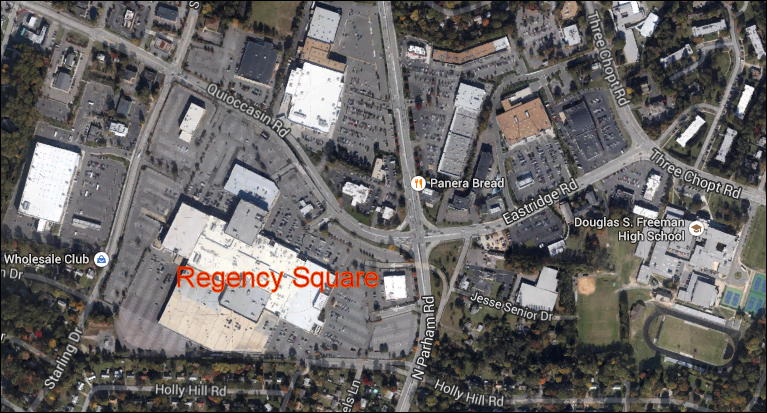
Regency Square Mall, a failing, 39-year-old shopping mall in the heart of the prosperous “West End” of Henrico County, is expected to go up for sale by year’s end. While the sale likely will prove distressing to bond holders — nearly $70 million in loans are 70% secured by the mall, which is appraised at only $25 million, reports the Times-Dispatch – a change in ownership creates a tremendous opportunity for Henrico County to reinvigorate a major commercial district.

While Regency enjoys an excellent location and serves an affluent market, it faces tough competition from two newer, pedestrian-style malls: Short Pump Town Center and Stony Point Fashion Park. Regency has zero pedestrian appeal — it is a boxy building set in a vast parking lot, and it is largely surrounded by strip shopping centers, some of which are themselves getting long in the tooth. It is no longer a place where anyone enjoys spending time.

I know Regency well — it is located a couple of miles from my home, and I shop there by necessity. Despite a superficial design makeover a few years ago, the place has little appeal. The problem is that the mall and the commercial area surrounding the mall were designed in the 1970s heyday of autocentric suburbia. Everything has been sacrificed for the comfort and convenience of the automobile. There are sidewalks in the area but no one uses them; the design violates every tenet of walkability. Ironically, the Regency Square area doesn’t even work well for the automobile. There are so many ill-timed stoplights that driving through it is a nightmare — to be circumvented if at all possible. Continue reading

The Chuck and Joe Traveling Municipal Salvation Show

The Joe and Chuck Traveling Municipal Salvation Show

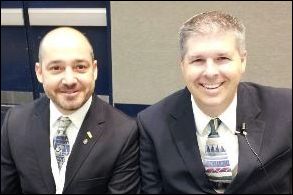
Joe Minicozzi (left) and Chuck Marohn

Joe Minicozzi and Chuck Marohn, principals with Strong Towns and Urban3 respectively, travel the country telling cities, towns and counties how to build better communities while remaining fiscally solvent. I have borrowed heavily from both Chuck and Joe in my writing about land use, transportation and community building, and it’s reassuring to see that as their own thinking evolves, it has moved in concert with mine. Most recently, Chuck has blogged about the paucity of useful information cities have to guide them in make zoning and capital spending decisions. He makes many of the same points I did in my recent post, “How Planners Can Rescue Virginia from the Fiscal Abyss.” Writes Chuck:

Despite running corporations (most cities are “incorporated” municipalities) that have billions of dollars in assets and liabilities and annual cash flows in the tens, and sometimes hundreds, of millions of dollars, few ever ponder some shockingly simple questions.

      • What are our total assets, the value of the tax base that constitutes our community’s wealth?

      Continue reading

      How to Convince Your Mom that Congestion Pricing Is Good

      by Michael Brown

      Odds are if you show up at a family reunion and try to convince your parents and siblings that congestion pricing is good, you’ll be lonely pretty quickly. People want the freeways to work but they hate paying tolls! If you are reading this, then you’re probably part of the choir. My goal isn’t to convert the converted as much as to provide new arguments and sound bites when talking to others.

      So, how do we reach others? Millions must be convinced to put down their pitchforks long enough to test the theory and decide for themselves if congestion pricing is worthwhile. Elected officials are afraid to take a position contrary to polls, and polls are overwhelmingly dominated by uninformed opinions.

      Too many citizens “learn” the issues of the day in 30-second television spots. Even those who make an effort to stay well informed are not the best ones to ask.  There are many fine teachers, dentists, and doctors with intelligent opinions but if you ask them about Congestion Pricing, most would focus on a single point – “double taxation.” Because no one listens long enough for a good explanation, politicians conform to polls of the uninformed rather than risk trying to change public opinion.

      congestion_pricing1

      =================
      This is the fourth part of a four-part series.

      Part 1        ◊       Part 2
      Part 3   
           ◊       Part 4
      =================

      Geeks and used car salesmen

      Congestion Pricing’s true believers are insiders who spend years exploring how market mechanisms can solve our transportation headaches. Typically, they are “nerdy engineer” types and Ph.D.’s at universities. They come up with great ideas but their main focus is convincing other geeks. Peer-reviewed articles loaded with incomprehensible equations and data may be good stuff and true, but the world will never move out of the congestion morass until the world “gets it” at the lowest-common- denominator level of things that matter to them. Continue reading