Light Rail Doesn’t Always Mean Fewer Buses

by Michael Lewyn

One common argument against new rail service is that rail cannibalizes bus ridership. One version of this argument is that riders of new light rail systems are nearly always former bus riders, so that any increase in rail ridership comes at the expense of bus ridership. A second version is that the costs of rail make it impossible for a region to maintain a first-class bus system.

If the first claim was correct, regions that introduced new light rail would be the most likely regions to have reduced bus ridership. A new post at City Observatory suggests that the correlation between new rail and reduced ridership is pretty modest. Daniel Hertz, one of our nation’s most interesting urban planning bloggers, has assembled data on bus ridership and service trends since 2000, including information from 39 urbanized areas with over 1 million people. His data shows that nine regions have experienced bus ridership losses of over 20 percent (Baltimore, Atlanta, Dallas, Cincinnati, Houston, Cleveland, Detroit, Milwaukee, San Jose). Four of these cities (Baltimore, Dallas, Houston, San Jose) have built significant new rail in the past couple of decades.  But five other cities in America’s Bus Ridership Dishonor Roll either lack significant rail service or (in the case of Cleveland) have primarily pre-2000 rail systems. By contrast, 30 other regions have experienced either ridership gains or more modest ridership losses: 13 of these regions have added new rail service, and 16 have not.* In other words, about one-fourth of the new rail cities (4 of 17) have suffered major ridership losses, and also about one-fourth of the other cities (5 of 22). Thus, the association between rail and reduced ridership is either nonexistent or fairly modest.

The association between new rail and bus service cuts is even weaker. Since 2000, six urbanized areas (Cleveland, Milwaukee, Pittsburgh, Detroit, San Jose, Houston) have reduced bus service, measured by route-miles, by over 20 percent. Only two of these regions (San Jose and Houston) have significant new light rail systems. (Two more, Cleveland and Pittsburgh, are “legacy rail” cities with significant but older rail systems). Continue reading
Why Buses Are Inferior

by Michael Lewyn

Critics of rail often argue that buses are superior; they are cheaper, more flexible and (sometimes) run almost as fast.  But in a recent blog post, Houston planning student Maggie Colson explains why trains are better than buses, even if the train isn’t much faster:

The train system was much easier to maneuver than the bus system. I found the bus system to be more complicated because you had to find the correct bus stop with the bus number labeled on it. In addition, you could easily end up going in the wrong direction – the buses did not have the directions labeled like the trains. On the bus you also had to know where you needed to get off. Unlike the train system, the bus did not stop at every stop and instead you had to push a button to request for the bus to stop. While this is not necessarily an issue once you know the route, trying to navigate for the first time was stressful. Without the use of my smartphone, I would not have found or gotten off at the correct bus stops.

In other words, with buses you really have to know what you are doing.

(Cross-posted from cnu.org)

Cars Are Expensive (And Other Things The Census Taught Me)

by Michael Lewyn

I just learned that national tables from the 2013 American Household Survey (AHS) are public. These tables contained a variety of information that I thought was at least mildly interesting. To name a few items:

  • Cars are really expensive—even when gas is cheap. The average household spent $800 per month on car-related costs. (Table S-04C). Only $200 of this sum was on gasoline—which means that even if gas was free, cars would still cost $600 per month. About half of household spending was for car payments, 15 percent was for insurance, and the rest was split between parking and maintenance.
  • Single family housing dominates the landscape. Sixty-four percent of all occupied housing units (and 62 percent of units built over the last several years) are detached single-family houses (Table C-01). This is especially true for owner-occupied units: even in central cities, 79 percent of owner-occupied units are detached houses (Table C-01-00).
  • Most single-family housing is not dense enough to support public transit. The average owner-occupied housing unit takes up 0.3 acres, as does the average housing unit built in the last several years. Thus, most blocks probably contain about three or four units per acre; basic bus service requires at least seven units per acre to be economically viable. (Table C-02). Continue reading

Bridj Comes to Washington

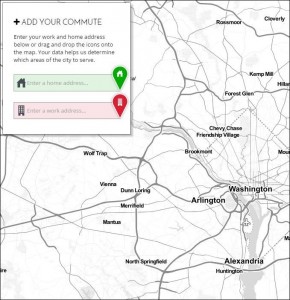
Bridj provides an interactive map of the Washington metro and invites visitors to plot the locations of their commutes. The data will help the company optimize its routes.

Bridj provides an interactive map of the Washington metro and invites visitors to plot the locations of their commutes. The data will help the company optimize its routes.

Last September, I posted about a Boston-area company, Bridj, that was reinventing the mass transit business by providing luxury bus rides to suburban commuters. For $6, Bostoners could get a comfortable, Wi-Fi-equipped ride from suburban locations to downtown Boston and Cambridge. Just as Uber was disrupting the taxicab industry, Bridj, I opined, would disrupt the bus transit industry.

Now Bridj is coming to the Washington region, the company has announced:

As the world’s first smart mass transit system, we deliver a fundamentally more efficient way of moving throughout the city. Powered by data and mobile tech, we’re able to optimize pick-ups, drop-offs, and routing based on need. Plus, since all rides are shared and each Bridj seats up to 14 passengers, fares cost only slightly more than the metro. However, on Bridj you’re always guaranteed a seat and an express trip between neighborhoods.

Our PhD-led data science team is developing our initial service area as we speak. Their algorithm takes into account dozens of different data streams on how D.C. moves, as well as feedback from potential users like yourself.

Continue reading

Suburban Multifamily: Smart Growth or Smart Sprawl?

In a recent article in the Columbia Journal of Environmental Law, law student Paige Pavone criticizes suburban apartments and condominiums as “green sprawl” because they “merely add density to suburban sprawl and exacerbate the very problems smart growth seeks to correct.” She explains that without public infrastructure to support walking and biking, these developments merely entice more people into car-dependent suburbia, and therefore should not be entitled to density bonuses and other incentives that a state might use to encourage smart growth. In particular, she claims that such “High-Density Islands” are cut off from “communities, local governments, nature, public transportation, and sidewalks.”

Is this critique fair? Somewhat.

Pavone examined a variety of suburban multifamily developments, but focuses on Reading Woods, in Reading, Massachusetts, a suburb of Boston. She claims that Reading Woods residents “cannot walk to the public library, a bank, or a grocery store” and would have to cross I-95 to reach a chain restaurant. So I decided to look at Reading Woods on Google Street View and see how horrible it is.

First of all, I looked for sidewalks. The main street serving Reading Woods is Jacob Way. Jacob Way generally has sidewalks, as does Augustus Court (the main street serving the part of Reading Woods further away from South). So it seems to me that a resident of Reading Woods can use sidewalks for most visits to South Street and other neighborhood streets. To reach Main Street (the neighborhood’s main commercial street) you must walk briefly on South Street, which also has a sidewalk (though it only serves one side of the street, and looks pretty narrow). Continue reading

Don’t blame the Koch Brothers (for low gas taxes)

After a variety of conservative groups (including some funded by the Koch brothers) sent a letter to Congress opposing gas tax increases, the liberal and urbanist blogospheres were chock full of stories like this one, complaining that Congress can’t reach a transportation deal because (in the words of grist.org)  “of the right-wing and Koch network’s coordinated national attack on transit.”  There is certainly an element of truth in these stories; indeed, conservatives don’t like tax increases and are often not particularly supportive of public transit.

But this narrative misses a huge fact: It’s not just the far Right (or even the not-so-far Right) that hates tax increases, especially gasoline tax increases. For example, a 2013 Gallup poll asked respondents if they “would support a state law that would increase the gas tax by up to 20 cents a gallon, with the new gas money going to improve roads and bridges and build more mass transportation in your state.” Only 29 percent of respondents would support the new tax. It wasn’t just conservatives or residents of conservative areas who were against the tax either; only 40 percent of Democrats, and only 32 percent of northeasterners, supported the tax hike.  Even in Massachusetts, voters recently voted to eliminate a law indexing the gas tax for inflation.

In sum, if you think we need to spend more money on transportation, don’t blame a cabal of conservatives, blame the American people, who believe (rightly or wrongly)  they can have good roads and good transit without paying more money for them.  We have met the enemy and he (or she) is us.

(Cross-posted from cnu.org)

Potomac Yard Metro: a Financing Model for Mass Transit

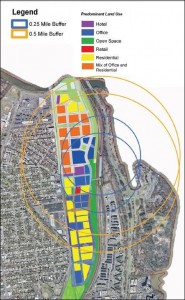
Image credit: North Potomac Yard Small Area Plan

Image credit: North Potomac Yard Small Area Plan. (Click for larger image)

by James A. Bacon

The Commonwealth of Virginia will help finance a new Metro station in Alexandria through a $50 million loan from the Virginia Transportation Infrastructure Bank approved by the Commonwealth Transportation Board earlier this week. The loan is a key piece of financing for the station, which is expected to cost between $209 million and $268  million to build. In turn, the Metro station is a key piece of infrastructure to advance development of between 9.2 million and 13.1 million square feet of residential, office, retail and hotel space in the Potomac Yard.

While the Metro project doesn’t pass the Bacon litmus test for 100% user-pays financing, it does better than most  mass transit projects Virginia has underwritten, and it would open up 300 acres for high-density, high-value development only five miles from the core of Washington, D.C.

The Potomac Yard, to be built on an old CSX railroad marshaling yard south of Ronald Reagan National Airport, could be Northern Virginia’s most important urban infill project of the early 21st century. Plans call for the creation of between 4,300 and 7,100 residential units, 3.2 million and 4.2 million square feet of office space, nearly 800,000 square feet of retail and 740 hotel rooms. We’re not talking about development that might happen… some day. There is a strong, demonstrated demand for the kind of walkable urbanism planned at Potomac Yard. Continue reading