by James A. Bacon
Well, I’m a steamroller, baby, I’m bound to roll all over you.
Yes, I’m a steamroller now, baby, I’m bound to roll all over you. …
– James Taylor “Steamroller
The words to James Taylor’s blues classic “Steamroller” have been churning through my mind during the 2014 Niagara Summit hosted by Richmond-based Tridium as I learn more about the constellation of technologies known as the Internet of Things — the ubiquity of sensors, the falling cost of wireless and data-storage technologies, the rise of “big data” and the emergence of incredibly sophisticated algorithms — and the impact they will have on the business landscape and society at large.
The Internet of Things (IoT), to borrow Taylor’s imagery, is a steamroller, a demolition derby, a napalm bomb. It will flatten — or, to borrow the tech buzz word du jour, totally “disrupt” — the business landscape. Most Americans have yet to hear of the Internet of Things. But as the next wave of the ongoing IT revolution that has transformed the world since the 1980s, it is as momentous as the rise of the PC, the Internet and mobile computing. Admittedly, the IT industry thrives on hype and the search for the Next Big Thing. But there is absolutely no doubt in anyone’s mind at Tridium or among the industry illuminati speaking here that the IoT is for real. IBM, Cisco, Google, Microsoft, Samsung, Intel and other industry giants are all piling into the IoT. Google recently paid $3.2 billion dollars for Nest Labs, a company founded in 2010, that manufactures smart home thermostats! Continue reading
 by Charles Marohn
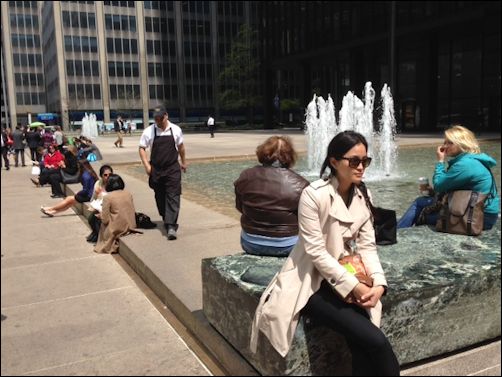 What makes a good urban public space? It takes more than an open plaza, which can be barren, inhospitable and desolate. The fountains, as shown here on Park Ave. in New York, are a definite bonus. But the critical ingredient is having somewhere to sit, even if it’s as simple as a set of shallow steps. I offer this example not because it is extraordinary in any way but because it is so totally ordinary. Cities and towns don’t have to spend millions of dollars on public art and landscaping. All they need is a vibrant street with lots of foot traffic and a place to eat lunch outside on a sunny spring day.