
Local Government Sales Tax

auto dealershipby Charles Marohn

Unless you are a modern day Istanbul and sit at the crossroads of trade and commerce with the ability to skim margins off the goods flowing through your community, why would a city rely heavily on the sales tax? The only reason is that it is easy. Unfortunately, for building a strong town, easy is not always productive.

The sales tax does a number of destructive things to your community, the worst of which is the way it devalues residential properties, and people in general, except in their role as consumers.

For the local government financing itself with sales tax, there are mostly negative financial implications from residential and other non-retail development. A new residence simply costs money. Same with a new office building. At best, they are loss-leaders in an effort to secure more sales tax revenue, although there is no way to track return-on-investment or correlate revenues with expenses.

The sales tax fails to align the interests of a local government and its residents, putting them in tension with one another. The optimum outcome for a local government reliant on the sales tax is for residents to spend their money prolifically then, when they run out, borrow money to spend more. Then, when the household is completely broke, move out of the community and make way for someone else who will spend more. Continue reading

Podcast Show 179: Ben Hamilton-Baillie

ben-hamilton-baillieby Charles Marohn

Ben Hamilton-Baillie, street designer and shared space advocate, joins the podcast from CNU 22 in Buffalo to talk about shared space, his memories of Hans Monderman and hopes for American transportation. This is a very special podcast you are not going to want to miss.

You can follow Ben Hamilton-Baillie on Twitter, see more of his work on his firm’s website and watch the video, Poyton Regenerated, that was discussed in the podcast.

Show 179: Ben Hamilton-Baillie

(Cross posted from Strong Towns)

Converted Garage Becomes Income

by Charles Marohn

Strong Towns contributor Johnny Sanphillippo films stories about urbanism, adaptation, and resilience for granolashotgun.com. His videos are edited by Kirsten Dirksen of Faircompanies.com.

(Cross posted from Strong Towns)

Historic Preservation

brewery

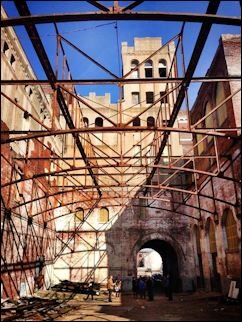
The historic Tennessee Brewery in Memphis.

by Charles Marohn

.I’m agnostic when it comes to historic preservation. I’m going to start with that because, for some people, historic preservation is a near religious belief. For others, it matters not at all. I don’t see this issue so black and white, which often puts me in the dangerous and confusing middle, a place where insight intersects with reason to form thoughts that are, unfortunately, often incoherent, if not totally offensive, to those that care about this issue far more than I do.

Let’s start with two observations that I find to be quite obvious. First, the United States has built very little that is either historic or worth saving. This becomes all the more true the further west one travels. Not only are we a young country – at least the western building-style portion – and thus have not had a lot of opportunity to build things that a laymen today would consider “historic” — but most of what we built that would potentially be historic was built out of non-enduring materials, generally wood. It is tough to “preserve” something quite prone to deterioration.

My second observation is a reaction to the first: because we have so few historic buildings, it should be a priority to maintain and restore those we have. I don’t believe this out of a sense of sentimentality – although I don’t fault people who do – but from an understanding of what these buildings mean to the health of a community. A city without historic buildings is like a family with no parents or grandparents; the children aren’t doomed, but there is a lot there to overcome. Continue reading

Friday News Digest

by Charles Marohn

Enjoy this week’s news.

  • Last week I wrote a post responding to a snarky article about the CNU that appeared in the Buffalo News. That brought a lot of reaction – both positive and critical – and I’ve opted to let it go, focusing my energies on more important things. I wouldn’t be mentioning it now except that Jeff Speck, who unfairly took the brunt of the critique in the original article, wrote a quite intelligent response. Unfortunately, it ran on Streetsblog and not in the Buffalo News (no offense, Streetsblog), two audiences where I suspect there is little overlap (and that’s too bad).

In the Buffalo News’ only prominent review of the event, art critic Colin Dabkowski wrote an “open letter to the New Urbanist movement,” that centered upon a damning critique of my community lecture there and also of my book, Walkable City, which he seems to have read in part.

The thoughts that follow are my response to Dabkowski’s review. The Buffalo News worked with me to craft this article as an Op-Ed for Sunday’s paper. Then, three hours from press time, they demanded that I remove most of my references to  Mr. Dabkowski’s error-loaded text. Not excited by that prospect, I am sharing my comments here instead.

  • I love seeing the Jason Roberts story told in different spaces, this time in the NY Times. What he and Andrew Howard are doing with The Better Block is nothing short of revolutionary. If your city is not (a) trying to hire them or (b) trying to replicate their approach, you are missing out.

Continue reading

ASCEnsorship

by Charles Marohn

Last week a friend sent me a link to a blog post on the American Society of Civil Engineer’s website. The post, titled “10 Myths About the Highway Trust Fund,” is the typical propaganda you always hear from ASCE. Things such as (#1) federal legislation ensures that “transportation projects are planned, developed and executed efficiently,” (#5) decreases in vehicle miles traveled is recession-related and we can expect a return to increasing VMT as the economy recovers and (#6) we need to act now to save jobs and the economy.

I’ve essentially ignored the ASCE for the past couple of years — as increasing numbers of people outside of Washington D.C. are also doing — but in this instance I decided to leave a comment on their blog. Here’s what I wrote.

ASCE is nothing but a propaganda organization. You are in such an echo chamber that you cite your old propaganda as the basis of your new propaganda. This current transportation financing system builds redundant and unnecessary infrastructure while leaving critical systems to rot. The sooner you and the entire DC-based system goes broke, the sooner serious people will be able to start fixing what you have broken. It can’t happen soon enough.

Now that’s pretty harsh, granted, but I didn’t use any inappropriate language, make any threats or do any of the normal things that gets your comment censored. Yet, that is exactly what has happened.  Continue reading

Podcast Show 178: Lynn Richards

broadcast_mikeby Charles Marohn

From CNU 22 in Buffalo, Chuck is joined this week by the incoming president and CEO of the Congress for the New Urbanism, Lynn Richards. They discuss Lynn’s background (really fascinating), how she became interested in leading the CNU and what she looks to accomplish in the position.

You can follow Lynn on Twitter at @lrichardsCNU.

Show 178: Lynn Richards

(Cross posted from Strong Towns)