What Price Happiness?

San Luis Obispo. Who wouldn't be happy living here... if you could afford it?

San Luis Obispo. Who wouldn’t be happy living here… if you could afford it?

by James A. Bacon

After learning that Virginia cities report some of the highest levels of personal satisfaction in the country (see “Happy“), I have been thinking a lot about what creates happy communities. In the hope of gaining a better understanding, I recently finished reading Dan Buettner’s 2010 book, “Thrive: Finding Happiness the Blue Zones Way,” that plumbed the social, economic and political wellsprings of happiness around the world.

The premise was intriguing: Buettner visited four “blue zones,” locations where research indicated inhabitants were world leaders in happiness. Visiting these zones — Denmark; Singapore; Monterey, Mexico; and San Luis Obispo, California — he interviewed politicians, academics, civic leaders and everyday people about why they thought their country/city measured off the charts.

The book is an easy and thought-provoking read. Buettner asks intriguing questions. Unfortunately, the answers to those questions are all across the board. While there are some universal constants — people are happier when they aren’t starving, dying from pestilence and in continual fear of their physical safety; people value family and friendships; people with a sense of purpose are happier than those without – different cultures define happiness in different ways. The things that make Danes happy often are very different from the things that make Mexicans happy. Transplant a Mexican family from Monterey to Copenhagen and the result will not be joy and contentment. Continue reading

Surprise — People Who Live in the Burbs Like Living There

Suburban living -- people seem to like it.

Suburban living — people seem to like it.

Americans living in the suburbs are more satisfied with their communities overall than their counterparts in urban or rural areas, finds the new Atlantic Media/Siemens State of the City Poll. Eighty-four percent of suburban residents rated their communities excellent or good, compared to 75% of urban dwellers and 78% of rural residents.

That finding seems all the more significant given the strong pro-urban bias of Atlantic Media, which publishes the Atlantic CityLab. A major theme of CityLab is how city centers and downtowns are undergoing a renaissance, reflecting a profound shift in American preferences for urban living over suburban living. It cannot have been easy for CityLab to conclude, “When it comes to overall community satisfaction, the suburbs are still king.”

But a closer examination of the data shows that conclusion to be almost meaningless — and that’s before considering the methodological issues related to divvying up the country into “urban,” “suburban” and “rural.” (CityLab acknowledges that some “suburban” areas are hard to distinguish from “urban” and others hard to distinguish from “rural.”) The poll results released yesterday don’t tell us what it is about “suburban” versus “urban” that people like or dislike.

Urbanism advocates generally argue that the preference for the urban way of life resides in its human settlement patterns — more compact development, walkable streets, transportation options and availability of amenities not found elsewhere. I would argue that those urban advantages were overwhelmed by unrelated issues such as inner-city poverty, crime, troubled schools and higher taxes, which drove whites and middle-class blacks into the suburbs. Any analysis needs to distinguish between the human environment and the built environment. Continue reading

Overruns, Subsidies and Pollution

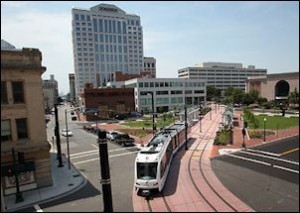
Tide Light Rail in downtown Norfolk. Photo credit: Hamptonroads.com

Tide Light Rail in downtown Norfolk. Photo credit: Hamptonroads.com

by James A. Bacon

Randal O’Toole, the Cato Institute’s transportation scholar, has penned a devastating take-down of Norfolk’s light rail system, the Tide. The rail line, which opened in 2011 60% over budget and 16 months late, ran operating losses of $12.5 million in 2012, about double projections. Farebox revenues covered about 5% of operating costs. Hoped-for redevelopment around the Tide’s eleven stations has yet to materialize. (The post is supposed to appear on O’Toole’s blog, The Antiplanner, but I could not find it there. I am relying upon an email version.)

Now, says O’Toole, the editorial writers at the Virginian-Pilot want to compound the folly by slashing fares from $1.50 per trip (before discounts), among the lowest in the nation, to $.50 in a desperate bid to jolt ridership and stimulate economic development. The problem with that idea, he says, is that it cannot generate sufficient ridership to encourage developers to build around the train stops. The idea would expand the operating deficit while doing nothing to build the property tax base.

Ironically, light rail, much beloved by environmentalists for taking CO2-emitting cars off the road, is more energy-intensive at low levels of ridership than automobiles. Writes O’Toole: “Norfolk’s rail line uses far more energy than cars: 5,400 BTUs per passenger mile in 2012 compared with an average of less than 3,400 for cars and 4,100 for light trucks (and 3,7000 for Hampton Roads buses).” Continue reading

Joel Kotkin on “What People Really Want”

(cross-posted at cnu.org)

Joel Kotkin recently wrote in the Washington Post that unspecified urban planners want “to create an ideal locate for hipsters and older, sophisticated urban dwellers” rather than focusing on the needs of “most middle-class residents of the metropolis.” He claims that these people want “home ownership, rapid access to employment throughout the metropolitan area, good schools, and ‘human scale’ neighborhoods” as well as “decent-pay [job] opportunities.” He doesn’t really explain how these goals can be achieved, other than noting that Sun Belt cities continue to grow more rapidly than high-cost northern cities, and thus must have somehow achieved these goals. Kotkin’s claims miss three realities.

First, smart growth-oriented planners seek to achieve some of these goals. By improving public transit and substituting street grids (which allow traffic to flow through a broad range of streets rather than being confined to a few major streets) for cul-de-sacs, they seek to expand “rapid access to employment throughout the metropolitan area.” Smart growth-oriented planners also seek to make cities more “human scale” by making them more friendly to pedestrians as well as automobiles. By contrast, much of America is “car scale” rather than “human scale.” And by expanding the urban housing supply, smart-growth oriented planners seek to make more homes available to more people. (Having said that, I agree with Kotkin that planners in “luxury” cities have failed to meet the latter goal- partially because density-phobia has limited development and thus artificially constricted housing supply).

Second, some of Kotkin’s worthy goals are beyond the reach of urban planning. Nearly all Americans are for “good schools” but urban planners don’t have any special expertise in how to create them. Other central-city policymakers have struggled with this problem for decades, usually without much success. Similarly, urban planners have no special expertise in how to create jobs, especially in the teeth of the post-2008 worldwide economic downturn. Even before the 2008 recession, Rust Belt metros like Buffalo struggled with job creation.

Third, to the extent a city can’t solve the “school problem”, it might as well try to attract the people who don’t need schools: singles and empty-nesters. Although Kotkin may sneer at these groups as “hipsters”, the fact of the matters is that the number of nonfamily households has exploded over time. In 1940, 47 percent of households were either married couples with children or single parents with children; today, only 30 percent do. Kotkin may bemoan the growth of nonfamily and empty-nester households, but they exist and need places to live too.

Highway to Serfdom

(cross-posted from planetizen.com, with minor modifications)

In “The Road to Serfdom,” F.A. Hayek wrote, “Individual freedom cannot be reconciled with the supremacy of one single purpose to which the whole of society is permanently subordinated.” Hayek was of course thinking about economic planning designed to govern society as a whole. However, his thoughts could just as easily be applied to transportation and land use policy; at all levels of government, 20th-century American land use and transportation planners sought to support “one single purpose to which the whole of society is permanently subordinated”—making cars go as fast as possible. For example, American planners bulldozed city neighborhoods to build highways so that cars could go from downtown to suburbs as rapidly as possible, widened existing roads so that cars could move as rapidly as possible, and limited density everywhere because of concerns about traffic congestion.

Much has been written about whether these policies have achieved their goals; however, it seems to me that even if car-oriented policies have reduced congestion, they may have also led to restrictions on the freedom of nondrivers.

Here’s why: after a few decades of car-oriented policies, driving inevitably became the norm in most of the United States. This alone need not, in theory, restrict the freedom of nondrivers.* However, once driving became the norm, politicians, police officers and prosecutors inevitably began to see walking as abnormal or even dangerous, and as a result have begun to limit pedestrians’ liberty in the name of security.

A very early manifestation of this mentality was anti-jaywalking statutes; in the 1920s, the automobile lobby and its allies persuaded state and local politicians to enact statutes outlawing something called “jaywalking”—that is, walking anywhere except at certain portions of the street (that is, intersections). Even at intersections, pedestrians can only cross streets for a few seconds at a time. Americans supported these statutes because they thought without these limits, pedestrians would not be safe from speeding cars.**

By contrast, drivers have the entire street at their disposal. In the most car-dominated places, police have gone beyond fining pedestrians for this offense; in some places, pedestrians have been arrested for jaywalking, and in others, they have been treated even more harshly. For example, if you are walking with a child at the wrong place or time and the child is hit by a car, you may be prosecuted for manslaughter, on the theory that your jaywalking caused the crash. If your jury is comprised of people who drive everywhere and view walking as abnormal and dangerous, your chances of acquittal are probably not very good.

On the other hand, police (many of whom spend lots of time in cars) and prosecutors tend to treat errant drivers leniently; as long as the state cannot prove a driver did not kill a pedestrian intentionally or after drinking copious amounts of alcohol, a driver who kills a pedestrian is unlikely to receive significant punishment in some jurisdictions. Less serious violations of traffic law are treated even less seriously by government and by the public; for example, I suspect that nearly every American who drives a car violates speed limits on a fairly regular basis.

Jaywalking statutes do at least allow walkers to cross some streets at some points. However, some government officials have gone even further in keeping minor pedestrians off the streets. If government officials view walking as dangerous, a logical step is to limit minors’ access to this activity. And most states have created perfect tools for such limitations, by enacting vague laws prohibiting “neglect” or “endangerment” or children. In some places, if you let your child walk (or even play) outside and anyone sees the child present without you, you can be arrested (and possibly even lose your child) for this offense, if the nearest police officer believes that a child alone is in more danger than a child in her parents’ vehicle. Continue reading

Let the Grass Grow Free

Native meadow grass

Native meadow grass

There’s a movement afoot in Henrico County to make it easier to grow grass. Not marijuana. Meadow grass.

Lawns are one of the banes of suburbia. They are biologically sterile, supporting very little wildlife. They require constant maintenance, including applications of fertilizer that washes into the watershed and cause algae blooms in the Chesapeake Bay and its major tributaries. They hold little water during a downpour, contributing to the problem of storm water management. Lawnmower engines are inefficient and contribute disproportionately to air pollution. As a society, we’d be better off without lawns. Just one little problem. Homeowners love them.

If people want to keep their lawns, that’s fine with me. But people who want to convert their lawns to prairie grass should be free to do so. Trouble is, they can’t. Suburban county ordinances require homeowners to cut their grass. Continue reading

No Silver Lining for the Silver Line?

metro_map

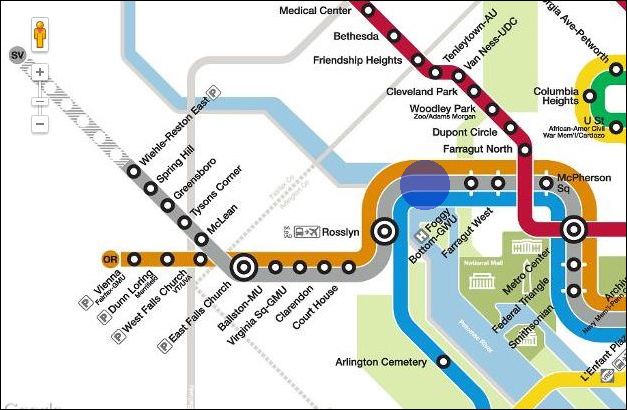
Blue dot indicates chokepoint where the Silver, Orange and Blue lines compete for restricted capacity on the Potomac River metrorail tunnel.

by James A. Bacon

By all accounts the Silver Line extension serving Tysons, Virginia’s largest commercial district, has enjoyed a successful start. Ridership is strong and in line with expectations. But a new issue arises. How much of the Silver Line’s traffic is cannibalized from the Orange and Blue lines?

The problem is that the three Metro lines must squeeze through the same Potomac River bridge to enter Washington, D.C. That bridge has a finite capacity of 26 trains per hour.  Trains assigned to the Silver Line are trains that cannot run on the orange and blue lines.

Is this a problem? Del. James M. LeMunyon, R-Oak Hill, worries that redistributing Metro riders between different lines will do little to alleviate regional traffic congestion. He broached the issue two days ago in a letter to Richard Saarles, CEO of the Washington Metropolitan Area Transit Authority (WMATA). Continue reading