
The Movement Grows

City living -- not just for liberals anymore.

City living — not just for liberals anymore.

Political and philosophical conservatives in the United States are far more likely to live in rural areas or suburbs than in the city  – and that augurs ill for the conservative movement and for America, observes Michael Hendrix, in the inaugural guest blog post in a new blog, “New Urbs.”

Cities are the centers of wealth creation and cultural influence in the modern world. By concentrating disproportionately in small towns and rural homesteads, conservatives isolate themselves from the institutions that dominate the country. “If conservatives feel like they’re on the outside looking in on culture-making now, just wait a decade or so—it’ll get worse,” Hendrix writes. “Both for our culture’s sake and our own, conservatives should learn to stop worrying and love the city.”

If Hendrix’s contribution is any indication, New Urbs is likely to make a lively contribution to the small but growing ranks of conservatives who advocate development of more compact, urbane, fiscally sustainable communities.

The blog is an initiative of The American Conservative. Explains Associate Editor Jonathan Coppage:

This is an emerging discussion on the right, and we’re excited to take a leading role in pushing it forward. Talk of conservative reform can only get so far before it accounts for the actual ways in which people live. Transit, development, zoning codes all shape our culture, and are ripe for conservative engagement. Conservatives have too often neglected cities to their own disadvantage. We aim to fix that.

Keep it coming! Continue reading

Fraudo-Mobility

(cross-posted from cnu.org)

One common buzzword used by defenders of the sprawl status quo is “auto-mobility”- a phrase calculated to imply that auto-dependent sprawl equals mobility.   But of course, this is not the case.  When other modes of transportation are made impossible or impractical, automobile dependence makes us all less mobile.

A related argument is that “automobility” empowers the poor (or women, or minorities) by enabling them to reach jobs and other destinations. But this is a self-fulfilling prophecy: if government policies are based on the assumption that everyone can/should/must drive, then more and more destinations will be accessible only by automobile, and thus people will need cars.  If government policies are based on the assumption that people should be free to use other options, then fewer destinations will be accessible only by car.

To give a simple example: imagine two towns: Freetown and Sprawltown.  In Sprawltown, everything is arranged for the convenience of fast-moving cars: roads are too wide to cross safely, there are few buses or trains interfering with car traffic, “jaywalking” laws ensure that pedestrians may only cross streets at dangerous intersections, and if you let your child walk to soccer practice you will be arrested for child neglect (since the police, like most right-thinking citizens, assume that a child is safe only when inside a parent’s fast-moving automobile or house).     In Sprawltown, someone without a car does lead a very difficult life, and ownership of a car is indeed liberating.

In Freetown, cars exist, but are not dominant.  Streets are narrower, transit options are many, and children are freer.  In Freetown, cars are more of a luxury and less of a necessity.  In a region comprised of many Freetowns, far fewer people will find a car to be liberating.

How to Convince Your Mom that Congestion Pricing Is Good

by Michael Brown

Odds are if you show up at a family reunion and try to convince your parents and siblings that congestion pricing is good, you’ll be lonely pretty quickly. People want the freeways to work but they hate paying tolls! If you are reading this, then you’re probably part of the choir. My goal isn’t to convert the converted as much as to provide new arguments and sound bites when talking to others.

So, how do we reach others? Millions must be convinced to put down their pitchforks long enough to test the theory and decide for themselves if congestion pricing is worthwhile. Elected officials are afraid to take a position contrary to polls, and polls are overwhelmingly dominated by uninformed opinions.

Too many citizens “learn” the issues of the day in 30-second television spots. Even those who make an effort to stay well informed are not the best ones to ask.  There are many fine teachers, dentists, and doctors with intelligent opinions but if you ask them about Congestion Pricing, most would focus on a single point – “double taxation.” Because no one listens long enough for a good explanation, politicians conform to polls of the uninformed rather than risk trying to change public opinion.

congestion_pricing1

=================
This is the fourth part of a four-part series.

Part 1        ◊       Part 2
Part 3   
     ◊       Part 4
=================

Geeks and used car salesmen

Congestion Pricing’s true believers are insiders who spend years exploring how market mechanisms can solve our transportation headaches. Typically, they are “nerdy engineer” types and Ph.D.’s at universities. They come up with great ideas but their main focus is convincing other geeks. Peer-reviewed articles loaded with incomprehensible equations and data may be good stuff and true, but the world will never move out of the congestion morass until the world “gets it” at the lowest-common- denominator level of things that matter to them. Continue reading

Don’t Blame The Rich For High Rents

(cross-posted from cnu.org) One common explanation for the high housing costs of New York and San Francisco is that the wealthy are pricing everyone else out of the market.  According to this narrative, there are so many obscenely wealthy people in such cities that developers are only building housing for the rich, thus making it impossible for the law of supply and demand to function. But a recent article on CNBC’s web page suggests that although New York does indeed have the highest percentage of millionaires in the United States, the second-place finisher is relatively low-cost Houston.  It therefore appears that a city can have lots of wealth and still have relatively low housing costs, if government makes it reasonably easy for people to build housing. This does not mean Houston is a perfect role model: although Houston’s regulations don’t disfavor all new construction, they still favor sprawl by limiting density and mandating parking.  As a result, Houston’s low housing costs are balanced out by high transportation costs. Ideally (from a smart growth perspective) a city would make new housing construction easy without mandating sprawl.

How Planners Can Rescue Virginia from the Fiscal Abyss

This is a copy of a speech that I presented to the Virginia Chapter of the American Planners Association Monday, with extemporaneous amendments and digressions deleted. — JAB

Thank you very much, it’s a pleasure to be here. Urban planning is a fascinating discipline. As my old friend Ed Risse likes to say, urban planning isn’t rocket science – it’s much more complex. Planners synthesize a wide variety of variables that interact in unpredictable, even chaotic, ways. In my estimation, you don’t get nearly enough respect and appreciation for what you do

OK, enough with the flattery. Let’s get down to business.

toastThis is you. You’re toast. Unless you change the way you do things, you and the local governments across Virginia you represent are totally cooked. … Here’s what I’m going to do today. I’m going to tell you why you’re toast. And then I’m going to tell you how to dig your government out of the fiscal abyss, earning you the love and admiration of your fellow citizens.

Why You’re Toast

old_people2Here’s the first reason you’re in trouble — old people. Or, more precisely, retired government old people. Virginia can’t seem to catch up to its pension obligations. The state says the Virginia Retirement System is on schedule to be fully funded by 2018-2020. But the state’s defines 80% funded as “fully funded,” which leaves a lot of wiggle room. The VRS also assumes that it can generate 7%-per-year annual returns on its $66 billion portfolio. For each 1% it falls short of that assumption, state and local government must make up the difference with $660 million. As long as the Federal Reserve Board pursues a near-zero interest rate policy, depressing investment returns everywhere, that will be exceedingly difficult. A lot of very smart people think 5% or 6% returns are more realistic. In all probability, pension obligations will continue to be a long-term burden on localities. Continue reading
The Top Ten Positive, Sustainable Effects of Congestion Pricing

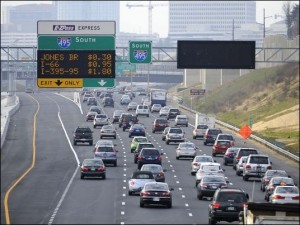
Congestion pricing on the Capital Beltway Express

Congestion pricing on the Capital Beltway Express

=======================
This is the third part of a four-part series.

Part 1        ◊       Part 2
Part 3   
     ◊       Part 4
=======================

by Michael Brown

“Free” freeways aren’t as free as they used to be. Adding new capacity costs billions of dollars and mires communities in unaffordable debt. We can’t continue borrowing, taxing and building like we did a generation ago. In Parts I and II of this series, I outlined a  strategy for using tolls to limit access during periods of peak demand in order to avoid the roughly 30% capacity loss caused by overloading a freeway. Not only will this Freeway Optimization strategy help preserve the environment and reduce the fiscal burden on the next generation, it will provide tangible benefits today!  Here are the Top 10 Benefits of Freeway Optimization.

#10. Use more off-peak capacity

Freeways have a lot more capacity than we think. It’s just that much of the time it isn’t being used. If there are incentives to avoid peak travel, some people will shift some of their trips to off-peak periods — in effect utilizing some of that unused capacity. Continue reading

Maps of the Day: Condition of Virginia Roads and Bridges

Citing data provided by the White House as President Barack Obama makes the case for more federal transportation funding, the Wall Street Journal has produced these interactive maps showing how the condition of roads and bridges varies widely by state. Virginia’s roads are in relatively good shape (only 12% rated poor) but its bridges are dicey (26% rated structurally deficient or functionally obsolete). Continue reading