Urbanizing the Burbs: Fairfax Circle Plaza

rt50by James A. Bacon

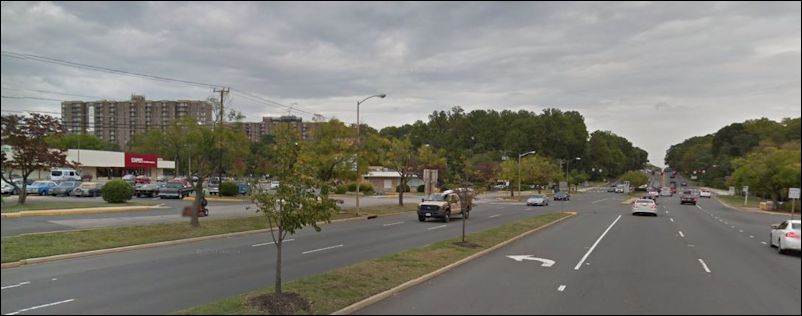
Route 50 through the City of Fairfax is a classic stroad, a street-road hybrid, that originated as a state highway and degenerated into a local access road for commercial development, with the result that it serves neither function — moving cars or providing local access — especially well. In a lengthy stretch around Fairfax Circle, the “highway” is flanked by disconnected, low-density and low-value development such as gas stations, fast food, auto dealerships, shopping centers and the like. It’s typical of the “suburban sprawl” development that has dominated Fairfax City and County, and the rest of Virginia, since World War II.

At long last, the stars are aligned to re-develop much of this corridor as high-value, higher-density, mixed-use property that will fill the city’s coffers with greater tax revenue at little offsetting cost — and create an attractive place where people are more likely want to live and do business.
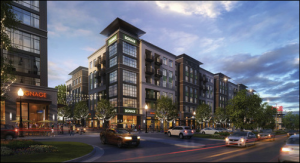
fairfax_circle_plazaOn Tuesday, City Council approved a plan by Combined Properties build two apartment buildings with 400 units, ground-floor retail, and a 54,000-square-foot grocery store. Structured parking will replace large parking lots. Expanded sidewalks, buffers and a frontage road with parallel parking will create a pedestrian-friendly environment. While the plan has imperfections, the results will be vastly preferable to what’s there now. Continue reading


Quote of the Day: Doug Koelemay

koelemayAs it appears increasingly likely that Congress will throttle the flow of federal transportation dollars to the states, state officials are looking at alternative financing mechanisms such as Public Private Partnerships (P3s). As it happens, Virginia is one of only four states with extensive experience with P3s — the others are California, Texas and Florida — so it’s no surprise that Governing magazine touched base with Doug Koelemay, the McAuliffe administration’s P3 chief, for comments in a recent article.

Koelemay, who heads the state’s Office of Transportation Public-Private Partnerships, … stresses the need for an open process in developing the agreements. Public notice and comment periods are often “sterile” and yield little useful information. But more public involvement can help planners develop better projects, Koelemay says, because they can understand the public’s concerns as consumers of transportation services.

P3s are an invaluable tool for building transportation mega-projects. But as experience in Virginia has shown, there is a built-in tension between protecting the confidentiality of P3 contract negotiations and maintaining openness and transparency. The public is not well-served by a process in which a negotiated contract is presented with a take-it-or-leave-it option. Of course, the public is not well served either by an open-ended process that allows for continual modifications and revisions leading to mission creep and cost overrruns.

I’m not sure how to balance the conflicting considerations. There are no easy answers. Koelemay is clearly signaling that the McAuliffe administration is leaning toward greater openness and transparency.

– JAB

(Cross posted from Bacon’s Rebellion)

Will Google Cars Boost City Productivity?

Prototype of the Google self-driving car.

Prototype of the Google self-driving car.

The spread of Self-Driving Cars (SDCs) will lead to tremendous increases in the productivity of cites, argues Brian Wang in The Next Big Future blog. Wang builds his argument on claims by Google that the ability of SDCs to drive faster and closer with greater safety than human-driven cars will effectively double the capacity of roadways. In turn, doubling roadway capacity will eliminate a major limit to urban density. Doubling effective density, according to a variety of economic research, will result in a 12.5% increase in productivity. Furthermore, in today’s conditions, doubling a city’s population requires only an 85% increase in infrastructure to support it; strip out the need to upgrade roads, and infrastructure spending is even less. “In general,” writes Wang, “creating and operating the same infrastructure at higher densities is more efficient, more economically viable, and often leads to higher-quality services and solutions that are impossible in smaller places.”

Sounds great. Just one problem. Wang ignores the crucial distinction between roads and streets. Roads and highway, designed for the efficient movement of automobiles between far-apart destinations, very well could double in capacity if Google’s calculations are correct. However, city streets serve a very different function, especially as the Complete Streets movement takes hold. Streets provide local access to cars, buses, bicycles and pedestrians alike; they also help define public spaces. Doubling the speed of cars in city streets would displace other modes of conveyance despite ample evidence that people are yearning for more walkability. In other words, it won’t happen. City dwellers won’t let it happen. Continue reading

How Affordable Housing Policies Backfire

DC’s City Center includes 92 IZ units. Image via Foster and Partners.

by Emily Washington

Affordable housing policies have a long history of hurting the very people they are said to help. Past decades’ practices of building Corbusian public housing that concentrates low-income people in environments that support crime or pursuing “slum clearance” to eliminate housing deemed to be substandard have largely been abandoned by housing affordability advocates for the obvious harm that they cause stated beneficiaries. While rent control remains an important feature of the housing market in New York and San Francisco, even Bill de Blasio’s deputy mayor acknowledges the negative consequences of strong rent control policies. In the U.S. and abroad, politicians and pundits are beginning to vocalize the fact that maintaining and improving housing affordability requires housing supply to increase in response to demand increases.

While support for older housing affordability policies has dissipated, the same isn’t true of inclusionary zoning. From New York to California, housing affordability advocates tout IZ as a cornerstone of successful housing policy. IZ has emerged as the affordable housing policy of choice because it has the benefit of supporting socioeconomic diversity, and its costs are opaque and dispersed over many people. However, IZ has several key downsides including these hidden costs and a failure to meaningfully address housing affordability for a significant number of people. Shaila Dewan of the New York Times captures the strangeness of IZ’s popularity: Continue reading

The General Theory of Walkability

by Charles Marohn

This is the week for new TEDx talks. Yesterday is was Leigh Gallagher and today it is architect and author Jeff Speck. His book, Walkable City, is another essential read for those working to make their places better.

(Cross posted from Strong Towns)

The Evolution of the Burbs

Leigh Gallagher, assistant managing editor of Fortune magazine, made a big splash last year with her book, “The End of the Suburbs.” While she added little new to the urbanism vs. suburbanism debate, she did a superb job of articulating and popularizing the urbanism side of the argument. The title is misleading — probably dictated by her publishers looking to make it more controversial – in that Gallagher doesn’t predict the demise of the suburbs but rather their transformation. In the TED speech shown above (Hat tip: Strong Towns blog) she makes the case that the “suburbs,” by which she means the lower-density, autocentric communities built since World War II, will take on more traditional urban forms: more density, greater walkability, less cookie-cutter building types.

It would be safe to say that Gallagher sees little future for the low-density “cul de sac” suburb and predicts a revival of the older, trolley-stop or train-station suburbs of the early 20th century where houses were close together, blocks were lined with sidewalks, and there were local downtowns that people could walk to. “A lot of people think these kinds of suburbs are really well positioned for the future,” she says. Whether you call them “urban burbs,” or “vintage burbs,” (after the movie) “Silver Lining Playbook burbs,” or, following the The New York Times, “hipsturbia” (gag), they represent a mid-density development type that Americans will see more of. Continue reading

The Better Block

Clarence Eckerson of Streetfilms has done a fantastic job highlighting four years of awesomeness for Jason Roberts, Andrew Howard and The Better Block. I love these guys and believe they are exactly what America needs right now.

“The Better Block” Celebrates Four Years of Re-imagining Streets from STREETFILMS on Vimeo.

(Cross posted from Strong Towns)