In a recent article in the Columbia Journal of Environmental Law, law student Paige Pavone criticizes suburban apartments and condominiums as “green sprawl” because they “merely add density to suburban sprawl and exacerbate the very problems smart growth seeks to correct.” She explains that without public infrastructure to support walking and biking, these developments merely entice more people into car-dependent suburbia, and therefore should not be entitled to density bonuses and other incentives that a state might use to encourage smart growth. In particular, she claims that such “High-Density Islands” are cut off from “communities, local governments, nature, public transportation, and sidewalks.”
Is this critique fair? Somewhat.
Pavone examined a variety of suburban multifamily developments, but focuses on Reading Woods, in Reading, Massachusetts, a suburb of Boston. She claims that Reading Woods residents “cannot walk to the public library, a bank, or a grocery store” and would have to cross I-95 to reach a chain restaurant. So I decided to look at Reading Woods on Google Street View and see how horrible it is.
First of all, I looked for sidewalks. The main street serving Reading Woods is Jacob Way. Jacob Way generally has sidewalks, as does Augustus Court (the main street serving the part of Reading Woods further away from South). So it seems to me that a resident of Reading Woods can use sidewalks for most visits to South Street and other neighborhood streets. To reach Main Street (the neighborhood’s main commercial street) you must walk briefly on South Street, which also has a sidewalk (though it only serves one side of the street, and looks pretty narrow). Continue reading →
Like this:
Like Loading...

 by James A. Bacon
 by Ron Beitler
 by James A. Bacon
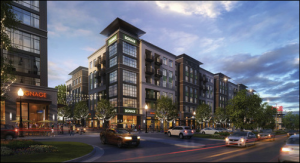 On Tuesday, City Council approved a plan by Combined Properties build two apartment buildings with 400 units, ground-floor retail, and a 54,000-square-foot grocery store. Structured parking will replace large parking lots. Expanded sidewalks, buffers and a frontage road with parallel parking will create a pedestrian-friendly environment. While the plan has imperfections, the results will be vastly preferable to what’s there now.