by Michael Lewyn
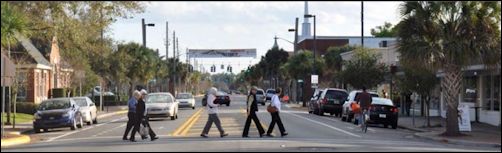
Some months ago, I wrote that laws against so-called “jaywalking” (that is, crossing in places other than crosswalks or where traffic lights encourage pedestrians to cross) fail to promote safety, because traffic lights are inadequate guides to safety. When crossing midblock, a pedestrian need only watch out for traffic coming in one direction—right toward her. By contrast, when crossing at a light, a pedestrian may be in less danger from cars coming straight at him, but may be attacked by cars making left and right turns. Moreover, it is not at all clear that jaywalking is a major cause of pedestrian fatalities; although most crashes do occur outside intersections, these crashes often occur in places where there is no easily available crosswalk. According to traffic writer Tom Vanderbilt, “While jaywalking is often cited as a cause of pedestrian accidents, less than 20 percent of fatalities occurred where a pedestrian was crossing outside an easily available crosswalk.” And even where a pedestrian is jaywalking, a crash may be caused primarily by driver misconduct.
However, my article did not fully address the social harms caused by these laws. I did mention that to the extent these laws discourage walking, they increase traffic danger, because more cars mean more potential crashes.
But even if this were not the case, the social benefits of jaywalking laws might be outweighed from their costs. In particular, jaywalking laws are harmful from a public health perspective, a social equity perspective, and a libertarian perspective.
The public health costs from increased driving have been amply discussed in smart growth literature. But just to summarize the key issue, when we drive instead of walk, we create two major types of public health risks. First, we harm ourselves. Less walking means less exercise, which means an elevated risk of many diseases; for example, the risk of type 2 diabetes is 31 percent lower for participants who engaged in regular moderate-intensity physical activity such as walking. Second, people who drive more and walk less endanger the rest of society. Even leaving aside the risks of climate change, particulate matter and other pollutants emitted from motor vehicles create significant costs. For example, one study found that particulate matter emitted from motor vehicles creates $211.6 million of health care costs in Auckland, New Zealand, alone. So, to the extent jaywalking laws reduce walking, they create increased risks of harm for both their intended beneficiaries and for society as a whole. Continue reading