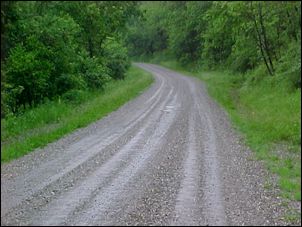
The Self-Inflicted Infrastructure “Crisis”

Gravel roads look a whole lot better if you're paying for them yourself.

Gravel roads look a whole lot better if you’re paying for them yourself.

by James A. Bacon

We continually hear about an “infrastructure crisis” in the United States, a malady from which Virginia has not been spared. Talk of pot-holed streets, tottering bridges and crumbling highways invariably moves to talk about the need to spend more on infrastructure, which morphs into raising taxes — never by talk about paring back infrastructure that has outlived its economic usefulness.

However, there is a growing body of commentary suggesting that the problem may not be too little infrastructure but too much — too much of the wrong kind of infrastructure in the wrong place. The drum-bangers for more infrastructure spending ignore a fundamental reality: The more infrastructure you build, the more you have to maintain. The more maintain, the more you spend on maintenance. The more you spend on maintenance, the less there is to spend on new stuff.

Writing in New Geography, John Sanphillippo focuses on the disproportionate resources devoted to paving and maintaining subdivision roads in New Jersey. Based on his description, New Jersey should rename itself from “the Garden State” to “the Asphalt State.” The New Jersey Highway Trust Fund is near bankrupt, he writes. Unless the gas tax is raised, all revenue will go exclusively to debt service. And we thought we had problems in Virginia! Continue reading

Atlas Sprawled

Libertarians dream of a laissez-faire capitalist nation, one with minimal government regulation and lots of entrepreneurs. There are many reasons why this goal is difficult to achieve; however, one reason is inherent in capitalism itself. As soon as a business gets large enough to have some spare cash, it might use that spare cash to obtain favors from government.

Of course, I am not the first person to discover this. For example, the plot of Ayn Rand’s Atlas Shrugged focuses less on the evils of the welfare state than on the efforts of a well-connected steel company (Orren Boyle’s Associated Steel) to use government to squash competition from Rearden Steel.

Peter Norton’s book Fighting Traffic shows how automobile-oriented street rules are at least partially a result of similar special interest manipulation. In the early 1920s, auto sales suffered because of urban traffic congestion and bad public relations related to the death toll from automobiles running over pedestrians. The auto industry and related groups such as road-builders and tire companies (or as Norton calls these groups, “motordom”) responded in three ways.

First, motordom hijacked the safety issue by blaming the victim. Car companies claimed that pedestrian deaths were the result of something called “jaywalking” (i.e., pedestrians using the streets as they had always used them, rather than waiting for automobile traffic to take its turn). In addition to financing a public relations campaign against jaywalking, motordom encouraged cities to enact anti-jaywalking ordinances.

Second, motordom lobbied government to reconstruct American streets in ways that favored fast car traffic, and even created its own “experts” to lobby city officials. A Los Angeles auto club hired Miller McClintock, a Harvard graduate student, as a consultant. Before being hired by the car lobby, McClintock wrote that widening streets would merely attract more traffic. After going on the motordom payroll, McClintock endorsed wider streets and fining jaywalkers. Car companies then hired McClintock to establish a foundation that taught engineers how to design cities for cars. The motordom-subsidized engineers then went to work in cities throughout the country, creating the sort of streets that infest cities today: wide streets where traffic flows at speeds fatal to pedestrians. Continue reading

From the Department of Worst Practices: Vanishing Medians

(cross-posted from cnu.org)

One thing that can make suburban roads less intolerable for pedestrians is a large median, so that the pedestrian can cross a huge road two or three lanes at a time, instead of having to cross an entire six- or eight-lane highway in one mad dash.

I recently saw an excellent example of how not to design a median: instead of being parallel with the sidewalk and ending at an intersection, the median ended 20 feet or so south of the intersection, thus forcing pedestrians to choose between using the median (but having to jaywalk to do so) and crossing at the intersection and accompanying traffic light.  Obviously, this sort of design makes the median less useful to pedestrians.

Mission Accomplished? Not Yet.

(cross-posted from planetizen.com)

Over the past few years, I’ve read a lot of articles and blog posts proclaiming that cities are back: that millenials want to drive less and live in cities, and that suburbs as we know them may even be dying.

I agree that many consumers demand more walkable development, both in cities and in suburbs. But even in relatively prosperous, safe cities, the political obstacles to meeting this demand are enormous. To name a few:

*Zoning. The increased desirability of urban life means that in many central cities and walkable inner suburbs, there is simply not enough housing to go around. But zoning law is generally designed to limit density (i.e. neighborhood population), which means that if a landowner wants to build new housing, it will usually have to apply to the city for a rezoning. However, rezonings tend to be politically difficult, because people who live in a neighborhood tend to like it the way it is- otherwise they would be living somewhere else. So as long as zoning is designed to limit density and accommodate present residents at the expense of future residents, urban cores will never be able to accommodate consumer demand. (I note that this is equally true for already built-out suburbs- so in many regions, the only easy place to build new housing is at the fringe of suburbia).

*Transit. Many Americans may wish they could drive less- but if their residences and jobs aren’t in places with good public transit, they may never get the chance. The highway lobby of road-builders and suburban developers has plenty of money to give to politicians, while there isn’t really much of a transit lobby (beyond bureaucrats who can’t give campaign contributions, and environmentalists who are more interested in other issues). So whenever economic growth flattens, public transit is one of the first things to be cut back; after the 2008-10 financial crisis, nearly every American city areduced transit service. (To see a few examples, just google ‘transit cutbacks.’) And even in relatively good times, transit is politically vulnerable because, unlike highways, transit often lacks a reliable source of funding.  For example,Seattle plans to eliminate 28 bus routes this fall to make up for weak sales tax revenues, and to eliminate even more routes in 2015.

*Street design. Many commercial streets are designed for high-speed traffic– for example, the eight-lane street near my former apartment in Jacksonville, Florida. Because a pedestrian is more likely to be killed by a car going 40 mph than by one going 20 mph, such streets are not particularly safe for pedestrians. In theory, these streets could be retrofitted. For example, a city could effectively slow traffic by widening sidewalks and medians, thus reducing the number of traffic lanes. However, these changes would cost money and be politically controversial.

Continue reading