Utilities, Schools and Induced Demand

Cross-posted from cnu.org

Numerous commentators have questioned the view that increased highway spending reduces congestion, pointing out that highways may increase demand for driving, thus leading to more traffic.  In a recent newsletter, Robert Poole responds to the “induced demand” concept by writing:

 And this gets back to the question of how a highway provider should respond to increased demand from its customers. Should it tell the customers they are wrong to prefer personal mobility? Should an electric utility tell its customers they should switch to wood-burning stoves, rather than adding generating capacity? Should a school district not add schools to serve a growing population of families with kids? Infrastructure providers are supposed to provide the vital facilities that people need (and are willing to pay for), not tell them their preferences are wrong.

But the comparison between highways and other goods strikes me as not quite right.  The utility customers are presumably paying for their electricity.  By contrast, even if gas taxes were equal to highway spending (which they often aren’t) the highway system is rotten with cross-subsidies: because all drivers pay into the same gas tax trust fund, taxes paid by urban drivers can be used predominantly to serve rural drivers, or vice versa.  Moreover, highway spending may create externalities, because increased driving leads to increased pollution.  So yes, sometimes preferences are “wrong”, in the sense that accommodating them creates social costs.

What about the school district analogy?  Poole seems to think that it is axiomatic that of course school districts should add population where there are more children. But it seems to me that this need not be the case: school districts can always enlarge classes.  Here, as in the situation of highways, the right answer depends on externalities: do larger classes create worse educational results, thus creating societal externalities (such as stupider graduates who are less productive or more criminal)?  And does such harm outweigh the social costs of raising taxes to build more schools?  I suspect the right answer is: sometimes yes, sometimes no.
Arlington Scraps Streetcar Projects

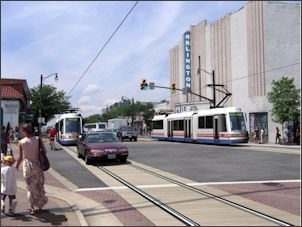
Rendering of a Columbia Pike streetcar.

Rendering of a Columbia Pike streetcar.

by James A. Bacon

Arlington County’s surprise decision yesterday to cancel proposed streetcar projects for Columbia Pike and Crystal City should not be seen as a rejection of the concept of streetcars but a rejection of the funding mechanism chosen by the board that asked taxpayers to bear the fiscal risks while property owners enjoyed the benefits.

Arlingtonians, who voted John Vihstadt to the County Board earlier this month in an election that had become a referendum on the streetcar projects, questioned whether the $550 million price tag justified the purported economic development benefits. Board Chair Jay Fisette cited the decisive election results in canceling the project for which he and other board members had spent 15 years shepherding through the planning and fund-raising process.

One big problem for streetcar backers was defending the Columbia Pike project in the face of escalating cost estimates. The $358 million price tag was up $48 million from a federal cost estimate last year and up $100 million from a previous county estimate. County officials, with years of planning invested in the project, maintained that the benefits still outweighed the costs. A substantial majority of citizens were skeptical, and they said the county’s transportation needs could be met more cost-effectively with improved bus service. Continue reading

Not A “War on Suburbia” Election

(cross-posted from cnu.org)

According to Joel Kotkin, this month’s elections were really about the “progressives’ war on suburbia.” According to Kotkin, the Democrats lost because they are “aggressively anti-suburban.” Since I didn’t vote for President Obama, I leave it to his supporters to defend him.

However, I do think it is worth pointing out that cities and suburbs moved in the same direction this year. The Republicans gained several governorships this year (Arkansas, Illinois, Maryland, and Massachusetts). I couldn’t find city election statistics for Arkansas, but I was able to find city board of elections statistics for the other three states. In each, the Republican candidates for governor improved on their 2010 showing. In Massachusetts, Republican Charlie Baker gained 30 percent of the Boston city vote, up from 23 percent in 2010. This 7 point gain was equal to his 6.5 point statewide gain (from 42 to 48.5 percent) and exceeded his 4 point gain in suburban Middlesex County.

In Illinois, the Republican vote share increased from 17 to 20 percent. Kotkin asserts that this is a “laughably pathetic” vote share, but in fact the Republicans gained almost as much in Chicago as they did statewide. They gained 3 percentage points in Chicago, and almost 5 points statewide (from 46% to 50.8%). (To be fair, the Republican gained a little more in the Chicago suburbs, but that may reflect the fact that he is from suburban Chicago while 2010 nominee Bill Brady is from downstate).

In Maryland, the Republican vote share in Baltimore city increased from 16 percent to 22 percent, a 6 point shift, more than the vote shift in Prince George’s County near Washington (4 points) and almost as much as the 7-point vote shift in Montgomery County. (However, the Republican gained more votes in the Baltimore suburbs, which by Kotkin’s logic means that they must have revolted against a “progressive war on Baltimore.”)

In sum, Republican candidates gained votes in suburbia- but they gained votes in cities as well, often in roughly equal proportions.

Optimism Bias and Risk in Public Private Partnerships

tollsby James A. Bacon

Randy Salzman, a free-lance Charlottesville writer, has spent the last couple of years trying to understand how Public Private Partnerships (P3s) work in Virginia. If the private sector is supposed to be so much more efficient than government, he asks, how  come so many big P3 transportation projects in Virginia and across the nation have gone bankrupt? Why do private sector companies continue investing in similar projects despite the obvious risk? And what exposure do taxpayers when deals go bad? He doesn’t have any definitive answers, but he lays out a lot of good questions in the latest issue of Style Weekly.

Salz, an occasional contributor to Bacon’s Rebellion, gets closest to the truth when he mentions the “optimism bias” in traffic forecasts. In project after project across the country, private P3 companies and  their government partners have over-estimated traffic volumes on the roads they build. Writes Salz:

One study found that the projections tended to be 109 percent more than actual traffic — or more than double — and that nowhere in completed American P3s have actual traffic and toll income come close to projections.

Here in Virginia, flawed traffic forecasts were at the root of the Pocahontas Parkway debacle in eastern Henrico County and, if I’m not mistaken, the Dulles Greenway bankruptcy in Loudoun County (although that was not a P3 project). And there’s a very good chance that the Capital Beltway Express’s Northern Virginia HOT lanes project will experience a similar fate. Continue reading

When Nuisance Law Is A Nuisance

(cross-posted from planetizen.com)

In the recent case of Loughead v. Buckhead Investment Partners, a group of Houston, Texas, homeowners filed a common-law nuisance action to prevent a developer from building an apartment building in their neighborhood; the plaintiffs asserted (among other claims) that the apartments caused increased traffic—a claim that would be true of any new housing. Under the law of nuisance, a landowner may recover damages whenever another person uses their land in a manner that causes substantial, unreasonable harm to other landowners. A jury awarded the plaintiffs damages in December 2013, and the verdict will be appealed.

The landowners sued for nuisance because Houston has no zoning code and the city could therefore not legally exclude the apartments—but at common law, something permitted by zoning can still be an actionable nuisance. So if the Loughead action is upheld on appeal, landowners all over the country may become more willing to file nuisance actions to keep out multifamily housing (or for that matter, any other allegedly undesirable land use).

It seems to me that states should prohibit nuisance claims against new multifamily housing (either through state legislation or through judicial decisionmaking), for three reasons.

First, the public policy in favor of affordable rental housing dictates against such actions. Throughout the United States, there is a rental housing shortage. Between 2000 and 2013, median household income has increased by 25.4 percent, while rent has increased by 52.8 percent. The explosion in rental costs has not been limited to gentrifying, traditionally high-cost cities such as San Francisco and New York. For example, in Hattiesburg, Mississippi, rents increased from 20 percent of household income in 1979 to 35.2 percent in 2013. The explosion in rents is in large part the result of increased demand for rental property; tighter credit standards and stagnant wages have kept would-be homeowners from buying houses and forced them to rent instead. The supply of multifamily housing has increased, but not fast enough to keep up with increased demand: the national rental vacancy rate (8.3 percent) is at its lowest point since 2000. Continue reading

No Wegmans for Tysons… Too Bad for Wegmans

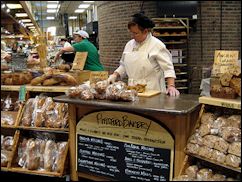
wegmans_bakeryCan Tysons have its cake and eat it, too? Perhaps not, at least if the cake is baked in a Wegmans Food Market bakery. Discussions to bring the Rochester, N.Y.-based grocery chain to a transit-oriented development around the McLean Metro station have ended in frustration, reports the Washington Post.

CityLine Partners, developer of the Scotts Run Station South project in Washington’s Northern Virginia suburbs, won rezoning approval last year to transform a typical suburban office park into 6.7 million square feet of mixed-use commercial and housing towers with ground-floor retail. The development plans includes contributing to a Tysons-wide grid street network, creating more walkable streets and reducing the parking footprint.

It would be a real coup to bring a Wegmans to the development. The upscale store appeals to exactly the kind of higher-income demographic that CityLine wants to attract to its project. But Wegmans’ business model meshes best with suburban development.  The company normally builds stores of more than 100,000 square feet surrounded by large surface parking lots. In Tysons, Wegmans was considering a new “urban” format of 80,000 square feet, similar to one it opened in Boston this spring, the Post reports. The idea was to place the store on the ground floor of a building with apartments upstairs. Continue reading