This is Why Downtown Salt Lake is a Drug-Dealing Paradise

slc_parking_lotsby Jim Dalrymple

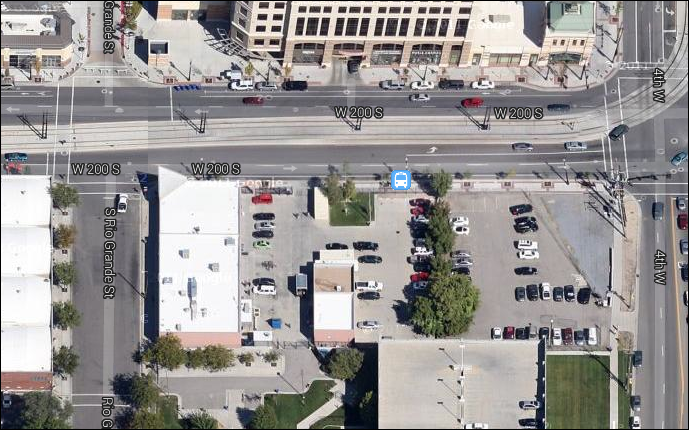
A few evenings ago, I walked down a street in downtown Salt Lake City near my home and was offered drugs. Six different times. By six different dealers. All within one block.

Of course all cities have rough areas and this spot in particular — 200 South near the Gateway Mall — is well-known by locals as a troubled area. But it’s also right downtown near a not-so-old shopping area, transit stops and housing. It’s a place that shouldn’t be rough and that definitely shouldn’t have people brazenly selling drugs as if it were an illicit farmer’s market.

So why is it used by criminals and ignored by everyone else?

The reasons are likely legion but here’s one the city may not have considered: parking.

In an article this week in The Atlantic Cities, Jenny Xie wrote that eliminating parking actually cut down on drug deals in San Francisco and Baltimore. The idea is that drug dealers use idling and parked cars to conduct transactions, so eliminating their parking eliminates their workplace. To that I’d add that excessive parking also can be alienating to pedestrians and generally law abiding people. Think big abandoned parking lots, for example, that due to neglect become ripe for crime. Continue reading


The Acid Test for Richmond BRT: Will Property Owners Tax Themselves?

BRT in Cleveland

BRT in Cleveland

by James A. Bacon

Momentum is building in the Richmond region to build a 7.4-mile Bus Rapid Transit system along the Broad Street corridor. Transit lovers tout the many blessings that a BRT system would bring, and they discuss the projected costs, but there are two things you never hear them talk about: Risk and ROI (return on investment). No one ever asks if investment in BRT is a competitive use of scarce public capital.

BRT can provide the Richmond region with service comparable to light rail at a fraction of the cost — that’s the message that made it into the lead of an article written by Peter Bacque in the Times-Dispatch this morning. “It’s a very cost-effective way to have a premium transit service,” said Amy M. Inman with the Virginia Department of Rail and Public Transit at a meeting of the Urban Land Institute.

Building a BRT system, in which buses would run on dedicated lanes between Rockett’s Landing, downtown and Willow Lawn, would cost an estimated $53.8 million to build and equip and $2.7 million a year to run. Funding would come from federal, state and local government. Continue reading

Don’t Expect Increased Real Estate Assessments to Bail Out Local Government

demand_instituteThere’s bad news for local governments in Virginia that rely upon property tax revenues to support schools, public safety and other priorities. Property values for single-family homes, which account for a large majority of most jurisdictions’ total assessed value, will not increase much over the next few years, according to a new study by the Demand Institute.
Nationally, the picture  is dismal enough. “Double-digit increases in U.S. home prices over the past two years are not indicative of future trends,” states the report. “They were driven largely by investors buying up swaths of distressed homes to meet growing rental demand. Over the next five years, prices will grow over a much slower rate. We forecast existing single-family media home prices to grow at an average annual rate of 2.1 percent between 2015 and 2018 as supply and demand move into sustained equilibrium.”

But there will be significant variations among the 50 states. And Virginia drew the short end of the stick. Of the 50 states and District of Columbia, the Demand Institute ranks Virginia third from the bottom (D.C. is at the very bottom) for expected rebound in the median price for a single-family house between 2012 (the market trough) and 2018 — only 14%. Continue reading

What Does Bloombergian Zoning Look Like?

NY_rezoningby Daniel Hertz

One common objection to zoning deregulation from social welfare advocates is that giving developers more leeway to build what they want is just a “neoliberal” sop to private business interests. As a general rule, sops to private business interests can’t do things like boost affordable housing or increase low-income people’s access to jobs and grocery stores.

Note, of course, that the much more common objection to zoning deregulation from privileged neighborhood groups is precisely that it will boost affordable housing and increase low-income people’s access to jobs and grocery stores.

Anyway, I suspect that one reason some social welfare advocates conceive of zoning deregulation as a sop to private business is that they associate it with “neoliberal,” “pro-development” mayors like Richard M. Daley or Rahm Emanuel in Chicago, or Michael Bloomberg in New York. The problem with that, of course, is that we’ve already established that both Daley and Emanuel have presided over a city where any kind of multiunit housing is outlawed in the vast, vast majority of residential neighborhoods. Daley, in fact, presided over major downzonings (a tightening of restrictions) in many neighborhoods. (More on that later.)

And what about Bloomberg, the world’s poster boy for business-friendly city governance by and for the rich? What kind of wild zoning deregulation did he oversee? Continue reading

Guilt and the Sport of Buying Local

Locally-owned businesses line Main St. in Moncton, Canada.

by Gracen Johnson

I spend a lot of time browsing through real estate listings, getting an idea of who owns the buildings I love most and the ones that make me cringe. The other day, I came across exactly the kind of retail storefront property that houses some of my favourite downtown destinations – lively location, exposed brick, beautiful windows, vintage street appeal. Rent is $3,500 a month for ~3000 sqft. including parking. To my knowledge, there is nothing unusual about the rent but at the time the number burned into my brain.

If you’re a small business owner and take a gamble on this property, you’ve got to be bringing in over $100 per day just to pay rent. Then there’s the cost of your inventory, wages, marketing, administration, etc. When I think of how small the profit margins are on most of what I buy, and how infrequently I purchase items with large margins this all started to make my head spin. The cafés that serve as our offices, meeting rooms, and third places are earning mere cents on a cup of coffee. Our downtown art store is matching Amazon pricing while paying a team of top-notch staff. How do these places survive? Are the owners just in it as a labour of love?

I’ve long been a proponent of the buy local movement for the warm fuzzies. I crave the opportunity to become a welcomed regular at a few favourite places. Continue reading

A Less Destructive Form of Sprawl?

The red dot marks the location of the proposed George Washington Village.

The red dot marks the location of the proposed George Washington Village on the outer fringe of the Washington MSA. (Click for larger image.)

by James A. Bacon

A development group is asking for approval to build up to 2,900 homes and 1.8 million square feet of commercial space off Interstate 95 in Stafford County, Va. The proposed “George Washington Village” calls for a 1,100-acre town-center development with a mix of single-family detached houses, town houses and apartments to be built over 20 years. The plan includes more than 400 acres of open space, $50 million in new infrastructure and amenities such as parks, athletic fields and swimming pools, according to the Free Lance-Star.

I have long argued that the momentum of growth and development is shifting back toward the urban core. There’s only so much added population that built-up neighborhoods can absorb, however. Getting municipal approval to tear down old buildings and erect new ones in their place tends to be more drawn out than building in empty fields. Therefore, in fast-growth MSAs like Washington, new development will continue to take place on the metropolitan periphery — just at a slower pace than before.

The George Washington Village is anecdotal, to be sure, and it may not be typical of most development taking place on the far southern fringe of the Washington metropolitan area. But I wonder if it is indicative of a broader trend to building more clustered, village-style development in exurbia instead of the traditional pattern of scattered cul-de-sac subdivisions and shopping centers . Continue reading

Car Sharing Cutting into Automobile Ownership

BMW, Ford and other auto manufacturers are pushing shared-rider automobile services, especially in congested European cities. The practice is spreading to the U.S.

BMW, Ford and other auto manufacturers are pushing shared-rider automobile services, especially in congested European cities. The practice is spreading to the U.S.

by James A. Bacon

The spread of car sharing could erode automobile sales and automobile ownership in the years ahead, according to a new study by AlixPartners, a business advisory firm. The study, which surveyed 1,000 licensed drivers in 10 developed car-sharing markets and 1,000 drivers nationally as a control group, found that car sharing appears to be displacing vehicle purchases at a rate of 32 to 1 (one car-sharing vehicle displaces 32 vehicles purchases) — more than double the rate suggested by previous studies.

So far, car-sharing services such as ZipCar, FlexCar, RelayRides and Hubber have eroded automobile sales by approximately 500,000 vehicles. As the business model spreads to other markets, it could reduce automobile purchases by an additional 1.2 million cars through 2020, the study concludes. “While the approximately 500,000 vehicle purchases avoided to date is itself a large number,” said Mark Wakefield, leader of AlixPartners’ North American automotive practice, “this study suggests that car sharing nationally could scale up as these 10 markets have, and if that happens, the impact on the traditional automotive market could be explosive.”

The merger of Zipcar and Flexcar in 2007 is thought by many to have ratcheted up the commercialization of car sharing in North America. The recent advance by larger corporations — including Avis (which bought Zipcar), Daimler, BMW and Enterprise — into car sharing suggests that the industry is accelerating up an adoption S-curve, according to the study. Continue reading