The Quiet Boom and Bust of PA Townships

Sprawl in York County, Pa.

Sprawl in York County, Pa.

by Ron Beitler

The following appeared in an op-ed this AM in The Morning Call. I wanted to re-post as it succinctly sums up the reality Lower Macungie recently began to face with a tax increase in response to a budget deficit. I’m hoping we continue serious discussions about how got to this point and what we can do to keep taxes sustainably low over the long run proactively. The alternative is reacting to shortfalls and never addressing underlying issues.

To do this it’s important we understand how we got to where we are. This post is a preface to a post I’m doing later on in the week where I’ll outline some items I think are a part of the solution. This post deals with how we got to where we are. 

By Gerald E. Cross – Pennsylvania Economy League.

Since the 1970s, Pennsylvania’s cities have grabbed headlines as they sank into a financial morass while the state’s townships quietly prospered.

But recent data indicates that the once booming townships – where almost half of state residents live – are also seeing troubling signs including rising service costs and tax revenue that is either declining or flattening. Continue reading

Downtown Richmond Falls in Love with the Mid-Rise

The old...

Past…

by James A. Bacon Still need proof that the momentum of growth and development is shifting back to traditional downtowns? Consider this: Roughly 3,000 apartment units are under construction in the Richmond metropolitan region — and half of them are located downtown.

The new. (Photo credit: Richmond Times-Dispatch).

Present… (Photo credit: Richmond Times-Dispatch).

That gem of a factoid was buried in a Times-Dispatch article about the construction of two mid-rise buildings on the edge of Virginia Commonwealth University. A $13.6 million, seven-story structure on Grace Street, owned by the VCU Real Estate Foundation, will be used for classrooms, faculty office, media relations and retail space. A $20 million, 11-story building, developed by private investors, will have 150 apartment units open to anyone, not just students, who wants to rent them. With amenities including a fitness center, rooftop lounge and recreation room, rents will run between $920 and $1,500 per month. The new buildings replace two older structures, one currently used by VCU and the other a seedy, one-story retail building. Continue reading

Money Hall

moneyballby Charles Marohn

The problem we are trying to solve is that there are rich teams and there are poor teams, then there’s fifty feet of crap, and then there’s us.

It’s an unfair game.”

– Billy Beane in the movie Moneyball

What do you do when conventional wisdom is wrong? Obviously wrong? And you have the data to prove it?

You change conventional wisdom, of course. But what happens when people are trapped in a system defined by conventional wisdom, where the risks and rewards are tilted in favor of those who hold to convention and against those who upset the status quo?

In trying to answer this question, I found inspiration in Michael Lewis’ story of Billy Beane in “Moneyball,” a book that later became a movie of the same name.

Billy Beane, a former major league baseball player turned general manager of the Oakland A’s, could have played it safe. He had plenty of money, a good resume and was coming off a season where his team dramatically overachieved. He had every personal incentive to stick to convention. Continue reading

Urbanists Right and Left

by Michael Lewyn

There is finally a new blog, Smart Growth for Conservatives, focusing on issues of interest to those of us who generally support smart growth and new urbanism, and yet are less politically liberal than most people who do so.

How are conservative smart growthers (or CSGs) similar to their more liberal allies?  Like environmentally minded critics of sprawl, CSGs oppose government subsidies for sprawl and sprawl-generating government regulations. In particular, quite a few of the new blog’s posts focus on wasteful sprawl-generating road spending.

Having said that, CSGs do tend to differ from other smart growth supporters in a couple of ways. First, they tend to be fiscal conservatives, and thus skeptical of public amenities that are nice to have but perhaps not absolute necessities. As a result, they are less consistently supportive of public spending on public transit and pedestrian/bicycle facilities than liberals might be. Second, some issues that are generally part of today’s liberal agenda are deemphasized by CSGs. In particular, CSGs are less likely to discuss climate change or social diversity than liberal new urbanists. I also suspect that CSGs are less likely to support smart growth regulations such as Oregon’s growth boundaries; but since most Americans don’t live in Oregon, CSGs aren’t as obsessed with these regulations as are conventional pro-sprawl conservatives.

Of course, CSGs differ among themselves. Some CSGs are (as Mitt Romney might say) “severe” fiscal conservatives, and thus tend to be skeptical of all large-scale government expenditures. Personally, I am more of a Nixon Republican – which is to say, although I am less pro-regulation and egalitarian than many liberals, I am willing to support government spending not just as an “investment” (whatever that means) but as a public amenity akin to parks and schools.

(Cross posted from Planetizen.)

Chicago’s Zoning Laws Are Just Insane

Click for larger image.

Click for larger image.

by Daniel Hertz

One thing that happens when I bring up the fact that Chicago, like pretty much all American cities, criminalizes dense development to the detriment of all sorts of people (I’m great at parties!): Whoever I’m talking to expresses their incredulity by referencing the incredible numbers of high-rises built in and around downtown over the last decade or so.

I try to explain that, while impressive, the development downtown is really pretty exceptional, and that 96 percent or so of the city doesn’t allow that stuff, or anything higher than four floors or so, even in neighborhoods where people are lining up to live, waving their money and bidding up housing prices. Then they make some noncommittal grunt and change the subject.

But I’m not BSing here. Not only does the city make it illegal in the vast, vast majority of its space to build super-dense towers or medium-dense mid-rises in very high-demand neighborhoods like Lincoln Park or Wicker Park, but it even criminalizes your standard two- or three-flat apartment buildings in most neighborhoods — meaning that a developer who wants to build some moderately priced housing in a moderate-demand neighborhood (like, say, Portage Park) has to deal with local income segregationists.

Let me say that again: In most Chicago neighborhoods, it is illegal to build anything other than single-family homes.

You don’t believe me. That would be really weird, you say. Well, check the map above. Continue reading

Peak Wal-Mart

by Charles Marohn

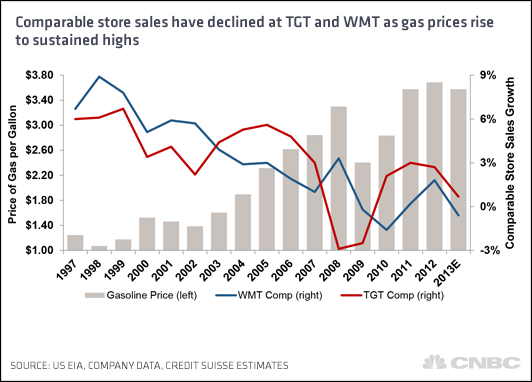
Earlier this month we shared some notes on the struggles of Wal-Mart and similar big box retailers. The Good Ship Subsidy is listing to port and taking on more water, making the big box business model suddenly seem very fragile. Here’s same store sales compared to gas prices over the past decade and a half:

wal-mart

Unfortunately, the joke’s ultimately on us, or at least our local governments. The big box development model — build on cheap land on the edge of the community with taxpayers subsidizing your hard infrastructure/transportation costs, tilting the competitive landscape in your favor in the process — is designed to be transitory. These buildings are, unlike the miles of public pipe and asphalt that serve them, quite disposable.

And dispose of them is what Wall Street analysts are now expecting.

The big-box discounter is in need of a bricks-and-mortar makeover, analysts said. To resonate with today’s shopper, Wal-Mart needs to move its stores closer to major population centers, shrink the square footage of its superstores and shutter about 100 under-performing U.S. locations, they suggest. Continue reading

“Neoliberalism” Not to Blame for Gentrification

gentrificationby Daniel Hertz

As high housing prices become a more and more powerful force in determining the basic shape of our lives – where we get to live, what jobs we can apply for, what schools our children get to go to – there’s a growing demand for some sort of explanation, some sort of narrative, about what’s going on.

This week, James Frank Dy Zarsadiaz took a stab at articulating one popular version, which places blame firmly on “neoliberalism” and the unfettered market.

“Gentrification isn’t new,” he writes. He continues:

It’s actually baked into the economic forces that have been driving urban development since the 1950s, [when] newly opulent Americans turned to the economic philosophy of neo-liberalism…. In the economic context of cities, neo-liberal ideology encourages free enterprise, open competition, deregulation, and the dismantling of public goods…. The city is increasingly undemocratic…. But ultimately, this pattern of neo-liberal problem-solving reinforces gentrification.

Now, the devaluation of public goods and services — say, closing lots of neighborhood schools, or public health clinics — is a neo-liberal phenomenon that meaningfully hurts people of limited means, and makes the city a harsher environment for them. Those kinds of closures can also be a way of making an area more palatable for developers who target the educated affluent class, and so can play a role in gentrification.

But as an explanation for the last 60 years of housing policy, and how we got where we are today — with rolling waves of gentrification and real estate prices that have made American cities more segregated by income than at any other time in living memory — it’s just missing an enormous amount. Continue reading