by Charles Marohn
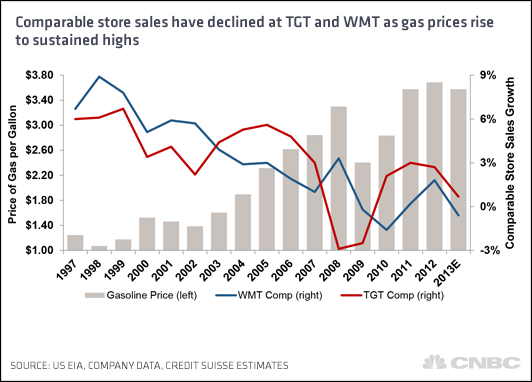
Earlier this month we shared some notes on the struggles of Wal-Mart and similar big box retailers. The Good Ship Subsidy is listing to port and taking on more water, making the big box business model suddenly seem very fragile. Here’s same store sales compared to gas prices over the past decade and a half:
Unfortunately, the joke’s ultimately on us, or at least our local governments. The big box development model — build on cheap land on the edge of the community with taxpayers subsidizing your hard infrastructure/transportation costs, tilting the competitive landscape in your favor in the process — is designed to be transitory. These buildings are, unlike the miles of public pipe and asphalt that serve them, quite disposable.
And dispose of them is what Wall Street analysts are now expecting.
The big-box discounter is in need of a bricks-and-mortar makeover, analysts said. To resonate with today’s shopper, Wal-Mart needs to move its stores closer to major population centers, shrink the square footage of its superstores and shutter about 100 under-performing U.S. locations, they suggest.
“High sustained transportation costs and broader consumables distribution appear to be reshaping consumer shopping behavior,” Credit Suisse analyst Michael Exstein said in a research note on Wednesday. “Wal-Mart and Target have been slow to react thus far, but we think the broader trend will call for the rollout of smaller ‘big boxes.’ “
I wonder if planners, engineers and economic development advocates will embrace public support of downtown, boutique Wal-Marts and the systems they need to thrive the way they did the big box model. I also wonder if we should expect the National Trust for Historic Preservation to step in to save the four abandoned walls of reinforced concrete slab that support a leaking asphalt roof on the site formerly occupied by Wal-Mart.
Change. The only thing more dependable is the irony it entails.
(Cross posted from Strong Towns.)