Housing Affordability for Millennials

millennial_affordability

by James A. Bacon

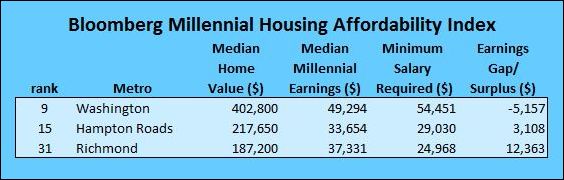
As the global epicenter of technology innovation, Silicon Valley creates a massive amount of wealth — but the housing supply, hemmed in by geography and zoning regulations, is incredibly restricted. The resulting housing crunch is so severe that Millennials are hard pressed to live there. The median income for Millennials in the San Jose metropolitan area is the highest of any of the 50 largest metropolitan regions in the country — $53,000. But the median home value of $925,000 requires an income of $133,000 to pay a mortgage (not to mention a 20% down payment). The earnings gap, according to a new housing index published by Bloomberg, is $80,000!

If Millennials are the life-blood of creativity and innovation for metropolitan economies, the cost of housing could be Silicon Valley’s Achilles heel. The housing supply is so out of whack, as it is in neighboring San Francisco, that, as much as Millennials are drawn to the excitement and glamour of working at companies like Apple and Google, they simply can’t afford it unless they’re willing to live five or six to an apartment.

According to Bloomberg, housing is unaffordable for thirteen of the 50 largest U.S. metros. The biggest affordability gaps are on the West Coast, but Boston, Washington and New York are on the list as well. Young people are willing to tolerate sub-par living conditions for a while, especially while they are single. One of my daughters shared a tiny rental apartment with four roommates while living in Jackson,Wyoming, which, due to its awesomeness, has similar affordability issues. But she rented her own place when she moved back to Richmond. And now that she is getting married, she and her fiance have no trouble affording a comfortable starter home in a nice neighborhood near the University of Richmond. When educated Millennials are ready to get married and start families, the idea of sharing a house with four or five roommates is not a serious option. Continue reading

In Praise of Organic Tourism

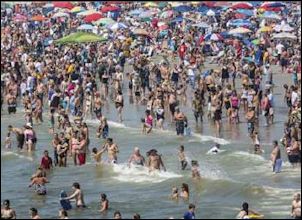
Which would you rather have in your community.... massive crowds of drunken, puking college kids like Fort Lauderdale....

Which would you rather have in your community…. massive crowds of drunken, puking college kids like Fort Lauderdale….

by James A. Bacon

Promoting tourism is a major part of Virginia’s economic development strategy for good reason. Tourism supports jobs, expands the tax base and helps pay for amenities — restaurants, arts, cultural institutions — that can be enjoyed by the whole community. But it can create problems, too, such as crowding, traffic congestion, noise and tacky, haphazard development. Handled poorly, tourism actually can degrade a community’s quality of life.

It is critical to differentiate between mass-market tourism and what Edward T. McMahon, writing in the May issue of Virginia Town & City, calls “responsible” tourism. Mass market-tourism is all about putting “heads in beds.” It is high volume, high impact but low yield. Think Fort Lauderdale, the “spring break capital” of the United States, which attracted millions of college kids who slept six to a room and spent money on little but beer and t-shirts.

... or a recreational amenity like the beautiful Virginia Creeper Trail?

… or a recreational amenity like the beautiful Virginia Creeper Trail?

“Mass market tourism is … about environments that are artificial, homogenized, generic and formulaic,” writes McMahon. By contrast, “responsible tourism is about quality. Its focus is places that are authentic, specialized, unique and homegrown. … Think about unspoiled scenery, locally owned businesses, historic small towns and walkable urban neighborhoods.”

The challenge for Virginians, suggests McMahon,  a senior resident fellow at the Urban Land Institute, is to promote tourism without losing our soul. There is more to building a tourism industry than spending marketing dollars to lure visitors. It involves making destinations more appealing. “This means identifying, preserving and enhancing a community’s natural and cultural assets, in other words protecting its heritage and environment.” Continue reading

Reinventing the Suburban Office Park

Sidney Gunst built Innsbrook as a state-of-the-art suburban office park in the 1980s but says he would do it very differently today.

Sidney Gunst built Innsbrook as a state-of-the-art suburban office park in the 1980s but says he would do it very differently today.

Article published in June issue of Henrico Monthly magazine:

By James A. Bacon Jr.

In September 2010, the Henrico County Board of Supervisors put its stamp of approval on a plan to transform the county’s largest office park, the Innsbrook Corporate Center. The idea behind the plan, called Innsbrook Next, was to convert a smattering of office buildings surrounded by parking lots and connected by winding, unwalkable roads into Henrico’s de facto downtown. Planners envisioned millions of square feet of mixed-use development: office towers, parking garages and apartment buildings with stores and restaurants on the ground floors.

Not only would Innsbrook Next breathe new life into Henrico’s largest employment center – between 15,000 to 25,000 people work there, depending on whom you talk to – it represented a sea change in planning policy for the county. Having filled up with traditional, low-density suburban development, the affluent, western half of the county had nowhere to grow but up. To accommodate more growth and more jobs, Henrico had to begin urbanizing. Innsbrook Next would concentrate much of the expected growth into a district that would cause minimal disruption to established neighborhoods.

Nearly five years later, little has happened. A partnership of Markel Corp. and Highwoods Properties submitted a plan to develop the first phase of Innsbrook Next with 2.2 million square feet of mixed-use buildings. The county granted the needed zoning approvals, but the developers backed off. Dominion Virginia Power, a major property owner, submitted plans to convert overflow parking into a townhouse complex. But when county staff balked at aspects of the proposal, Dominion withdrew the project.

Then, earlier this year, the Dixon Hughes Goodman CPA firm announced the relocation of its headquarters office from Innsbrook to downtown Richmond. A prominent reason given was to make it easier to recruit talented young employees looking for urban amenities. Soon after, insurance firm Rutherfoord said it would consolidate offices, including its Innsbrook headquarters, in the new Libbie Mill-Midtown project at West Broad Street and Staples Mill Road, which had gotten the jump on Innsbrook in building what urban planners call “walkable urbanism.”

Across the country, suburban office parks are having a tough time. Built mainly in the 1970s, ’80s and ’90s, their age is showing. The buildings have lost the sheen of newness. Mechanical systems are wearing out, and maintenance costs are rising. And most challenging of all, young people prefer to work in urban settings where they can walk to restaurants, galleries, music and entertainment. For decades, downtown areas hemorrhaged tenants as companies decamped for the suburbs. Now the reverse is happening: Some businesses are moving back to the city. Continue reading.

Will the “Ferguson Effect” Kill Urban Renewal?

by James A. Bacon

Baltimore is the East Coast’s answer to Detroit, a once-prosperous city hollowing out from decades of mismanagement under the Blue State governance model. By the time the Washington Village Development Association (WVDA) filmed its documentary, “Fleeing Baltimore,” in 2013, 31,500 residents had abandoned Maryland’s largest city over the previous decade. Sixteen thousand buildings stood vacant. The documentary described how heroic efforts of middle-class Baltimoreans, both black and white, to clean up trash, combat crime and provide positive experiences for inner city youth were overwhelmed by the ineffectiveness of the city’s criminal justice system.

If conditions were hostile to the middle class two years ago, imagine what it is like now. Last month, a 25-year-old black man, Freddie Gray, died under mysterious circumstances in police custody, raising concerns about police abuse and laying bare a history of strained relations between police and the city’s poor black population. Riots ensued, and now gun violence is up 60% compared to the same time last year. Thirty-two shootings took place over Memorial Day weekend.

Similar explosions in violence are occurring in cities across the United States as as police and inner-city populations react to a series of incidents in which unarmed black men died at the hands of white police. In what what urbanist Heather Mac Donald calls the “Ferguson effect,” police are disengaging from discretionary enforcement activity, the criminal element is feeling empowered and a wave of violence has reversed much of twenty years’ decline in crime rates. Continue reading

Bridj Comes to Washington

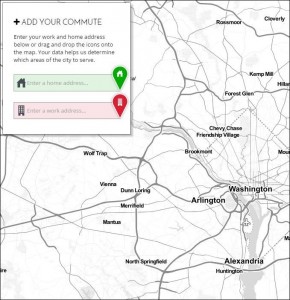
Bridj provides an interactive map of the Washington metro and invites visitors to plot the locations of their commutes. The data will help the company optimize its routes.

Bridj provides an interactive map of the Washington metro and invites visitors to plot the locations of their commutes. The data will help the company optimize its routes.

Last September, I posted about a Boston-area company, Bridj, that was reinventing the mass transit business by providing luxury bus rides to suburban commuters. For $6, Bostoners could get a comfortable, Wi-Fi-equipped ride from suburban locations to downtown Boston and Cambridge. Just as Uber was disrupting the taxicab industry, Bridj, I opined, would disrupt the bus transit industry.

Now Bridj is coming to the Washington region, the company has announced:

As the world’s first smart mass transit system, we deliver a fundamentally more efficient way of moving throughout the city. Powered by data and mobile tech, we’re able to optimize pick-ups, drop-offs, and routing based on need. Plus, since all rides are shared and each Bridj seats up to 14 passengers, fares cost only slightly more than the metro. However, on Bridj you’re always guaranteed a seat and an express trip between neighborhoods.

Our PhD-led data science team is developing our initial service area as we speak. Their algorithm takes into account dozens of different data streams on how D.C. moves, as well as feedback from potential users like yourself.

Continue reading

Resilience and Competitive Economic Advantage

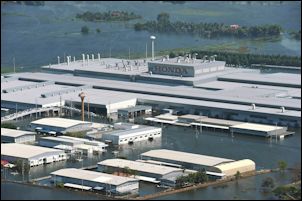
Flooded Honda factory in Bangkok, 2011 -- what you might call a serious business continuity issue.

Flooded Honda factory in Bangkok, 2011 — what you might call a serious business continuity issue.

by James A. Bacon

If you were a manufacturing company contemplating an expansion to Hampton Roads, you would take into account traditional criteria such as proximity to customers and suppliers, access to a skilled workforce, transportation connections, prevailing wage levels, taxes and so on. But as corporations become increasingly sensitive to the issue of business continuity in the face of disruption or disaster, you also might consider the region’s vulnerability to flooding.

Outside of New Orleans, Hampton Roads is the lowest-lying metropolitan area in the country. It is notoriously prone to flooding now, and the region’s vulnerability will only get worse as the sea level rises. You may or may not believe the McAuliffe administration’s predictions that the sea level will be 1 1/2 feet higher by 2050, but the risk that the forecast might prove accurate would have to factor into your calculations. Logical questions would arise: Would flooding disrupt rail and highway access to your facility? Would it hamper the ability of employees to get to work?

Perhaps the most important question is this: Do state and local governments have a plan to cope with recurrent flooding that will likely only get worse in time? How resilient is the region — not just one particular jurisdiction but, given the connectedness of transportation arteries and commuter flows — the entire region? Continue reading

Henrico Still Building Schlock

west_broad_marketplace

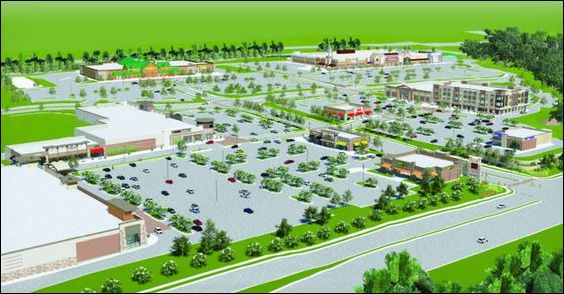
Artist’s rendering of West Broad Marketplace

by James A. Bacon

The developer of the West Broad Marketplace, which will bring a Wegmans grocery store and outdoor gear retailer Cabela’s to western Henrico County, promises Richmonders a shopping treat that “I don’t think you’ve experienced before.” That may be true. Unfortunately, Jack Waghorn, president of Vienna-based NVRetail, will replicate the experience of driving through traffic-clogged thoroughfares and parking in vast, open-air parking lots that Richmonders will find all too familiar.

The Henrico Wegman’s is scheduled to open in mid-2016, with a counterpart in Chesterfield County opening around the same time. Henrico County officials were on hand for a ground-breaking yesterday. No doubt county leaders are pleased that Henrico citizens will have access to the popular, high-end grocery store, not to mention the tax revenues generated by the store and the 550 to 600 full- and part-time jobs created.

As can be seen in the artist’s rendering above, however, West Broad Marketplace will perpetuate the dysfunctional low-density land use patterns of post World War II sprawl that has already made the Short Pump area a congested hell hole. I avoid going there if at all possible, and others do, too, although sometimes they have no choice because that’s where the region’s upscale stores are concentrated. Driving in and around Short Pump is always a dismal experience. When I visited one time last month to do some Christmas shopping, traffic was so gridlocked that cars were backed up onto I-64, causing a slowdown on the Interstate. That may sound banal to Northern Virginians but it’s unprecedented for the Richmond region.

The traffic congestion in Short Pump is the foreseeable consequence of zoning for mile after mile of single-use shopping-center development around the intersection of Interstates 64 and 295. Planners allowed for no other connectivity: shopping centers don’t connect with each other, much less with nearby residential neighborhoods. There are no side streets to divert traffic. All cars pile onto West Broad Street. The area is utterly unwalkable — visitors have no choice but to drive their cars from destination to destination, adding to the congestion — and there is no mass transit.

The county will never have enough money to build its way out of this mess. Indeed, the problem is so bad that congestion is radiating out from the Short Pump area to places, like the Innsbrook commercial park, where traffic conditions once were tolerable. At some point, I predict, conditions will become so atrocious that — Wegmans or no Wegmans — affluent households, corporate offices and high-end retailers will seek somewhere else in the Richmond region to locate. When the 30-year amortization of all those commercial buildings expires, retailers will pack up and follow. Once the newness wears off, there’s nothing to keep anyone there.

(Cross posted from Bacon’s Rebellion.)