Smart Growth for Conservatives

by Ron Beitler

Proud to be a contributor at a new blog called “Smart Growth for Conservatives“. 

“Smart Growth for Conservatives provides analysis of transportation and land use issues from a center-right perspective, with an emphasis on fiscal conservatism and market-based solutions.”

Smart growth is an issue conservatives should rally around. At it’s core it’s a blueprint for building long term fiscally sustainable places. So why has it gotten such a bad rap from some in the conservative movement? I’m going to borrow heavily from some of Jim Bacon’s writing here. It’s largely Jim and Strongtowns Chuck Marohn who really hooked me on the underlying conservative rationale. Conservatives mistakenly equate smart growth with intrusive government intervention in the economy, with regulations, subsidies and  boondoggles. Unfortunately, nothing could be further from the truth.

First, while conservative intellectuals are spot-on in their critique of mass transit subsidies, they are blind to subsidies for roads and highways. While they hit the bulls-eye in their critique of land use restrictions, they ignore the systemic subsidies for green-field development. Their critique runs only one way. – Why Conservatives (mistakenly) hate smart growth - Bacons Rebellion Continue reading
Big Box, Big Bollux

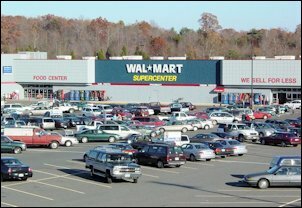
Ugly? Sprawl inducing? Low tax yield per acre? Yes, yes and yes. But very adaptable.

Ugly? Sprawl inducing? Low tax yield per acre? Yes, yes and yes. But very adaptable.

by James A. Bacon

Lefty Smart Growthers loathe big box stores, none more so than Wal-Mart. The big boxes are ugly as sin, they (allegedly) oppress their workers, they perpetuate dysfunctional, auto-centric human settlement patterns and they drive small, independent merchants out of business. If only there were a way to legislate them out of business!

Two decades ago, urbanists in the United Kingdom, hoping to preserve “town center vitality” from the effect of big-box stores, decided to do something. They enacted planning guidelines in 1993 and 1996 that created significant restrictions on large stores (more than 1,000 square meters) not located in town centers. In one respect, the restrictions worked as planned — they led to a reduction in the opening of large retail stores. In other respect, they failed — they accelerated the demise of small, independent merchants. Call it the law of unintended consequences.

Top-down social engineers are not always liberals and progressives; in the U.K. local Conservative Party officials also cracked down on big-box stores. Whatever their partisan affiliation, the goo-goos are often wrong but never in doubt. Rarely do they pause to measure results and see if what they’re doing is actually working. Fired up with noble intentions, they just plunge ahead with their next meddlesome scheme.

Fortunately, Rafaella Sadun, now on the faculty of the Harvard Business School, chose as part of her research dissertation to examine the consequences of the UK big-box regulations. Sadun tracked the number of U.K. planning grants and retail establishments between 1998 and 2004. As she wrote in “Does Planning Regulation Protect Independent Retailers“: “The main finding … is that independent retailers were actually harmed by the creation of entry barriers against large shops.” Continue reading

Shade on the Corner

shadeby Jim Dalrymple

One of the things I most dislike in the summer is standing on street corners waiting for my turn to cross. It’s so hot!

Phoenix, a place that knows a thing or two about heat, has a solution: free-standing metal parasols that are apparently just there to create shade. In places that are hot and sunny, this sort of thing can make a big difference.

Rick Rybeck on Value Capture

broadcast_mikeAttorney and job creation, transportation efficiency and economic development expert Rick Rybeck joins Chuck Marohn to talk about taxes, fees and creating incentives for a better land use approach. You can find out more about Rick and his work at www.justeconomicsllc.

Podcast Show 164: Rick Rybeck on Value Capture

(Cross-posted from Strong Towns.)

Commonwealth Cartography

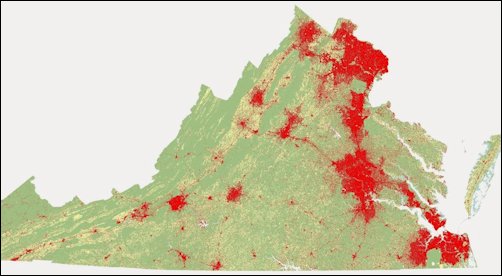
Virginia development in 50 years: sprawl scenario

I’m a map geek because maps help us visualize information that is difficult to explain in words. In few fields of endeavor is spatial visualization more important than understanding human settlement patterns. That’s why I’m psyched that Luke Juday, an urban planning graduate student at the University of Virginia, has launched a blog, “Mapping the Commonwealth.”

If the quality of his first three posts is indicative of his future work, I’ll be a regular visitor. Check these out:

In “Projecting Development,” Juday shows what Virginia will look like in 50 years if it grows by the same population and at the same low densities as in the past 50 years. He doesn’t think this is a likely scenario — but it’s a precautionary tale of what could await the Commonwealth if we don’t mend our ways. The red in the map above represents developed area — roads, buildings, parking lots, etc.

3d_densityIn “Visualizing Density in Three Dimensions,” he provides a 3-D look at density. This map highlights the a dramatic differences between Washington-Baltimore and the urbanized areas of downstate Virginia. Continue reading
Coming up: Cars and Traffic Lights that Communicate

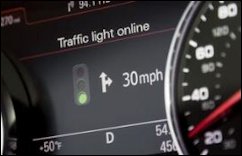
audi_displayThere are smart roads, and there are smart cars. The next step in the evolution of the digital city is smart cars that communicate with the smart roads.

As Jennie Xie writes for Atlantic Cities, there is considerable innovation in traffic signals these days. An increasing number of signals are synchronized to accommodate changing traffic flows during different times of day, week and year. Some are programmed to respond to changing conditions in real time. Meanwhile, new cars are rolling off the factory floor equipped with sensors and control systems designed to prevent inattentive drivers from drifting across lanes or tailgating too closely.

What if the traffic signal sent off a message telling cars when the light was about to change? In theory, cars could adjust their speed to reach the intersection when the light was green. If the traffic signals were networked, people could drive a lot farther before encountering a red light.

Automaker Audi is testing such a technology in Berlin and Ingolstadt in Germany and in Verona, Italy. And in Oregon, Texas and Utah, Green Driver is testing a mobile app that uses data from city traffic management systems to offer signal prediction regardless of the car being used.

The technology could well reduce congestion, concludes Xie, but there are safety concerns. It could cause problems if lights start changing unpredictably, if drivers speed up to catch lights, or if drivers pay more attention to the technology displays than to the actual road conditions around them.

(Cross-posted from Bacon’s Rebellion)

– JAB