Smooth-On a Great Fit for the Community

smooth-onCommissioners unanimously voiced support for Smoot-On, a manufacturer of molding supplies, at our last BOC meeting ahead of tonight’s 7 p.m. Zoning Hearing Board meeting.

Here is why I support Smooth-On based on smart growth principles: 

First, by encouraging a company to move into an existing empty building we help to preserve precious open space and farmland. Infill and true mixed-use is the alternative to greenfield development. Churning up our open space is costly both in terms of providing new infrastructure but also by hurting our quality of life.

Smooth-On projects to have 1/7th the impact (parking, traffic, deliveries) of Daytimers when they were operating at their peak. As an example, the projections are for 20 trucks total daily limited to Monday-Friday. These deliveries will also be limited to certain times and will not occur on weekends. Contrast that to distribution warehouses which generate 20-40 trucks an HOUR 24/7 and 365 days a year. Sounds like a pretty neighborhood-friendly deal to me compared to other alternatives. Remember, part of the Daytimers facility is a huge warehouse. There was a real fear a distribution outfit would have tried to purchase the property. This would have generated up to 10x the truck traffic.

Secondly, Smooth-On will bring over 150 good paying jobs. They’ve already stated they would like to hire former Daytimers employees who lost their jobs when the company relocated. This is contrary to distribution warehouses which typically hire a lot of seasonal and part time employees at much lower wages. Continue reading
A Free-Lunch No Brainer: Pay-As-You-Drive Insurance

pricing

by James A. Bacon

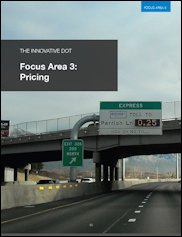
Pay-As-You-Drive (PAYD) automobile insurance bases premiums on the number of miles the customer drives. It stands to reason: the less you drive, the less likely you are to be involved in a traffic accident. As it also happens, the less you drive, the less you contribute to traffic congestion. Thus, it is in the interest of state transportation policy makers to encourage the adoption of PAYD insurance.

PAYD is one of the pricing strategies explored in Smart Growth America’s new policy manual, “The Innovative DOT: a handbook of policy and practice.” In the third of eight focus areas, the manual also makes a case for congestion pricing on toll roads. That’s a topic I have addressed extensively elsewhere, and Virginia is already a leading practitioner, so I will not dwell upon it. Instead, I will focus on PAYD, which has only recently entered the Virginia insurance marketplace.

According to the SGA manual, the Brookings Institution has calculated that PAYD insurance implemented nationally could reduce the number of vehicle miles traveled (VMT) by eight percent and save $50 billion to $60 billion a year by reducing the number of crashes and other driving-related externalities. Moreover, two-thirds of households would save an average of $270 per car per year, making insurance more affordable and decreasing the number of uninsured drivers on the road.

If the Brookings estimate of eight-percent VMT savings is anywhere near accurate, a shift to PAYD would be the closest thing to a free lunch imaginable. In Virginia, an eight percent reduction in traffic would translate into tens of billions of dollars in construction dollars that would not have to be spent. Add hundreds of millions of dollars yearly in reduced accident-related costs, and the policy is the closest thing to a public policy “no brainer” I can think of. Continue reading

How to Stretch those Transportation Tax Dollars

focus2aby James A. Bacon

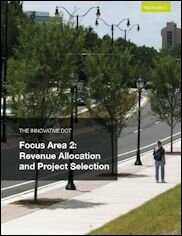
The Commonwealth of Virginia has spent way more effort in recent years figuring out how to raise taxes to build more transportation projects than it has ensuring that those tax dollars are well spent. That’s not for a lack of opportunities. In its new publication, “The Innovative DOT: a handbook of policy and practice,” Smart Growth America (SGA) argues that there are many techniques for stretching our tax dollars.

In the second of eight focus areas, the report explores three big ideas relevant to Virginia:

  • One funding pot. Put all transportation dollars for roads, rail and other transportation infrastructure in one big pot and allocate dollars based on Return on Investment. The project that provides the greatest benefit gets funded first, regardless of transportation mode.
  • Asset management. Adopt an Asset Management program for inventorying transportation assets, appraising their condition, and prioritizing maintenance expenditures. Timely preservation of assets can prevent the accelerating degradation of assets once they have begun deteriorating.
  • Performance metrics. Identify goals — congestion relief, facilitation of commerce, economic development, energy savings, pollution mitigation, coordination with local land use — and grade proposed transportation projects on the degree to which they improve those metrics. Base investment decisions on those metrics.

Bacon’s bottom line: By pigeonholing our transportation dollars between roads and rail, Virginia may be under-investing in some areas and over-investing in other areas. The idea of throwing all transportation dollars into a single pot has a certain appeal. In theory, it would facilitate financing of projects, regardless of mode, that offered the greatest public benefit. Continue reading

Spread of Protected Bike Lanes

cycle_track

by Andy Boenau

Not everyone is a bicycling news junkie. But if you’ve read about bike infrastructure projects in the last year, you’ve probably read articles by Michael Andersen. He’s on staff with the Green Lane Project — a program that helps people design better bike lanes. He also works part-time as a news editor with BikePortland.org.

What turns a newsman into a bike advocate?

Michael was trained as a journalist. He didn’t have a personal obsession with bikes until he had a professional obsession with bikes. Yes, he lives in Portland–America’s holy land for cycling–but Michael approached transportation issues from an equity perspective. He was learning about people released from jail who shared stories with a common thread: car falls apart and bad stuff followed.

“Honey, statistically speaking you’re going to die before me if you keep driving to work.”

Michael’s work involves talking to people from all walks of life. Most Americans have been programmed to believe that streets are safe for cars but dangerous for people to walk or bike. At least that’s my observation. Is the average person ready to re-think the purpose and function of streets? Michael challenges my assumptions and then speaks on behalf of all mankind. You want to hear this.

What is a protected bike lane?

I hear you. You want to geek out about human-scale city streets but you’re not sure how to sort out these different types of bicycling infrastructure. Is it the same thing as a bike lane? A cycle track? A greenway? HELP! Continue reading

Lerner Aims to Complete Tysons Office Tower… Two Years Late

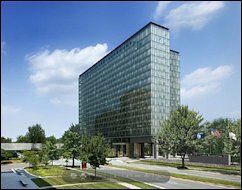
Artist’s rendering of Lerner’s new Tysons Tower. Original completion date: early 2014. New completion date: Late 2015/early 2016.

Artist’s rendering of Lerner’s new Tysons Tower. Original completion date: early 2014. New completion date: Late 2015/early 2016.

by James A. Bacon

The commercial building boom in Tysons triggered by the imminent completion of Phase One of the Rail-to-Dulles project doesn’t seem to be running on schedule. A Washington Post article today highlights Lerner Enterprise’s lengthy delay in building an 18-story, 476,000-square-foot office building near one of Tysons’ four Metro stations. Writes Jonathan O’Connell:

Office leasing has been flat, at best, in most parts of the region since then. The vacancy rate at office buildings in Northern Virginia is more than 17 percent, and other buildings built without tenants lined up are still largely empty. And the Silver Line has been delayed.

The good news is that Lerner is finally ready to move; it expects to complete construction by late 2015 or early 2016. But the question is how rapidly the Tysons commercial market can absorb (a) existing vacancies, (b) Tysons Tower, a Macerich project nearing completion, and (c) the Lerner office space, in a regional economy driven by federal spending in an era when federal spending, especially the defense spending so predominant in Northern Virginia, is severely curtailed and as businesses continue to shrink their office footprint per employee. Rob Whitfield, a former commercial real estate broker and a Rail-to-Dulles gadfly, estimates that Northern Virginia could have an eight-year office supply at present.

The multibillion-dollar long-term plan for transforming Tysons from a poster child for autocentric sprawl into a walkable, transit-oriented community has more interlocking pieces than a Chinese puzzle. The plan depends heavily upon an increase in development around Tysons to stimulate Silver Line ridership, pay for the reconfiguration of the business district’s paisley street pattern into a walkable grid, and generate tax revenues to offset the billions of dollars of road and highway improvements needed to move traffic in and out of the district. Continue reading

Why Tax Slush Funds Are Dangerous

The McKid line at Baxter School. No parents got wet in the taking of this photo.

The McKid line at Baxter School. No parents got wet in the taking of this photo.

by Charles Marohn

Government slush funds give us the means to build things we don’t really value, won’t fully utilize and ultimately lack the resources to maintain. Unfortunately, with the top/down tax structure the way it is today, local governments often have few choices but to go down this less-than-honest path. If we want a nation of Strong Towns, we need to accept a world in which we build only the things we are willing to pay for.

Last week, the city council in one of my joint hometowns – this time suburban Baxter, MN – was presented a plan to add a monthly franchise fee to gas and electric bills, a charge that would be passed on to utility users. Residential property owners with electric and gas would pay an additional $60 per year for their service. Commercial users will be charged up to $2,244 per year.

What is this charge for? Is the city experiencing extraordinary costs in administering their franchising program? Are there hidden costs in relocating utilities that the local government is trying to recoup? Is there an upgrade to the gas/electric system that the city is trying to fund?

Nope.

Tuesday, the Baxter City Council listened to options to raise money for the city’s street maintenance by using monthly gas and electric franchise fees.

That’s right. Suburban Baxter, which is just about to enter that second life cycle of the suburban Ponzi scheme in full force, needs money for street maintenance. It is actually road and stroad maintenance as Baxter does not have one single street in its entire inventory. Nonetheless, a slush fund of franchise fees or other uncorrelated charges – along with debt — is just the thing desperate local governments turn to when all that new growth is suddenly not so new anymore. Continue reading

Nashville Didn’t Fully Explore AMP Route without Dedicated Lanes

Photo credit: The Tennesseean

Photo credit: The Tennesseean

by Rod Williams

Most cities that develop a Bus Rapid Transit system do not dedicate a lane for a loading platform and a dedicated lane going both directions. Some do that for only part of the way and some not at all. There are various options for a BRT that would not take two or more lanes of traffic and reduce remaining traffic lanes to a nine-foot weight the way the Nashville AMP would do. Nashville’s design is only slightly faster and millions of dollars more expensive than alternative designs. See this article in the Tennessean for an explanation of alternative designs and examples from other cites using other design options. Nashville never did a study comparing other options.

At the center of the controversy over Nashville’s proposed $174 million bus rapid transit line is the question of whether stretches of a busy road now used for cars should be converted into bus-only lanes.

Opponents of the 7.1-mile line proposed for the West End/Broadway corridor connecting West and East Nashville say taking away space for cars on already congested streets will make traffic worse, not better. Metro officials contend the dedicated lanes let buses avoid traffic and are key to the Amp’s success.

But unlike other cities with such projects, Nashville never analyzed whether a bus line with the same mass-transit-style features — such as stations with level boarding platforms and pre-purchased tickets — would prove just as effective without the bus-only lanes. That question lingers as engineers move forward in the coming months on a $7.5 million engineering phase that could largely settle the design of the proposal.

(Cross-posted from A Disgruntled Republican in Nashville.)