Women Flex their Biking Muscles

amy_george

Amy George

by Amy George

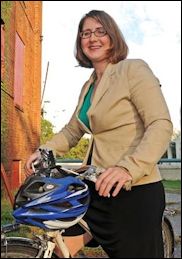
Riding a bicycle can be transformative to physical and mental well being, to families, to neighborhoods, and beyond. As cycling becomes more popular, more women and girls are enjoying its effects. However, representation among cyclists still tips male — 76% as measured per-ride in the U.S. Yet recent surveys show women overwhelmingly have a positive view of cycling. What is keeping so many women from taking to the streets on two wheels? Furthermore, why should we care, and what can be done about it?

Since 2010, Richmond as a community has taken several big steps in bicycle advocacy. RideRichmond formed that year, as did Mayor Dwight Jones’ Bike, Trail, and Pedestrian Commission. We have seen the creation of the dedicated, professional action and advocacy groups such as  Sportsbackers’ BikeWalkRVA and the VCU RamBikes program. In this landscape of growing bike-positivity, RideRichmond realized that women’s representation still is an underserved aspect of cycling advocacy. As believers in the bicycle, we could not stand by and watch the benefits of cycling distributed unequally to Richmonders. In order to begin this conversation, RideRichmond is hosting the first Richmond Women’s Cycling Summit on October 23 at the Virginia War memorial. Continue reading
City of Rifle Looks to Cycling to Improve Local Economy

by Jennifer Hill

Interest in cycling is growing as a relevant form of transportation and recreational day trip activity. Planning to develop new trail systems and citywide cycling street networks for its implementation can have a strong effect on the economies of small towns like Rifle, Colorado.

The expansion of road biking and mountain biking can create a draw to Rifle from I-70 as one of the first stops for these activities in Western Colorado. To advance this attraction, the City of Rifle went through a bike master planning process in fall 2013. The Sonoran Institute collaborated with the project team for Rifle’s first ever bike master plan by helping with outreach and communications, editing and designing the final document, and creating a short video about bicycling in Rifle. Continue reading

Follow the Rules, Bikers

by Charles Marohn

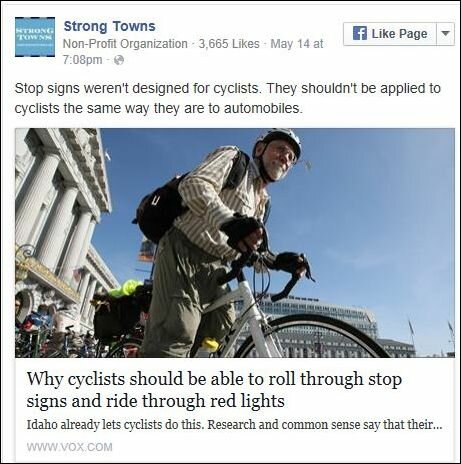
We need to rethink our urban areas. They need to be redesigned around a new set of values, one that doesn’t seek to accommodate bikers and pedestrians within an auto-dominated environment but instead does the opposite: accommodates automobiles in an environment dominated by people. It is people that create value. It is people that build wealth. It is in prioritizing their needs – whether on foot, on a bike or in a wheelchair – that we will begin to change the financial health of our cities and truly make them strong towns.

Last week I started a discussion by making a statement I felt to be fairly obvious. Apparently not everyone sees it the same way.

Biking and Walking in San Antonio

by Charles Marohn

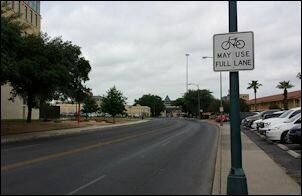
san_antonioFrom my Facebook feed where I have been posting photos of San Antonio:

Hey Chuck, Can you please tell me your thoughts about this sign. I would like to Share those thoughts with my friends on the following FB Groups. San Antonio Cycling Community, San Antonio Cycling, Alamo City Bicycle Crew, and Bicycle San Antonio.

You asked.

First, in any functional place, this sign is redundant. This is a handful of blocks from the core downtown of San Antonio. It is two blocks from UTSA. Why would there need to be a sign telling people that bikers are welcome and that they can use one of the two lanes in each direction? Where are they supposed to be? This is a signal – one of MANY – that biking and walking infrastructure is a sad afterthought here, if even thought of at all. Continue reading

Map of the Day: Cycling to Work

bicycling_to_work

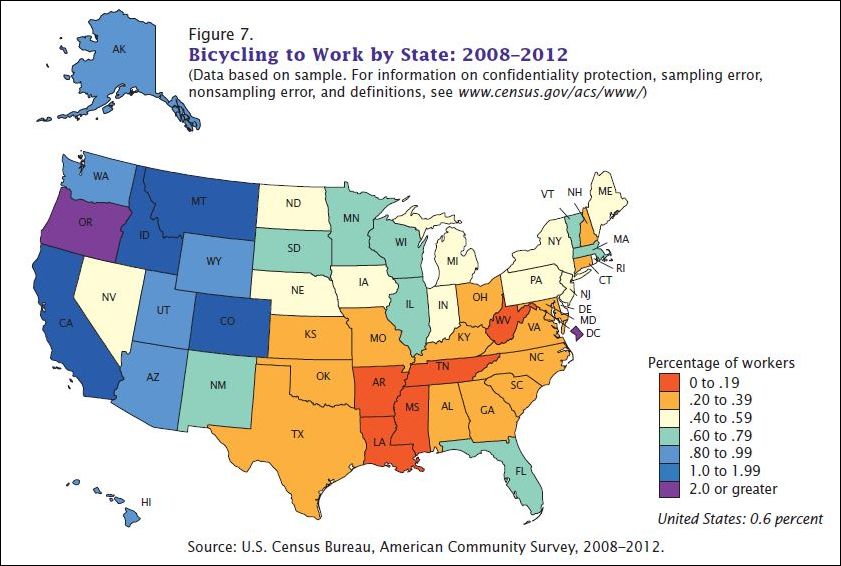
The number of U.S. workers who traveled to work by bicycle increased from about 488,000 in 2000 to about 786,000 in 2008-2012, the largest percentage increase of any transportation mode, according to a new report issued by the U.S. Census Bureau based upon its annual American Community Survey. Fully one percent of the population in the nation’s largest cities commute by bicycle now.

The percentage of Virginians who bicycle to work is lower than the national average, as can be seen in the map above published by the Census Bureau.

Males are twice as likely to bicycle to work as women nationally, and lower income workers are more than two to three times more likely than Americans in higher income brackets. Hispanics and white are twice as likely to use bicycles as African-Americans. Continue reading

Reversing Sprawl through Connectivity

memphisby A.C. Wharton Jr.

Last week, Smart Growth America released “Measuring Sprawl 2014,” a report examining development in 221 major metropolitan areas in the U.S. and evaluating development on a national index. With a score of 71, the greater Memphis region ranks near the bottom of the list at number 196 out of 221. Furthermore, Memphis ranks as the sixth most sprawled large metropolitan area.

While these findings are disappointing, they are not surprising. The Memphis region has shown a pattern of sprawled development over several decades. Between 1970 and 2010, the city of Memphis population increased by 4 percent (619,757 to 645,237), while the geographic area of the city increased by 55 percent (208 square miles to 323 square miles). This is why the work we’ve done over the last few years, starting with Sustainable Shelby, to create a more sustainable city and region is so important for our future.

Since 2010, Memphis officials have worked to improve conditions for persons using bikes and have embarked on an ambitious process to create new bike infrastructure throughout the city. The result of 71 new miles of dedicated bike lanes, shared-use paths, and bikes are increased bicycle usage (double the usage in 2008) and improved safety (number of accidents reduced by 35 percent since 2008). Most of these new miles were achieved through coordination with ongoing repaving projects and did not require any new budgetary considerations in order to create on-street bicycle lanes. With an understanding of projects planned for the next three years, Memphis is expected to once again double the miles of bicycle-specific infrastructure within its limits by 2016.

Continue reading

Stupid Is as Stupid Does

by Charles Marohn

There are a lot of cities out there – a lot of staff members and a lot of elected officials – that would like to make changes in the direction their community is heading. There are many, in fact, who desire to move away from the financially-ruinous auto-dominated building pattern and into something that would provide for more opportunities for biking and walking. This can be scary, especially when these urges are relatively new, not well grounded in a coherent worldview, completely inconsistent with the local government’s other actions and being done in a place that is lacking a culture of walking and biking.

Have no fear. Today I’m going to provide some tips – some do’s and don’ts – for public officials to help them navigate this difficult transition.

Do: Ensure that your proposed bike lanes connect places people may want to bike to.

Don’t: Simply add a bike lane to a random project where there is little demand, or even reason, to bike.

To be successful, a bike lane should actually allow a biker to get somewhere they want to go. For your first project, pick a location where you have destinations already in place. For example, a commercial node with restaurants, a barber shop and retail stores would work well. Schools and parks also make for good destinations for bikers. Your proposed bike trail is not likely to be embraced if it, for example, begins at a highway intersection and ends in a field with nothing but a church (more on that later) in between.

It is important that new bike lanes actually connect desired destinations, at least if there is an expectation that they will be used. Continue reading