Walkability No Guarantee of Healthy Housing Market

This graph shows how the midsized cities (excluding Arlington) with Top 10 walkability rankings score in WalletHub’s latest ranking of cities with the healthiest real estate markets. Sad to say: High walkability seems to be correlated with moribund real estate economies. The cities are (from left to right): Jersey City, Newark, Hialeah, Buffalo, Rochester, St. Paul, Cincinnati, Richmond and Madison. (Click for more legible image.)

This graph shows how the midsized cities (excluding Arlington) with Top 10 walkability rankings score in WalletHub’s latest ranking of cities with the healthiest real estate markets. Sad to say: High walkability seems to be correlated with moribund real estate economies. The cities are (from left to right): Jersey City, Newark, Hialeah, Buffalo, Rochester, St. Paul, Cincinnati, Richmond and Madison. (Click for more legible image.)

There is an interesting juxtaposition of news items today. Redfin, the real estate brokerage website, has published a list of the Top 10 most walkable midsized cities in the country. Arlington County (a highly urbanized county) scored third and Richmond scored ninth, based on their Walk Score rankings.

Arlington won kudos for its Ballston-Virginia square neighborhood, where residents can walk to an average of 13 restaurant, bars or coffee shops within five minutes. While the Washington metropolitan area is notorious for its traffic, many Arlington residents live car-free, opting to get around on foot, bike and public transportation.

Richmond earned recognition for the revitalization of neighborhoods surrounding downtown, including Jackson Ward, Shockoe Bottom, Monroe Ward, the riverfront and Manchester. The Fan and Carytown neighborhoods to the west of downtown also stood out for their walkability.

To many urban theorists, walkability is a critical determinant of a community’s livability, ranking close behind the cost of real estate, the quality of schools and the level of taxes in what people take into account when deciding where to live. But it’s no guarantee of prosperity or rising real estate values…. which brings us to the other news item. Continue reading

The Democratization of Data

Map showing green coverage in Tysons. Image credit: UVa Today.

Map showing density of green coverage in Tysons. Image credit: UVa Today.

Andrew Mondschein, an assistant professor at the University of Virginia School of Architecture, is studying how the redevelopment of Tysons affects the pedestrian experience. The first step is collecting data. Accordingly, he is dispatching students equipped with sensors, wearable cameras and smartphone apps to monitor temperature, light levels, green cover, noise pollution and carbon monoxide emissions in ever nook and cranny of the what he calls the “archetypal American edge city.”

The goal of Fairfax County planners is to transform the autocentric mix of offices, shopping malls and plate-of-spaghetti road network from the epitome of suburban sprawl into a smart-growth poster of mixed-use development and pedestrian-friendly streets.

tysons_illumination

Map showing intensity of illumination.

“Tysons Corner is on the forefront of transforming suburban places into more urban places and all that entails,” says Mondscheinin an article published in UVa Today. “For city and urban planners, it is exciting, because if we densify suburbs we could reduce driving and emissions, provide more housing and make transit, walking and biking easier and more pleasant – hopefully improving public and environmental health. The Tysons Corner project embodies all of these wonderful goals.” Continue reading

Cookie Cutter? What Cookie Cutter?

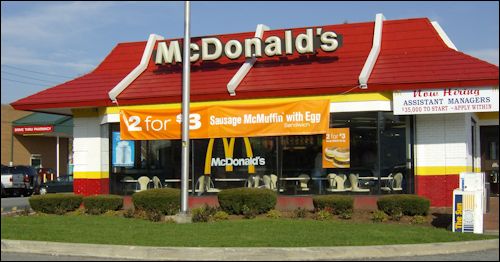
suburban_mcdonalds
by James A. Bacon

McDonalds is one of those American companies that the fashionable set love to hate. Critics gripe about everything from the nutritional quality of its food to the way it sources its beef. One recurring source of scorn is how the restaurant chain undermines community character by building loud, garish stores, typically surrounded by asphalt on locations accessible only by automobile. It’s not clear to me whether McDonalds is imposing some atrocious architectural template upon its stores nationwide or whether the template is imposed upon McDonalds by the Euclidian zoning codes of jurisdictions across the United States. Regardless, there is nothing inevitable about the red roofs, golden arches and ticky-tack decor.

Ed McMahon, whose work on Virginia tourism and land use I highlighted in a recent blog post, responded to a comment in that post to the effect that “McDonalds didn’t make billions by letting locals operate different restaurants under a common banner.” Actually, he says, McDonalds is more flexible than most people realize.

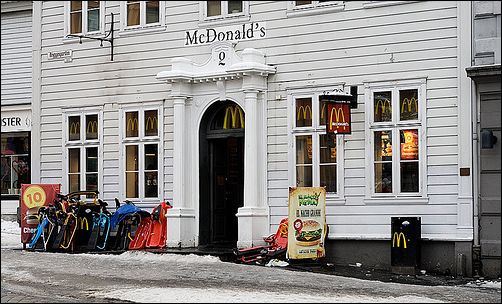
“I just wanted to point out that McDonald’s does indeed allow locals to operate  restaurants that are totally different architecturally from what most Americans are used to seeing,” he says. By way of proof, he offers some of the photos he has collected of McDonalds restaurants around North America and Europe.

Norway

Norway

Continue reading

Housing Affordability for Millennials

millennial_affordability

by James A. Bacon

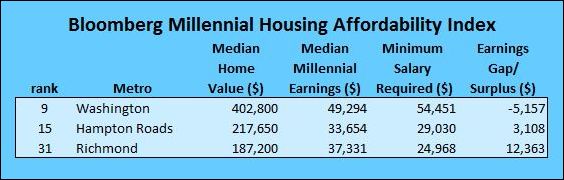
As the global epicenter of technology innovation, Silicon Valley creates a massive amount of wealth — but the housing supply, hemmed in by geography and zoning regulations, is incredibly restricted. The resulting housing crunch is so severe that Millennials are hard pressed to live there. The median income for Millennials in the San Jose metropolitan area is the highest of any of the 50 largest metropolitan regions in the country — $53,000. But the median home value of $925,000 requires an income of $133,000 to pay a mortgage (not to mention a 20% down payment). The earnings gap, according to a new housing index published by Bloomberg, is $80,000!

If Millennials are the life-blood of creativity and innovation for metropolitan economies, the cost of housing could be Silicon Valley’s Achilles heel. The housing supply is so out of whack, as it is in neighboring San Francisco, that, as much as Millennials are drawn to the excitement and glamour of working at companies like Apple and Google, they simply can’t afford it unless they’re willing to live five or six to an apartment.

According to Bloomberg, housing is unaffordable for thirteen of the 50 largest U.S. metros. The biggest affordability gaps are on the West Coast, but Boston, Washington and New York are on the list as well. Young people are willing to tolerate sub-par living conditions for a while, especially while they are single. One of my daughters shared a tiny rental apartment with four roommates while living in Jackson,Wyoming, which, due to its awesomeness, has similar affordability issues. But she rented her own place when she moved back to Richmond. And now that she is getting married, she and her fiance have no trouble affording a comfortable starter home in a nice neighborhood near the University of Richmond. When educated Millennials are ready to get married and start families, the idea of sharing a house with four or five roommates is not a serious option. Continue reading

In Praise of Organic Tourism

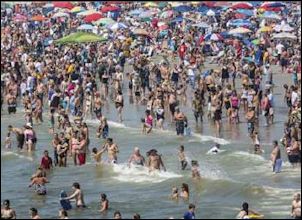
Which would you rather have in your community.... massive crowds of drunken, puking college kids like Fort Lauderdale....

Which would you rather have in your community…. massive crowds of drunken, puking college kids like Fort Lauderdale….

by James A. Bacon

Promoting tourism is a major part of Virginia’s economic development strategy for good reason. Tourism supports jobs, expands the tax base and helps pay for amenities — restaurants, arts, cultural institutions — that can be enjoyed by the whole community. But it can create problems, too, such as crowding, traffic congestion, noise and tacky, haphazard development. Handled poorly, tourism actually can degrade a community’s quality of life.

It is critical to differentiate between mass-market tourism and what Edward T. McMahon, writing in the May issue of Virginia Town & City, calls “responsible” tourism. Mass market-tourism is all about putting “heads in beds.” It is high volume, high impact but low yield. Think Fort Lauderdale, the “spring break capital” of the United States, which attracted millions of college kids who slept six to a room and spent money on little but beer and t-shirts.

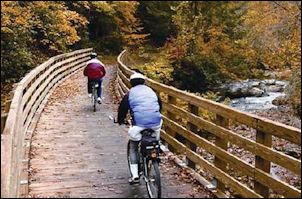
... or a recreational amenity like the beautiful Virginia Creeper Trail?

… or a recreational amenity like the beautiful Virginia Creeper Trail?

“Mass market tourism is … about environments that are artificial, homogenized, generic and formulaic,” writes McMahon. By contrast, “responsible tourism is about quality. Its focus is places that are authentic, specialized, unique and homegrown. … Think about unspoiled scenery, locally owned businesses, historic small towns and walkable urban neighborhoods.”

The challenge for Virginians, suggests McMahon,  a senior resident fellow at the Urban Land Institute, is to promote tourism without losing our soul. There is more to building a tourism industry than spending marketing dollars to lure visitors. It involves making destinations more appealing. “This means identifying, preserving and enhancing a community’s natural and cultural assets, in other words protecting its heritage and environment.” Continue reading

Reinventing the Suburban Office Park

Sidney Gunst built Innsbrook as a state-of-the-art suburban office park in the 1980s but says he would do it very differently today.

Sidney Gunst built Innsbrook as a state-of-the-art suburban office park in the 1980s but says he would do it very differently today.

Article published in June issue of Henrico Monthly magazine:

By James A. Bacon Jr.

In September 2010, the Henrico County Board of Supervisors put its stamp of approval on a plan to transform the county’s largest office park, the Innsbrook Corporate Center. The idea behind the plan, called Innsbrook Next, was to convert a smattering of office buildings surrounded by parking lots and connected by winding, unwalkable roads into Henrico’s de facto downtown. Planners envisioned millions of square feet of mixed-use development: office towers, parking garages and apartment buildings with stores and restaurants on the ground floors.

Not only would Innsbrook Next breathe new life into Henrico’s largest employment center – between 15,000 to 25,000 people work there, depending on whom you talk to – it represented a sea change in planning policy for the county. Having filled up with traditional, low-density suburban development, the affluent, western half of the county had nowhere to grow but up. To accommodate more growth and more jobs, Henrico had to begin urbanizing. Innsbrook Next would concentrate much of the expected growth into a district that would cause minimal disruption to established neighborhoods.

Nearly five years later, little has happened. A partnership of Markel Corp. and Highwoods Properties submitted a plan to develop the first phase of Innsbrook Next with 2.2 million square feet of mixed-use buildings. The county granted the needed zoning approvals, but the developers backed off. Dominion Virginia Power, a major property owner, submitted plans to convert overflow parking into a townhouse complex. But when county staff balked at aspects of the proposal, Dominion withdrew the project.

Then, earlier this year, the Dixon Hughes Goodman CPA firm announced the relocation of its headquarters office from Innsbrook to downtown Richmond. A prominent reason given was to make it easier to recruit talented young employees looking for urban amenities. Soon after, insurance firm Rutherfoord said it would consolidate offices, including its Innsbrook headquarters, in the new Libbie Mill-Midtown project at West Broad Street and Staples Mill Road, which had gotten the jump on Innsbrook in building what urban planners call “walkable urbanism.”

Across the country, suburban office parks are having a tough time. Built mainly in the 1970s, ’80s and ’90s, their age is showing. The buildings have lost the sheen of newness. Mechanical systems are wearing out, and maintenance costs are rising. And most challenging of all, young people prefer to work in urban settings where they can walk to restaurants, galleries, music and entertainment. For decades, downtown areas hemorrhaged tenants as companies decamped for the suburbs. Now the reverse is happening: Some businesses are moving back to the city. Continue reading.

Will the “Ferguson Effect” Kill Urban Renewal?

by James A. Bacon

Baltimore is the East Coast’s answer to Detroit, a once-prosperous city hollowing out from decades of mismanagement under the Blue State governance model. By the time the Washington Village Development Association (WVDA) filmed its documentary, “Fleeing Baltimore,” in 2013, 31,500 residents had abandoned Maryland’s largest city over the previous decade. Sixteen thousand buildings stood vacant. The documentary described how heroic efforts of middle-class Baltimoreans, both black and white, to clean up trash, combat crime and provide positive experiences for inner city youth were overwhelmed by the ineffectiveness of the city’s criminal justice system.

If conditions were hostile to the middle class two years ago, imagine what it is like now. Last month, a 25-year-old black man, Freddie Gray, died under mysterious circumstances in police custody, raising concerns about police abuse and laying bare a history of strained relations between police and the city’s poor black population. Riots ensued, and now gun violence is up 60% compared to the same time last year. Thirty-two shootings took place over Memorial Day weekend.

Similar explosions in violence are occurring in cities across the United States as as police and inner-city populations react to a series of incidents in which unarmed black men died at the hands of white police. In what what urbanist Heather Mac Donald calls the “Ferguson effect,” police are disengaging from discretionary enforcement activity, the criminal element is feeling empowered and a wave of violence has reversed much of twenty years’ decline in crime rates. Continue reading