Walkability No Guarantee of Healthy Housing Market

This graph shows how the midsized cities (excluding Arlington) with Top 10 walkability rankings score in WalletHub’s latest ranking of cities with the healthiest real estate markets. Sad to say: High walkability seems to be correlated with moribund real estate economies. The cities are (from left to right): Jersey City, Newark, Hialeah, Buffalo, Rochester, St. Paul, Cincinnati, Richmond and Madison. (Click for more legible image.)

This graph shows how the midsized cities (excluding Arlington) with Top 10 walkability rankings score in WalletHub’s latest ranking of cities with the healthiest real estate markets. Sad to say: High walkability seems to be correlated with moribund real estate economies. The cities are (from left to right): Jersey City, Newark, Hialeah, Buffalo, Rochester, St. Paul, Cincinnati, Richmond and Madison. (Click for more legible image.)

There is an interesting juxtaposition of news items today. Redfin, the real estate brokerage website, has published a list of the Top 10 most walkable midsized cities in the country. Arlington County (a highly urbanized county) scored third and Richmond scored ninth, based on their Walk Score rankings.

Arlington won kudos for its Ballston-Virginia square neighborhood, where residents can walk to an average of 13 restaurant, bars or coffee shops within five minutes. While the Washington metropolitan area is notorious for its traffic, many Arlington residents live car-free, opting to get around on foot, bike and public transportation.

Richmond earned recognition for the revitalization of neighborhoods surrounding downtown, including Jackson Ward, Shockoe Bottom, Monroe Ward, the riverfront and Manchester. The Fan and Carytown neighborhoods to the west of downtown also stood out for their walkability.

To many urban theorists, walkability is a critical determinant of a community’s livability, ranking close behind the cost of real estate, the quality of schools and the level of taxes in what people take into account when deciding where to live. But it’s no guarantee of prosperity or rising real estate values…. which brings us to the other news item. Continue reading
Beauty and Boredom in Kansas City

Every so often, I walk forty-five minutes to work rather than taking a bus. My walk takes me through Kansas City’s Brookside neighborhood, an area full of distinguished-looking old houses on gridded streets with sidewalks. Sounds great, right?

Yet my walk is missing something: variety. Once I leave the commercial area a couple of blocks from my apartment, I see almost nothing but single-family homes until I get to work. One lesson of my walk is that even if an area is incredibly well-designed, it gets boring without diversity of uses.

(Cross-posted from cnu.org)

Parks for Pedestrians: No Easy Matter

(Cross-posted from planetizen.com)

Last weekend, I visited Rock Creek Park in Washington, D.C. Rock Creek Park is quite different from the parks I am used to in New York City, both in good ways and in bad ways.

On the positive side, Rock Creek Park is more wooded and natural-looking than most parks. While a typical park is mostly grassland, Rock Creek Park is mostly forest. I saw three deer in the park over the course of an hour or two, which is three more than I would normally see in a park.

On the other hand, Rock Creek Park seems to me to be made for cars rather than for pedestrians. Although there are certainly some pedestrian entrances to the park, one of the main entrances, Military Road, is a high-speed road with no sidewalks in the blocks closest to the park.

As I walked along the park’s eastern border on 16th Street N.W., I only saw one or two pedestrian trails per mile leading westward through the park. Because the park is so densely forested, the only feasible way to walk through the park is through those trails. And as I walked, I didn’t really have a good idea where I was going; in the course of my two-mile walk from 16th Street to Military Road, I saw only one map—and even that one was more focused on the park’s interior than on how to get out of the park.

Unfortunately, Rock Creek Park has the virtues of its defects. A typical grassland park is pretty easy for a pedestrian to navigate; to get from the east end of New York’s Central Park to the west end, all a pedestrian need do is walk across the grass and keep walking. A more heavily forested park such as Rock Creek Park can be quite impressive, but may need a bit more planning to be pedestrian-friendly.  In particular, such a park may need more visible trails than other parks, and may need more maps to guide pedestrians.

The Rise of Walkable Urbanism and “the End of Sprawl”

foot_traffic_aheadby James A. Bacon

The Washington metropolitan region is the national model for “walkable urbanism” in the United States — more so even than metropolitan New York, according to the findings of “Foot Traffic Ahead: Ranking Walkable Urbanism in America’s Largest Metros,” a report released this morning by LOCUS, an organization of smart-growth real estate developers, and Smart Growth America.

The study identified 558 WalkUPs — regionally significant activity centers characterized by a high level of walkability — in the nation’s 30 largest metros. Forty-five of them are located in the Washington region, about half in the District of Columbia and half in surrounding Virginia and Maryland jurisdictions. The overall walkability exceeds even that of New York. While Manhattan is the single-most walkable place in the United States, it accounts for only 0.3% of the New York metro region’s land mass, and outer jurisdictions dilute its overall walkability, explained Christopher B. Leinberger, LOCUS president  and co-author of the report, during the LOCUS annual conference.

Washington’s lead in developing “walkable urbanism,” in contrast to the “drivable suburbanism” that dominated U.S. growth and development between World War II and the Great Recession of 2007-2008, should stand the region in good stead as it faces an economic future made insecure by the retrenchment of its main growth industry, the federal government. Walkable urbanism is closely correlated with the presence of a highly educated workforce, and a highly educated workforce is closely correlated with faster economic growth. While correlation does not necessarily mean causality, an argument can be made the the desirable attributes of walkable urbanism make it easier to attract and retain educated workers who, in turn, contribute to economic growth. Continue reading

Silicon Valley Knows Technology, Not Land Use

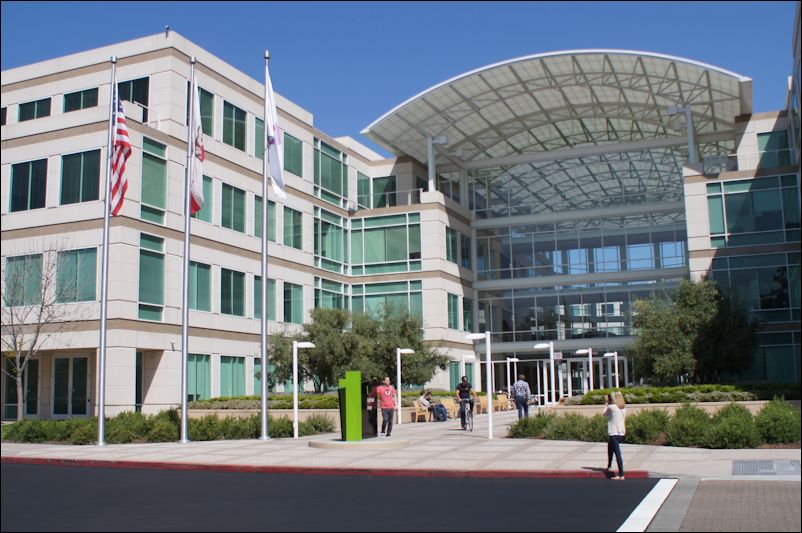
Apple headquarters, Cupertino, Calif.

Apple headquarters, Cupertino, Calif. Impressive facade but poor public spaces.

by James A. Bacon

Apple, Google and other collosi of Silicon Valley are re-shaping the world with their technology but you could never imagine them as masters of innovation by viewing their corporate campuses. While the office interiors may be arrayed with java bars and collaborative workplaces to stimulate creativity, the building exteriors are for the most part bland steel-and-glass boxes of a type that can be found anywhere in the United States. Moreover, surrounded by parking lots and landscaping, the buildings are isolated — islands in a sea of mulch and asphalt. Creativity and interaction end at the front door. The streets, sidewalks and other pieces of the public realm are innovation dead zones.

That was the impression I gained from the Bacon family’s whirlwind tour of Silicon Valley earlier this week that took in the corporate headquarters not only of Apple and Google but Hewlett-Packard, Yahoo! and LinkedIn. Perhaps we arrived at the wrong time of year, the wrong time of the week or the wrong hour of the day but we saw almost nothing going on. Most of the street-level activity at Apple was generated by tourist traffic to the Apple store. The environs of the famed Googleplex were even more desolate. Continue reading

L.A.’s Pedestrian Environment

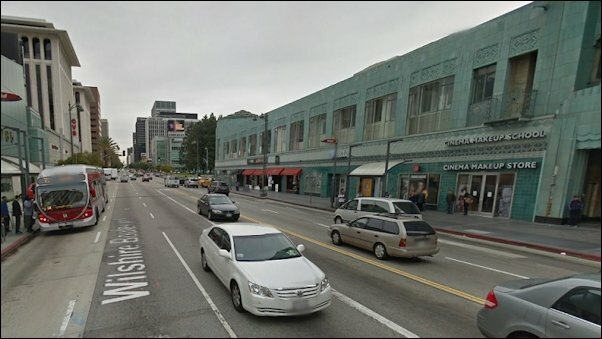
Wilshire Boulevard

Wilshire Boulevard

by Emily Washington

Last week, Tyler Cowen wrote that Los Angeles is the best city in the world based on several factors, including that it’s one of the best cities for walking. While he makes the valid point that LA’s beautiful weather gives it an advantage over many other American cities with good walking opportunities, I have to disagree that it ranks among the best cities for walking as a tourist or for enjoyment. I’ve spent a lot of time thinking about this topic because my boyfriend is from LA and has often tried to convince me that it has great walking neighborhoods.

Tyler is clearly correct that weather is an important aspect of walkability, so whether or not LA can compete with older, colder American cities on walkability depends on the walker’s preferences for weather relative to other factors like aesthetics and safety. Personally, I weight urban design much more heavily for walkability than weather, and from this standpoint I don’t think LA can compete with the few cities built before wide boulevards became standard street construction. As Nathan Lewis points out, American city planners began building wide streets well before personal cars became common for transportation. Only the U.S.’s oldest neighborhoods that predate the Revolutionary War feature the narrow streets that facilitate a pedestrian scale environment.

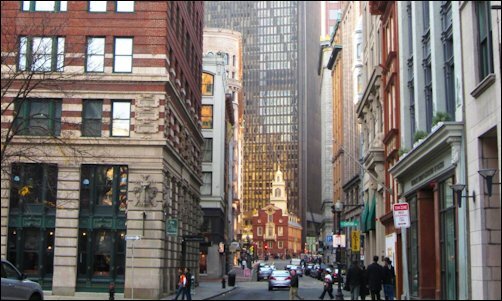
BostonStephen Stofka at Strong Towns supports 1:1 as the best ratio of building height to street width, but personally, I prefer a “really narrow street” design with mid-rise buildings, with a ratio often approaching 2:1. With buildings taller than the streets, pedestrians feel a sense of enclosure and close-in building facades pull the walker along as compared to the expansiveness of wide streets that make comparable walking distances feel farther. Although some call Boston’s financial district an urban canyon, to me it’s one of the most interesting places to walk that I’ve seen in the U.S. It’s building height to street width ratio is much higher than 1:1. Continue reading