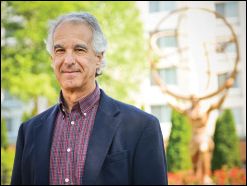
Sidney Gunst built Innsbrook as a state-of-the-art suburban office park in the 1980s but says he would do it very differently today.
Article published in June issue of Henrico Monthly magazine:
By James A. Bacon Jr.
In September 2010, the Henrico County Board of Supervisors put its stamp of approval on a plan to transform the county’s largest office park, the Innsbrook Corporate Center. The idea behind the plan, called Innsbrook Next, was to convert a smattering of office buildings surrounded by parking lots and connected by winding, unwalkable roads into Henrico’s de facto downtown. Planners envisioned millions of square feet of mixed-use development: office towers, parking garages and apartment buildings with stores and restaurants on the ground floors.
Not only would Innsbrook Next breathe new life into Henrico’s largest employment center – between 15,000 to 25,000 people work there, depending on whom you talk to – it represented a sea change in planning policy for the county. Having filled up with traditional, low-density suburban development, the affluent, western half of the county had nowhere to grow but up. To accommodate more growth and more jobs, Henrico had to begin urbanizing. Innsbrook Next would concentrate much of the expected growth into a district that would cause minimal disruption to established neighborhoods.
Nearly five years later, little has happened. A partnership of Markel Corp. and Highwoods Properties submitted a plan to develop the first phase of Innsbrook Next with 2.2 million square feet of mixed-use buildings. The county granted the needed zoning approvals, but the developers backed off. Dominion Virginia Power, a major property owner, submitted plans to convert overflow parking into a townhouse complex. But when county staff balked at aspects of the proposal, Dominion withdrew the project.
Then, earlier this year, the Dixon Hughes Goodman CPA firm announced the relocation of its headquarters office from Innsbrook to downtown Richmond. A prominent reason given was to make it easier to recruit talented young employees looking for urban amenities. Soon after, insurance firm Rutherfoord said it would consolidate offices, including its Innsbrook headquarters, in the new Libbie Mill-Midtown project at West Broad Street and Staples Mill Road, which had gotten the jump on Innsbrook in building what urban planners call “walkable urbanism.”
Across the country, suburban office parks are having a tough time. Built mainly in the 1970s, ’80s and ’90s, their age is showing. The buildings have lost the sheen of newness. Mechanical systems are wearing out, and maintenance costs are rising. And most challenging of all, young people prefer to work in urban settings where they can walk to restaurants, galleries, music and entertainment. For decades, downtown areas hemorrhaged tenants as companies decamped for the suburbs. Now the reverse is happening: Some businesses are moving back to the city. Continue reading.
Like this:
Like Loading...