Cookie Cutter? What Cookie Cutter?

suburban_mcdonalds
by James A. Bacon

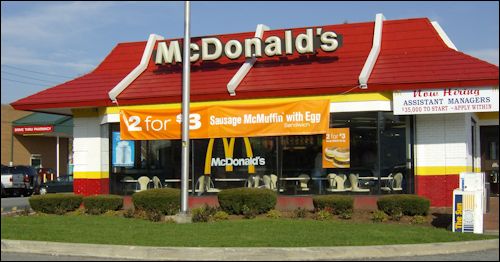
McDonalds is one of those American companies that the fashionable set love to hate. Critics gripe about everything from the nutritional quality of its food to the way it sources its beef. One recurring source of scorn is how the restaurant chain undermines community character by building loud, garish stores, typically surrounded by asphalt on locations accessible only by automobile. It’s not clear to me whether McDonalds is imposing some atrocious architectural template upon its stores nationwide or whether the template is imposed upon McDonalds by the Euclidian zoning codes of jurisdictions across the United States. Regardless, there is nothing inevitable about the red roofs, golden arches and ticky-tack decor.

Ed McMahon, whose work on Virginia tourism and land use I highlighted in a recent blog post, responded to a comment in that post to the effect that “McDonalds didn’t make billions by letting locals operate different restaurants under a common banner.” Actually, he says, McDonalds is more flexible than most people realize.

“I just wanted to point out that McDonald’s does indeed allow locals to operate  restaurants that are totally different architecturally from what most Americans are used to seeing,” he says. By way of proof, he offers some of the photos he has collected of McDonalds restaurants around North America and Europe.
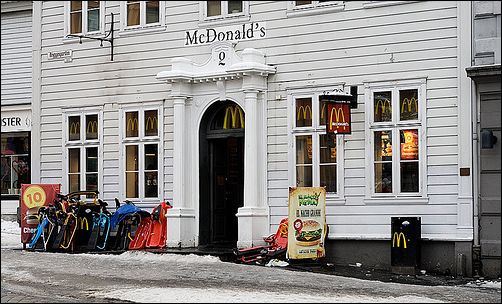
Norway

Norway

Continue reading

What Density-Phobia Gets Wrong

by Michael Lewyn

Some prosperous American cities have a housing supply problem: they have made zoning more and more restrictive over time, thus causing limited housing supply, thus causing escalating housing prices. And because some people fleeing high housing prices move to automobile-dependent suburbs or smaller cities, restrictive urban zoning means more suburbanites with more cars, creating more pollution everywhere.

So one might think that the logical solution is to build more housing in urban areas, especially in the costliest markets. Yet in a recent article, the Philadelphia Inquirer‘s Inga Saffron wrote: “Density has to be relative to what already exists … so neighborhoods can step up density gradually.” In other words, don’t build too much stuff because…why? Most of her article seems devoted to the evils of tall buildings.

As far as I can tell, there are three myths underlying Saffron’s article.

Myth 1: “Beware! The high-rises are coming!” Saffron writes that some unnamed “hard-line” density proponents “assume there is only one way to achieve real density. They use density as a rallying cry to justify the construction of more and bigger high-rises, in both America’s thriving cities and its hollowed-out ones.” Continue reading

Do Tall Buildings Attract Rich Foreigners?

I was discussing Washington, D.C.’s height limits with some acquaintances on Twitter; one of them suggested that allowing taller buildings might turn Washington into a “global city”, which in turn would cause foreigners to surge into Washington and drive up real estate prices (as has arguably been the case in parts of Vancouver and New York).

This argument seems to be to be based on two assumptions that are at best unprovable:

1.  Washington is just attractive enough to attract foreign demand if height limits are lifted. Since I don’t know of any evidence of a surge in foreign investment in the Washington suburbs (which lack height limits) this seems hard to believe.

It could be argued that the blocks near Congress or the White House are so prestigious that they have an attraction that the District of Columbia’s more urban suburbs lack. Even if this was true, it seems to me that (a) this is not true of most of the District, and (b) if it was true, the District’s townhouses and existing stock of mid-rise buildings would be just as attractive to the rich foreigners as high-rises.

2.   Rich foreigners will only invest in urban high-rise condos (as opposed to other types of buildings). This argument could be true in theory, but I don’t see any evidence that this is the case. In fact, at least some low-rise areas are attractive to foreign buyers; for example, 41 percent of trulia.com searches in Los Angeles’s suburban Bel Air district come from foreigners, as opposed to 13 percent of searches in Los Angeles generally. Thus, it seems to me that if a well-off area lacks foreign demand absent high-rises, high-rises will not create such demand.

(Cross-posted from cnu.org)

Downtown Salt Lake Demolition Exposes Cool, Old Facade

by Jim Dalrymple

Demolition for the Utah Performing Arts Center is underway on Main Street. While that means downtown will be kind of a mess for quite a while, it also exposed an interesting old facade on one of the buildings.

facade1This picture shows what the buildings looked like back in November:

facade2


And here’s what it looks like now:

The building that has the yellow covering on the front in the first picture is the same one that has a fairly impressive arch in the second picture. That yellow covering was made out of some sort of vinyl-like material so I always wondered what was underneath. Turns out, it was a pretty cool building.

Continue reading

The Devil Is in the Detail

by Nathaniel Hood

Almost there.

We have embraced a degree of urbanism in our towns and cities. The planning, architecture and development communities have slowly adopted concepts of good urban design. It’s part of an ideological battle that the New Urbanists have won. But, we aren’t all the way there yet. We’ve only finished half the equation.

To illustrate my point, we’ll need to first visit to Troy, New York.

devil1I saw this site plan on Facebook (via Duncan Crary) about two proposed buildings in downtown Troy.

The buildings have a variety of uses, address the street and reacquaint the public to a waterfront park. These are all excellent things. Troy-aficionado, author and urbanist Duncan Crary agrees:

“The urbanism of the buildings … appears to be good. Apartments, yes. Retail, yes. Plaza, sure. Buildings that come up to and respect the “build-to” line, yes! Two buildings rather than one, the more the merrier.” Continue reading