(Reposted from Strong Towns.)
Granary Row, Salt Lake City
Reply
(Reposted from Strong Towns.)

(Reposted from Strong Towns.)
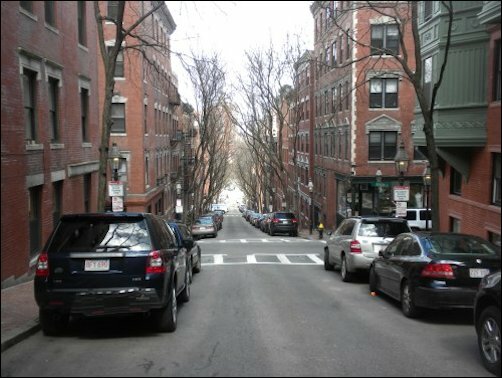
Boston
by Jim Dalrymple
Perhaps the ideal size of a building is just tall enough (or short enough) that people will still take the stairs to the top.
That’s basically the idea Robert Freedman suggests in a great post over at Planetizen discussing the pleasure, economics and feasibility of cities with plenty of medium-height buildings. The idea is that cities need some amount of density to thrive, but massive elevator-oriented towers don’t feel sufficiently human scale.
I agree; pretty much all of my favorite spaces across the world are dominated by mid-rise buildings. As Freedman points out,
In areas of Manhattan where entire blocks of walk-up apartments have been preserved, the human scale provides an amazing and welcome contrast to the soaring, elevator-towers that cover much of the rest of the island. You immediately sense how the heights of the buildings are in harmony with the width of the street. The materials are warm and natural, and, on the Avenues and major streets, the sidewalks are lined with small shops and restaurants. While walking, you have the sense that you “fit.” It’s not unlike retrieving your jacket after having mistakenly slipped into someone else’s that was several sizes too large. It just feels right. Continue reading
 by Jim Dalrymple
My colleague at the Tribune Tony Semerad had an interesting piece last week on the rapidly growing housing market in Utah. Basically, a lot of people are banking on new single family home construction, while a lot of others think the future is in apartments. On apartment vacancies, he writes,
Apartment developers already are bringing a record number of new dwellings to market in and around Salt Lake City in a kind of boom in multifamily units, particularly downtown.
They’ve been spurred by falling vacancy rates for apartments, which, according to the U.S. Census Bureau, closed 2013 at around 6.7 percent statewide, down from 8.3 percent just five years ago. Local analysts say the number has dipped as low as 5 percent in recent months.
So what does all this mean?
I think it shows that we’re at a pivotal moment right now in Utah, where we have the opportunity to channel a lot of demand into better city building. We can either opt for sustainable, transit-oriented places. Or we can keep building sprawl.
 by Jim Dalrymple
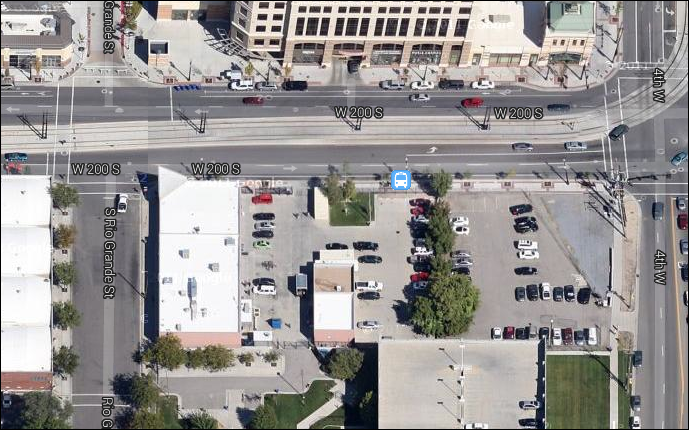
A few evenings ago, I walked down a street in downtown Salt Lake City near my home and was offered drugs. Six different times. By six different dealers. All within one block.
Of course all cities have rough areas and this spot in particular — 200 South near the Gateway Mall — is well-known by locals as a troubled area. But it’s also right downtown near a not-so-old shopping area, transit stops and housing. It’s a place that shouldn’t be rough and that definitely shouldn’t have people brazenly selling drugs as if it were an illicit farmer’s market.
So why is it used by criminals and ignored by everyone else?
The reasons are likely legion but here’s one the city may not have considered: parking.
In an article this week in The Atlantic Cities, Jenny Xie wrote that eliminating parking actually cut down on drug deals in San Francisco and Baltimore. The idea is that drug dealers use idling and parked cars to conduct transactions, so eliminating their parking eliminates their workplace. To that I’d add that excessive parking also can be alienating to pedestrians and generally law abiding people. Think big abandoned parking lots, for example, that due to neglect become ripe for crime. Continue reading
by Jim Dalrymple
The street in the picture below is 400 South in downtown Salt Lake City. In general, it’s a massive and massively unpleasant street:
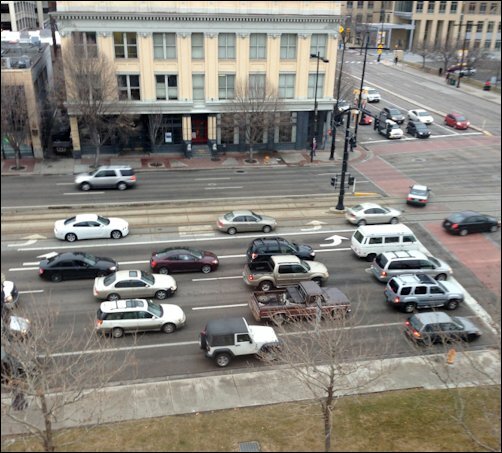 Including turn lanes, there are a full six lanes of traffic for cars just in one direction. Here are the reasons this is a major problem:
1. It’s expensive. Maintaining this type of street is vastly more expensive than the analogous-but-smaller version of a downtown street you’d see in most cities.
2. It encourages speeding, which problem is exacerbated by Salt Lake City’s long blocks. That, in turn, increases the frequency and severity of accidents. Continue reading

Photo credit: Salt Lake Tribune
Good news for Salt Lake City: developers are finally building slightly higher density housing.
An article by my colleague Tony Semerad explains that a developer is building a series of townhouses in South Salt Lake. The developer plans to open model units this weekend and has already sold two units. Though I’m not a huge fan of the buildings’ actual look, they have better street engagement than what is usually considered a “townhouse” in Utah.
Here’s are some of the more interesting things about this development:
• As the article points out, it signals a trend in the housing market toward more “urban” — i.e. dense — housing.
• Apparently the supply of single family homes along the Wasatach Front is “dwindling.” I find this a little hard to believe because there is a lot of space and a lot of listings, so the takeaway here is probably that demand for housing is outpacing supply, driving up prices. That could be bad news for younger people wanting to buy a single family home, but it may also be good news for those interested in seeing more high and medium density development. Continue reading
by Jim Dalrymple
Demolition for the Utah Performing Arts Center is underway on Main Street. While that means downtown will be kind of a mess for quite a while, it also exposed an interesting old facade on one of the buildings.
 This picture shows what the buildings looked like back in November:

And here’s what it looks like now:
The building that has the yellow covering on the front in the first picture is the same one that has a fairly impressive arch in the second picture. That yellow covering was made out of some sort of vinyl-like material so I always wondered what was underneath. Turns out, it was a pretty cool building.