What Robert Moses Got Right (and Kansas City Gets Wrong)

by Michael Lewyn

Robert Moses is most famous (or perhaps infamous) for paving over large chunks of New York City with highways. But he also built and rehabilitated thousands of acres of parks and playgrounds; and in this area his contribution to the city was more unambiguously positive.

Moses believed parks should be used not just for leisurely contemplation but for active recreation; for example, he added eighteen playgrounds to Central Park alone. Moses also commonly added ballfields, tennis courts and other sports-oriented spaces to city parks.

By contrast, Kansas City has many chunks of lawn that include no active uses whatsoever; some of them don’t even include benches to sit on. These grasslands (see here for an example) waste lawn that could be used for housing or commerce, artificially reducing city density and value without creating any compensating value.

(Cross-posted at cnu.org)

Private Investment in the Public Realm

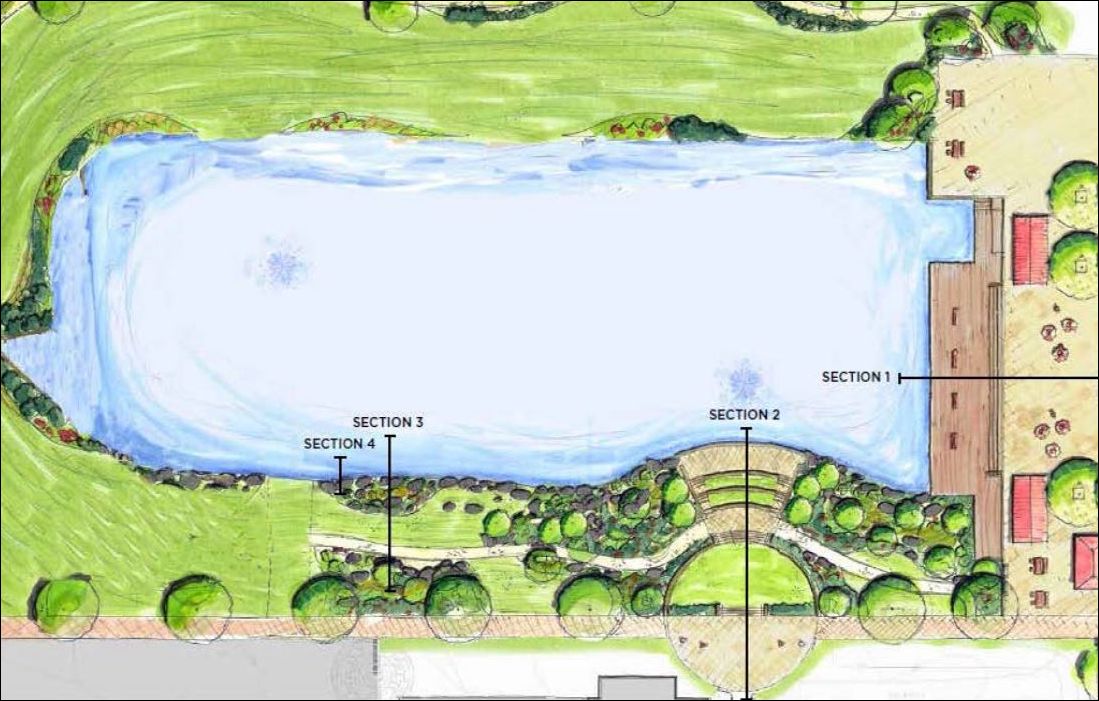
libbie_mill_lake
by James A. Bacon

The American suburbs built since World War II have many deficiencies, not the least of which are expensive, fiscally unsustainable infrastructure and a proclivity toward traffic congestion. But the greatest drawback of all gets the least attention: the poverty of the public realm. Outside of shopping malls, there really is no public realm in the post-World War II suburbs. Streets are not designed for walking. There are no plazas. Parks are accessibly mainly by automobile. The only gathering places are found indoors — libraries, churches, fitness clubs and the like.

But tastes are changing, and a new generation of real estate developers understands that creating quality public spaces — particularly streets, sidewalks and parks — allows them to charge premium prices for their buildings. The key insight they have grasped is that humans are social creatures. Yes, people like their privacy of their homes, but they also enjoy being around other people. They like to walk. They like to watch other people. They like gathering in groups. Continue reading

How to lead a walking tour

by Michael Lewyn

On Sunday May 3, I led my first Jane’s Walk. Jane’s Walk (named after Jane Jacobs) is an international movement of walking tours, usually held in the first week of May. In case some of you are thinking of getting involved next year, I am writing to show how you can lead a walk without an enormous amount of research.

I chose to lead a walk in Brookside, my current neighborhood in Kansas City, Missouri, (\where I am finishing up a one-year visitorship at the University of Missouri at Kansas City’s school of law. Since I haven’t lived in Kansas City long enough to be an expert on neighborhood history, I chose to focus on Brookside as an example of a streetcar suburb—that is, a neighborhood, usually built between 1900 and 1930, that is more walkable than postwar suburbia but not quite as dense as urban parts of New York or Chicago. I hoped to show how Brookside differs both from more downtowns and from sprawling suburbs.

I began in the neighborhood’s richest residential blocks; I pointed out one major difference between these blocks and newer suburbs. Brookside has a grid of short, interconnected streets; north-south streets are about 400 feet long, one-third the length of some suburban streets. (East-west streets are somewhat longer). As a result, pedestrians have many different options, and can reach a residential street without having to walk out of their way or spend unnecessary time on a busier street. Continue reading

The Invisible Parking Garage

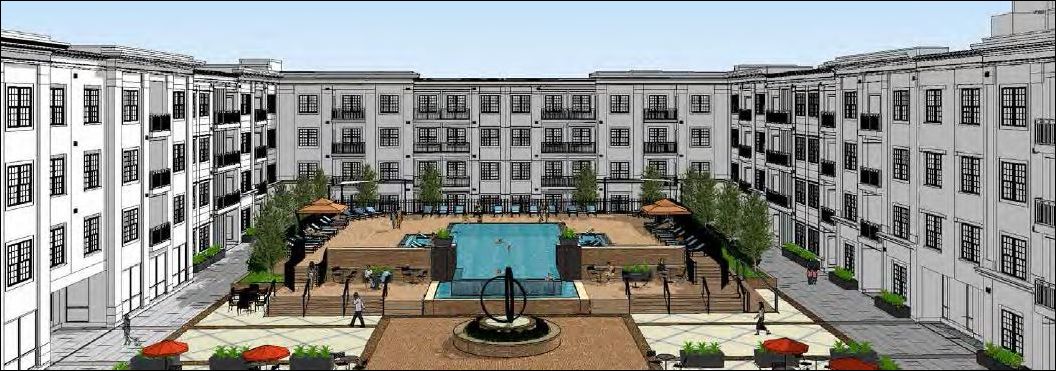
Draft rendering of planned apartment building at Libbie Mill-Midtown shows how garage rooftop will be used as communal space.

Draft rendering of a planned apartment building at Libbie Mill-Midtown shows how garage rooftop will be used as communal space. Illustration credit: Gumenick Properties.

by James A. Bacon

It is axiomatic among New Urbanists and like-minded brethren in the Smart Growth movement that parking garages create dead space in the urban fabric that discourages walkability and depresses neighboring property values. Some architects try to dress up the structures by giving them facades that imitate the look of regular buildings, draping them with plantings or otherwise making them visually interesting. Another strategy is to hide garages underground or relegate them to the middle of the block.

There is nothing new under the sun, as the old saying goes, so the Gumenick Properties design for a planned apartment building in its Libbie Mill-Midtown project may not be the first of its kind. But I feel safe in saying that it is unique to the Richmond real estate market — and it’s a solution that, economics permitting, should be employed more frequently.

Libbie Mill-Midtown is an 80-acre mixed-use development in Henrico County roughly midway between downtown Richmond and the Innsbrook Corporate Center. The company is billing the $434 million community as “ten minutes from everything.” When complete in ten years or so, depending upon market conditions, the project is expected to have 994 for-sale homes, 1,096 apartments, 160,000 square feet of retail space, a public library and office space. Marketing the project to people who want to rely upon the automobile less, Gumenick is placing tremendous emphasis on walkability. Continue reading

Suburban Multifamily: Smart Growth or Smart Sprawl?

In a recent article in the Columbia Journal of Environmental Law, law student Paige Pavone criticizes suburban apartments and condominiums as “green sprawl” because they “merely add density to suburban sprawl and exacerbate the very problems smart growth seeks to correct.” She explains that without public infrastructure to support walking and biking, these developments merely entice more people into car-dependent suburbia, and therefore should not be entitled to density bonuses and other incentives that a state might use to encourage smart growth. In particular, she claims that such “High-Density Islands” are cut off from “communities, local governments, nature, public transportation, and sidewalks.”

Is this critique fair? Somewhat.

Pavone examined a variety of suburban multifamily developments, but focuses on Reading Woods, in Reading, Massachusetts, a suburb of Boston. She claims that Reading Woods residents “cannot walk to the public library, a bank, or a grocery store” and would have to cross I-95 to reach a chain restaurant. So I decided to look at Reading Woods on Google Street View and see how horrible it is.

First of all, I looked for sidewalks. The main street serving Reading Woods is Jacob Way. Jacob Way generally has sidewalks, as does Augustus Court (the main street serving the part of Reading Woods further away from South). So it seems to me that a resident of Reading Woods can use sidewalks for most visits to South Street and other neighborhood streets. To reach Main Street (the neighborhood’s main commercial street) you must walk briefly on South Street, which also has a sidewalk (though it only serves one side of the street, and looks pretty narrow). Continue reading

High-Rises and Streetlife

One common argument against tall residential buildings is that high-rises reduce a neighborhood’s livability by reducing its streetlife. For example, a few months ago I read a blog post claiming that “people who live in the high floors of a high-rise are less likely to leave their homes.” I have lived in elevator buildings for the past couple of years, and can verify from personal experience that high-rise residents leave their homes for the same reasons that homeowners do: to go to work, to get groceries, and to perform all the other little functions that are necessary for a normal life. To be sure, a few people do work at home and get groceries delivered, but the overwhelming majority of people need to leave their homes on a regular basis, whether they live in a single-family house, a small multifamily building, or a high-rise.

Moreover, this argument doesn’t seem to be supported by what I have actually seen with my own eyes. New York City neighborhoods like Times Square and the Upper West Side certainly have plenty of elevator buildings, but these places have far more street life than many low-density suburbs or quiet rowhouse neighborhoods. Why? Because even if a few shut-ins are less likely to go outside than in a low-rise neighborhood, any negative results of this phenomenon are outweighed by the positive effects of density. So many people live, work and play near Times Square that its streets are far busier than those of a less dense rowhouse area such as Washington’s Capitol Hill (or even of higher-density rowhouse areas such as New York’s West Village). By contrast, my current neighborhood in Kansas City is not particularly lively—but my block (dominated by a 10-story building) seems no more lifeless than the street a block away dominated by three-story buildings, or the single-family home blocks west of my building.

In fact, high-rises may sometimes increase street life by increasing the popularity of city life and thereby increasing urban density. The “streetlife” argument against urban high-rises assumes that people who don’t live in high-rises would be happy to live in low-rise apartment buildings. In other words, it assumes that consumer preferences are: (1) highrises, (2) lowrises, and (3) suburbia. But some consumers may prefer (1) highrises, (2) suburbia, (3) lowrises, because they are only willing to live in the city if they can get the amenities that come with (1) for example, doormen to enhance security (which are more common in high-rises than in smaller buildings) or elevators to reduce stress on aging knees and hips. In turn, these consumers are more likely to walk on city streets than if they lived in suburbia, thus increasing urban streetlife. And if they are business owners or executives, they are more likely to place their businesses in the city than if they lived in suburbia, thus causing even more people to walk on city streets. Continue reading

Best Practices in Sprawl: Apartments

westgate

When I visted Fargo, North Dakota, I saw a few things I liked, such as a nicely fixed-up downtown and a beautiful historic district just south of downtown.

But I also saw something I liked in the suburb-like west side of town. An apartment complex was right in front of a far-too-wide suburban commercial street, rather than being set back behind a giant driveway as is often the case in suburbia.*  Why is this a good thing?  Because when an apartment building is right next to the sidewalk, its occupants can easily walk to nearby bus stops and stores (even in a suburb where crossing the street is a problem).

*For excellent examples of what NOT to do, go to Google Street View and look at Big Tree Lane in Jacksonville, Fla.

(Cross-posted from cnu.org)