Private Investment in the Public Realm

libbie_mill_lake
by James A. Bacon

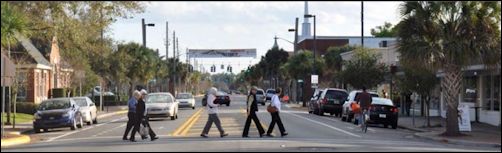
The American suburbs built since World War II have many deficiencies, not the least of which are expensive, fiscally unsustainable infrastructure and a proclivity toward traffic congestion. But the greatest drawback of all gets the least attention: the poverty of the public realm. Outside of shopping malls, there really is no public realm in the post-World War II suburbs. Streets are not designed for walking. There are no plazas. Parks are accessibly mainly by automobile. The only gathering places are found indoors — libraries, churches, fitness clubs and the like.

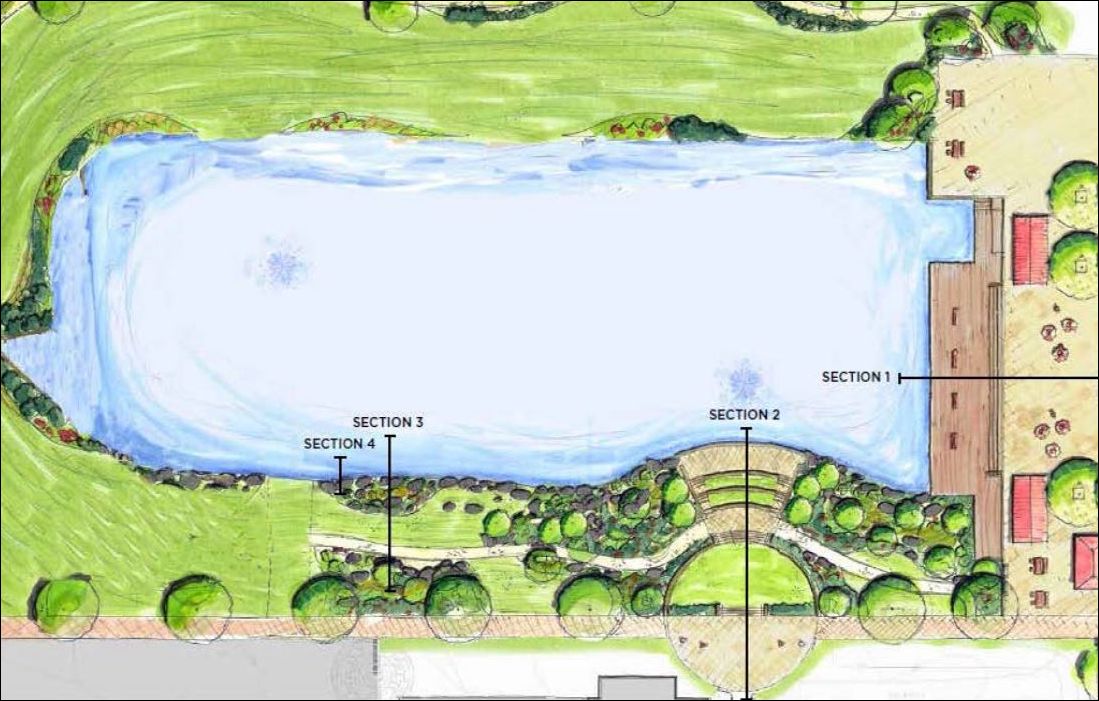
But tastes are changing, and a new generation of real estate developers understands that creating quality public spaces — particularly streets, sidewalks and parks — allows them to charge premium prices for their buildings. The key insight they have grasped is that humans are social creatures. Yes, people like their privacy of their homes, but they also enjoy being around other people. They like to walk. They like to watch other people. They like gathering in groups. Continue reading
The Invisible Parking Garage

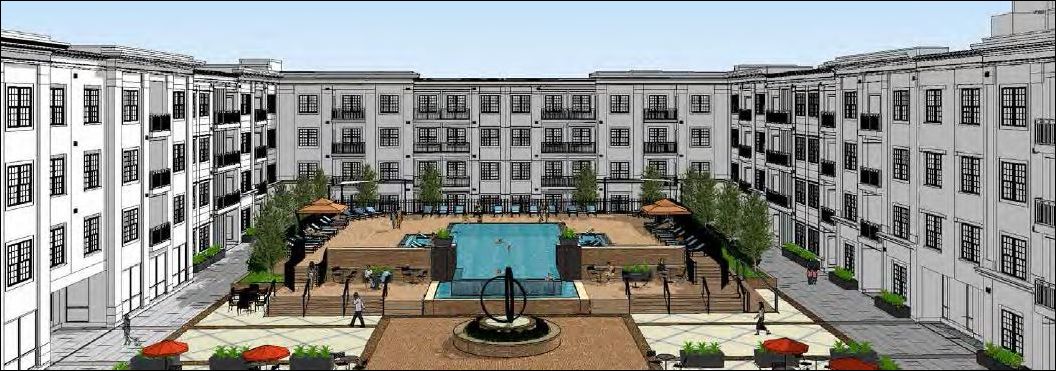
Draft rendering of planned apartment building at Libbie Mill-Midtown shows how garage rooftop will be used as communal space.

Draft rendering of a planned apartment building at Libbie Mill-Midtown shows how garage rooftop will be used as communal space. Illustration credit: Gumenick Properties.

by James A. Bacon

It is axiomatic among New Urbanists and like-minded brethren in the Smart Growth movement that parking garages create dead space in the urban fabric that discourages walkability and depresses neighboring property values. Some architects try to dress up the structures by giving them facades that imitate the look of regular buildings, draping them with plantings or otherwise making them visually interesting. Another strategy is to hide garages underground or relegate them to the middle of the block.

There is nothing new under the sun, as the old saying goes, so the Gumenick Properties design for a planned apartment building in its Libbie Mill-Midtown project may not be the first of its kind. But I feel safe in saying that it is unique to the Richmond real estate market — and it’s a solution that, economics permitting, should be employed more frequently.

Libbie Mill-Midtown is an 80-acre mixed-use development in Henrico County roughly midway between downtown Richmond and the Innsbrook Corporate Center. The company is billing the $434 million community as “ten minutes from everything.” When complete in ten years or so, depending upon market conditions, the project is expected to have 994 for-sale homes, 1,096 apartments, 160,000 square feet of retail space, a public library and office space. Marketing the project to people who want to rely upon the automobile less, Gumenick is placing tremendous emphasis on walkability. Continue reading

Can Short Pump Be Salvaged?

Short Pump. Photo credit: Henrico Monthly

Short Pump. Photo credit: Henrico Monthly

by James A. Bacon

The Short Pump area of Henrico County, the largest retail concentration in Central Virginia, is a fascinating test case for the proposition that it’s possible for state and local governments to build their way out of traffic gridlock. My verdict: Henrico has managed to beat the odds so far, but future prospects look bleak.

I focused on the transportation challenges of Short Pump in a cover story published this month in Henrico Monthly. A rural crossroads thirty years ago, Short Pump in Western Henrico County has exploded with development. Ranked by traffic counts, the stretch of West Broad between Interstate 64 and Pouncey Tract is the second busiest non-Interstate road in the entire Richmond region. Given the profusion of stop lights, it may be the most congested. With the Short Pump Town Center and other top-of-the-line retail, Short Pump is a location that Richmonders love to hate. In the immortal words of Yogi Berra, “Nobody goes there anymore. It’s too crowded.”

Henrico County planners and elected officials are acutely aware of the horrendous traffic conditions, and they have responded as suburban governments always have — by laying more asphalt. More than $150 million in state and local dollars have or will be spent between 2011 and 2017 to improve mobility in and around the area. For a while at least, the road projects seemed to be doing the job. After peaking at 69,000 vehicles per day in 2006, traffic counts along West Broad declined to 50,000 vpd by 2012. How much was due to the 2007 recession and how much due to Henrico’s road construction program isn’t clear. But there are indications the decline was only temporary. In 2013, the most recent year for which figures are available, the county spiked back up to 69,000. Continue reading

Measuring the Impact of Complete Streets

complete_streets

“Complete Street” projects that make streets more hospitable to pedestrians, bicycles and mass transit have a multitude of benefits, concludes Smart Growth America in a new report, “Safer Streets, Stronger Economies.” In a study of 37 projects, the authors found that complete streets tend to result in higher property values, fewer traffic accidents and injuries and more walking, biking and transit usage.

Previous studies of complete streets tended to focus on the health benefits associated with encouraging people to walk and bike more. People who live in walkable neighborhoods get 35 to 45 more minutes of moderate physical exercise each week, reducing their incidents of obesity. Youths who walk or bike to school tend to focus more and perform better in classrooms. The Smart Growth America report focused more on the economics of Complete Streets. Among the findings:

  • Fewer collisions. About 70% of projects studied experienced a reduction in collisions, and more than half a reduction in injuries. That translated into $18.1 million in lower collision costs in a single year for the 37 cases studied. “If a Complete Streets approach was used strategically … the savings over time could run into the hundreds of millions or billions of dollars.”
  • More walking, less driving. Among projects that tracked pedestrian and biking activity, 12 of 13 projects showed an increase in walking and 22 04 23 showed an increase in cycling. Among those that tracked driving, 19 of 33 projects had fewer cars than before, 13 had more, and one did not change.
  • Positive impact on local economy. Although results were mixed, the redesigned streets tended to report an increase in the number of businesses and the number of people employed. Of the ten projects that reported before-and-after data for property values, eight reported an increase in property values while two reported no change. In two-thirds of the studies for which comparable data was available, property values outpaced that of the city as a whole. In one project, Dubuque, Iowa, property values increased 111%.
  • Lower construction costs. The construction cost of upgrading streets to “Complete Streets” costs less per mile than average arterial cost per lane mile.

Continue reading

Uh, Oh, Maybe We Haven’t Reached “Peak Car”

moving_average

Click for more legible image.

by James A. Bacon

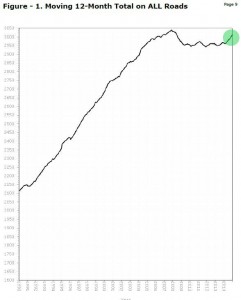
Proponents of Smart Growth, of whom I am one, have been arguing for several years that Americans embarked upon a fundamental shift in driving habits beginning in the mid-2000s. So marked was the decline in Vehicle Miles Traveled (VMT) that a certain triumphalism set in — the drop in driving signaled a shift back to mass transit and walkable urbanism. To be sure, some of the downturn could be attributed to the slow economy, but profound changes in values — a rejection of auto-centric development — was taking root. Some commentators went so far as to proclaim that America had reached “peak car,” and predicted that VMT per capita would continue to decline.

Well, the Federal Highway Administration has reported the latest numbers for 2014, and that triumphalism doesn’t seem quite as justified as it did a couple of years ago. Cumulative travel (measured by the moving 12-month average of Vehicle Miles Driven) increased 1.7% last year, bringing the total travel to a point just shy of the record in 2007. Even more worrisome, drivers were really on a tear at the end of the year. Traffic volume in December increased by 5% compared to the same month the year before.

I haven’t seen how other Smart Growthers have spun this data, and they may have interpretations that confirm their conviction that a big re-set is occurring in human settlement patterns. But I regard the data as grounds for re-examining some of my long-held beliefs — not to change them necessarily, but to go back and take a fresh look and see if they still hold up. Continue reading

Community Policing and Human Settlement Patterns

Former Police Chief Rodney Monroe implemented community policing in Richmond is credited with bringing down the city's sky-high crime rate. Can his approach be replicated in suburban Henrico and Chesterfield?

Former Police Chief Rodney Monroe, who implemented community policing in Richmond, is widely credited with bringing down the city’s sky-high crime rate. Can his approach be replicated in suburban Henrico and Chesterfield?

by James A. Bacon

Community policing is key to the war on crime, agreed top law enforcement officials yesterday at a public forum hosted by the Richmond Times-Dispatch. Community policing gets police out of their cars so they can patrol neighborhoods on foot, interact with residents and build trust. “I do think the relationship piece … is the critical piece,” said Henrico County Police Chief Doug Middleton.

The reversion from police-by-patrol-car to community policing is credited with much of the downturn in crime in recent years, along with adoption of the “broken windows” theory of crime fighting, which advocates going after smaller crimes, and the use of statistical tools to predict areas where crimes are more likely to occur. In the city of New Haven, Conn., community policing has coincided with a 30% decline in serious crime since 2012, according to a front-page article in the Wall Street Journal today.

Community policing is back in the spotlight since a U.S. Justice Department probe into law enforcement practices in Ferguson, Missouri, where the police killing of a young black man triggered rampant protests. The suburban locality’s community-policing efforts “have dwindled to almost nothing in recent years,” the report said. Police had lost “the little familiarity it had with some African-American neighborhoods.” Continue reading

Bridj Comes to Washington

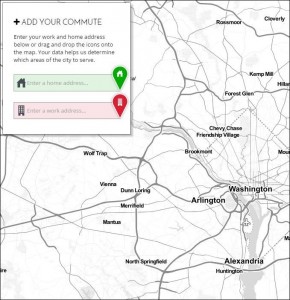
Bridj provides an interactive map of the Washington metro and invites visitors to plot the locations of their commutes. The data will help the company optimize its routes.

Bridj provides an interactive map of the Washington metro and invites visitors to plot the locations of their commutes. The data will help the company optimize its routes.

Last September, I posted about a Boston-area company, Bridj, that was reinventing the mass transit business by providing luxury bus rides to suburban commuters. For $6, Bostoners could get a comfortable, Wi-Fi-equipped ride from suburban locations to downtown Boston and Cambridge. Just as Uber was disrupting the taxicab industry, Bridj, I opined, would disrupt the bus transit industry.

Now Bridj is coming to the Washington region, the company has announced:

As the world’s first smart mass transit system, we deliver a fundamentally more efficient way of moving throughout the city. Powered by data and mobile tech, we’re able to optimize pick-ups, drop-offs, and routing based on need. Plus, since all rides are shared and each Bridj seats up to 14 passengers, fares cost only slightly more than the metro. However, on Bridj you’re always guaranteed a seat and an express trip between neighborhoods.

Our PhD-led data science team is developing our initial service area as we speak. Their algorithm takes into account dozens of different data streams on how D.C. moves, as well as feedback from potential users like yourself.

Continue reading