
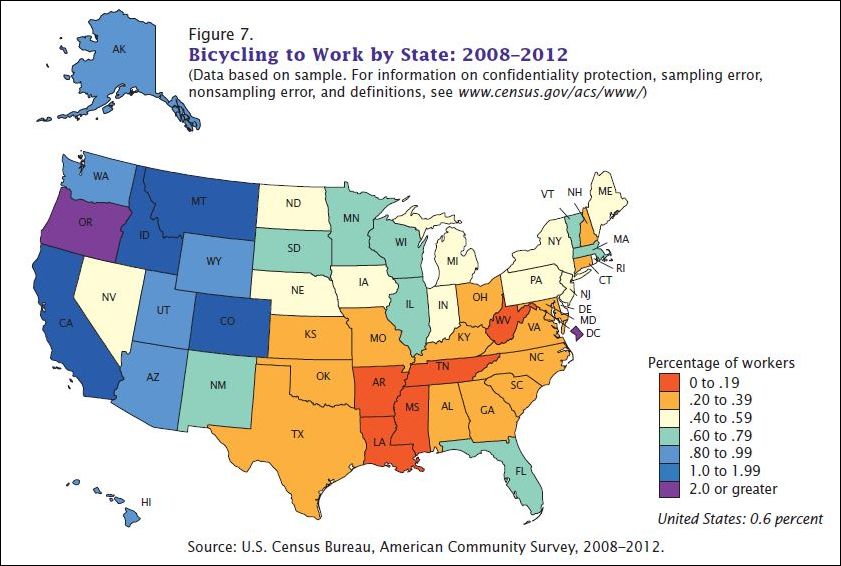
The number of U.S. workers who traveled to work by bicycle increased from about 488,000 in 2000 to about 786,000 in 2008-2012, the largest percentage increase of any transportation mode, according to a new report issued by the U.S. Census Bureau based upon its annual American Community Survey. Fully one percent of the population in the nation’s largest cities commute by bicycle now.
The percentage of Virginians who bicycle to work is lower than the national average, as can be seen in the map above published by the Census Bureau.
Males are twice as likely to bicycle to work as women nationally, and lower income workers are more than two to three times more likely than Americans in higher income brackets. Hispanics and white are twice as likely to use bicycles as African-Americans.
The political economy of bicycling. There are two closely aligned constituencies that agitate for making American cities more bicycle friendly: environmentalists and urbanists. The enviros love cycling because it causes no pollution and emits no greenhouse gases. Urbanists, most of whom are environmentalists as well, also support cycling because it takes automobiles off the road, ameliorating congestion and reducing the demand for automobile parking. Both of these constituencies skew heavily to the educated white demographic.
However, Hispanics are more likely than any ethnic group to ride bicycles to work. That’s all the more interesting when you consider how in many regions Hispanic immigrants have settled in the suburbs. By contrast, African-Americans are less likely than any ethnic group to bicycle to work. Is there a cultural difference here? Do Hispanic immigrants come from countries where riding bicycles to work was a prevalent form of transportation? I don’t know, but it’s worth looking into.
Regardless, I would suggest that the bicycle lobby — I can only hope that it will one day grow to become known as Big Bicycle — expand its advocacy of bicycles beyond the environmental and urbanist justifications, as legitimate as they are. Bicycles also should be a means of mobility for the poor. There is no cheaper form of transportation. Even poor people can afford to purchase bicycles; charitable organizations in Richmond are collecting used bicycles and giving them to poor people for free. For poor workers lacking access to automobiles, bicycles expand the range they can cover on foot by a factor of three or four.
All I hear from the anti-poverty groups is the need to expand and subsidize mass transit. You could turn the average city into a bicycler’s paradise for the fraction of the cost of adding Bus Rapid Transit or light rail — and you wouldn’t incur the same operating deficits year after year. As for Republicans, conservatives and others who are reflexively skeptical of investing in bicycle infrastructure, I’m surprised they haven’t positioned bicycles as an alternative means of helping the poor access jobs at a fraction of the cost. Let’s see a little more imagination, guys!
– JAB
(Cross posted from Bacon’s Rebellion.)
It’s a combination of mass transit and cycling that really works. Mixed modes of transport can cover a far greater area far better than any single mode. If you provide robust walking and cycling infrastructure in the neighborhoods and join that to a robust mass transit backbone, you get the best of both.
I fully agree with your view of cycling as affordable transport, but too many American cities require workers to travel too far for cycling alone.