The Suburbs Are Dying

by Charles Marohn

A recently released TEDx talk from our friend, Leigh Gallagher, author of The End of the Suburbs.

If you’ve not read the book, you really should, especially the second chapter which focuses on Strong Towns. Highly recommended.

(Cross posted from Strong Towns)

Re-Thinking the Sidewalk

tree_rootsby James A. Bacon

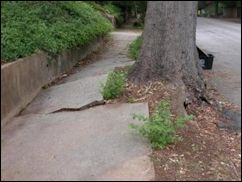
The vast majority of sidewalks in my home town, Richmond, Va., are made of concrete slabs. Concrete materials are inexpensive and the sidewalks are easy to install. But in a burg like Richmond, where people dearly love their trees, concrete pavement presents a problem. Tree roots lift or crack the slabs, creating hazards for pedestrians. Replacement can get costly — as much as $35 per square foot in Los Angeles.

So, the race is on to re-think the humble sidewalk, reports the Atlantic City Lab. Is it practicable to use other materials? Can sidewalks be integrated into storm water management systems? Can they be used to generate energy? Is their sole function to enhance walkability?

Some locales have run underground tubes carrying hot water under sidewalks to keep them clear of snow and ice. Others are tinkering with ways to convert the kinetic energy of footsteps into electricity, which can be used as an off-grid power source. Yet others are replacing concrete with recycled, hard-rubber mats that bend and buckle under tree roots without cracking. One English university is working on a self-healing sidewalk. Continue reading

Transit-Oriented Development vs. Development-Oriented Transit

by Charles Marohn

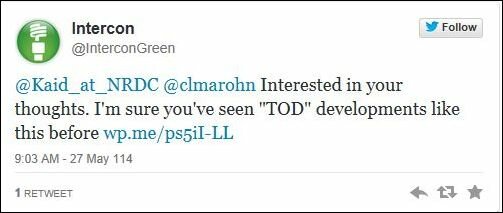
Today I received a tweet asking me about a transit oriented development (TOD). … In light of last week’s podcast on transit, I thought I should add a couple of thoughts on TOD.

tweet2

Build-it-and-they-will-come transit is no better than build-it-and-they-will-come highways. Both are a risky gamble with sketchy results, particularly for local governments. Transit oriented development is the transit-advocate’s response to highway strip development in the same way that Seaside and early New Urbanism was a response to greenfield suburban development. I’m sympathetic, but this isn’t the answer.

Instead of transit oriented development, we should have development oriented transit. Identify places where things are happening now and then connect them with the lowest level of viable transit possible. Make sure those places allow the next increment of development by right (without extensive permitting). This will ensure that the transit is viable AND that it supports that next level of growth and expansion.

When that next level of growth and expansion happens, everything moves up a notch. Upgrade the transit to the next level – from jitney to shuttle bus, from shuttle bus to city bus, from city bus to streetcar, from streetcar to light rail, from light rail to subway – and repeat. Continue reading

Webinar Recap: Missoula’s Old Sawmill District

by Alison Berry

We had a great webinar last week with Ed and Leslie Wetherbee, discussing their exciting project in the Old Sawmill District at the heart of Missoula. Here is a re-cap:

Ed and Leslie are working to restore the sight of an old sawmill. It used to look like this:

Historic slide

Here is an aerial view of the site, you can see piles of logs stacked top of the photo, and the rail line cutting diagonally through the site: Continue reading

Brightening up the Beach

lifeguard_art

Bobby Levin sits atop beach art in Virginia Beach. Photo credit: Inside Business.

It seemed like such a great idea: Commission painters to adorn Virginia Beach’s lifeguard stands with bright, crowd-pleasing art, and then pay for the initiative by selling sponsorships. “Between 42 lifeguard stands and 37 containers over a 3-mile resort strip, you’ll effectively have one fixture every 75 yards,” Bobby Levin told city officials, as re-told by the Inside Business. “You’ll have created a gallery on your beach.”

The city’s Resort Advisory Commission loved the idea, which is reminiscent of the psychedelic lifeguard towers in South Beach, Fla. Levin didn’t have any trouble lining up artists, but the business sponsors have been slow to come by. So far, there have been only three takers, for two stands and one storage container.

Oh, well. Levin has several prospects in the pipeline, but he concedes that the idea may take longer to lift off than he expected. Regardless, Project LifeguART is a worthy idea. It’s low cost and poses no risks to taxpayers — the risk is borne by Levin and his company — but it provides great public benefits. Public art brightens up the beach and creates helpful landmarks for walkers up and down the strand. So, here’s three cheers to Levin and the Resort Advisory Commission for taking a chance. Let’s hope they take even more.

— JAB

(Cross posted from Bacon’s Rebellion)

A Dystopic Future of Road-Clogging Robot Cars?

robocar

Robocar on a mission!

by James A. Bacon

Whether we’re ready for them or not, the United States will be flooded with self-driving cars (SDCs) within 10 to 15 years. Envisioning a future in which people subscribe to  driverless-car sharing services, some urbanists look to the future with equanimity: When people don’t need to own cars outright, they’re more likely to take mass transit more and use cars only for trips that require extra carrying capacity.

Others see driverless cars reviving the long-distance commute by allowing commuters to spending their time emailing or web surfing rather than focusing on the road. Then there’s Robin Chase’s nightmare vision of cities plunging into hellish congestion as robo-cars clog the roads running incessant errands for their owners.

As founder of car-sharing company Zipcar and peer-to-peer car-sharing enterprise Buzzcar, Chase has an interesting perspective. She wants to see car-sharing spread. She thinks it would be “thrilling” if SDCs morphed into a form of public transportation owned by municipalities, rental car companies or ride-sharing companies. When people use shared-car services for trips where only a car will do, they are more likely to walk, bike or ride transit for other trips. Fewer car trips equates to less congestion and pollution. Continue reading

What We’re Reading: The Gas Tax, Old Buildings & the Future of Sidewalks

by Alison Berry

Happy Friday, All! It’s been a busy week at Community Builders. Here are a few standouts from the Internet for some weekend reading:

Old Gas Pumps

On the gas tax: “We can’t expect people to travel like it’s 2014 if they pay for travel like it’s 1927.”

Millenials: are they “All look, no leap“?

Five things you need to know about the latest mortgage applications

Do historic buildings add value? An Economic Defense of Old Buildings

The Future of Sidewalks is not So Concrete – some cities are experimenting with alternative materials, with various levels of success. Continue reading