Freeways, New and Improved!

Freewaysby Michael Brown

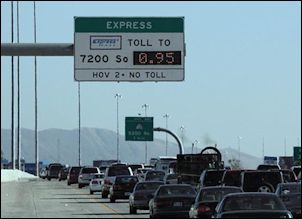
Urban freeways provided unprecedented mobility for decades, and helped the United States sustain a strong economy throughout those decades.  But their success eventually became their demise.  They enabled far-flung lifestyles, which induced demand and congested them faster than we expected.  At first it was cheap and easy to convert medians and shoulders to lanes. Unfortunately that enabled even further driving from the next wave of fringe residents. Now it is getting too expensive to expand, and we know that congestion will return soon anyway.

But hey, we’re Americans! Big things are what we do!  Yes, the spirit is able, but when we think about that federal debt clock getting close to $20-trillion, a small voice inside gnaws at us, “You already spent all the money, and your children’s money too. Fort Knox is full of IOU’s to who-knows-who?  Even if you can get another loan from China – they’re figuring out that you’ll never pay them back – how can you do this in good conscience?”  And we respond, “But how can we not?  Mobility is life!  Mobility is the economy!  We can’t earn the money we need to get out of our debts if we can’t get around!”

There Are Solutions!  Before you get liquored up at the “Build-Your-Way-Out Bar & Grill” once more, READ THIS!!  Earlier articles in this series articulated the benefits of two freeway optimization strategies – congestion pricing and preventive ramp metering (sometimes called “Managed Motorways”).  Either system can optimize traffic flow (i.e., eliminate mainline congestion), but both come with negative side effects and political hurdles.  That’s why there are few examples!  HOT lanes are the baby steps we’ve been able to make because they’re politically acceptable.  But the bang-for-buck of HOT lanes is much less impressive than pricing or preventive metering. Continue reading

How to Convince Your Mom that Congestion Pricing Is Good

by Michael Brown

Odds are if you show up at a family reunion and try to convince your parents and siblings that congestion pricing is good, you’ll be lonely pretty quickly. People want the freeways to work but they hate paying tolls! If you are reading this, then you’re probably part of the choir. My goal isn’t to convert the converted as much as to provide new arguments and sound bites when talking to others.

So, how do we reach others? Millions must be convinced to put down their pitchforks long enough to test the theory and decide for themselves if congestion pricing is worthwhile. Elected officials are afraid to take a position contrary to polls, and polls are overwhelmingly dominated by uninformed opinions.

Too many citizens “learn” the issues of the day in 30-second television spots. Even those who make an effort to stay well informed are not the best ones to ask.  There are many fine teachers, dentists, and doctors with intelligent opinions but if you ask them about Congestion Pricing, most would focus on a single point – “double taxation.” Because no one listens long enough for a good explanation, politicians conform to polls of the uninformed rather than risk trying to change public opinion.

congestion_pricing1

=================
This is the fourth part of a four-part series.

Part 1        ◊       Part 2
Part 3   
     ◊       Part 4
=================

Geeks and used car salesmen

Congestion Pricing’s true believers are insiders who spend years exploring how market mechanisms can solve our transportation headaches. Typically, they are “nerdy engineer” types and Ph.D.’s at universities. They come up with great ideas but their main focus is convincing other geeks. Peer-reviewed articles loaded with incomprehensible equations and data may be good stuff and true, but the world will never move out of the congestion morass until the world “gets it” at the lowest-common- denominator level of things that matter to them. Continue reading

The Top Ten Positive, Sustainable Effects of Congestion Pricing

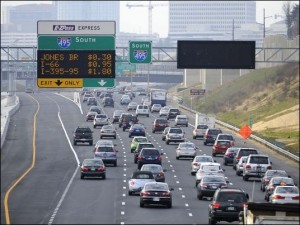
Congestion pricing on the Capital Beltway Express

Congestion pricing on the Capital Beltway Express

=======================
This is the third part of a four-part series.

Part 1        ◊       Part 2
Part 3   
     ◊       Part 4
=======================

by Michael Brown

“Free” freeways aren’t as free as they used to be. Adding new capacity costs billions of dollars and mires communities in unaffordable debt. We can’t continue borrowing, taxing and building like we did a generation ago. In Parts I and II of this series, I outlined a  strategy for using tolls to limit access during periods of peak demand in order to avoid the roughly 30% capacity loss caused by overloading a freeway. Not only will this Freeway Optimization strategy help preserve the environment and reduce the fiscal burden on the next generation, it will provide tangible benefits today!  Here are the Top 10 Benefits of Freeway Optimization.

#10. Use more off-peak capacity

Freeways have a lot more capacity than we think. It’s just that much of the time it isn’t being used. If there are incentives to avoid peak travel, some people will shift some of their trips to off-peak periods — in effect utilizing some of that unused capacity. Continue reading

Who Wants to Be a Billionaire? Embrace Congestion Pricing

competitive_advantage

=======================
This is the second part of a four-part series.

Part 1        ◊       Part 2
Part 3   
     ◊       Part 4
=======================

by Michael Brown

As I contended in my last post, Americans can do mountains of good for sustainability by using free-market pricing tools to solve traffic congestion. In this piece, I will argue that the first state to get serious about Freeway Optimization will enjoy a competitive advantage over all others.

The argument for how your community can become a billionaire has two parts. First, if your neighbors commit to Big Digs but your state solves the problem without construction, then you’ll save those construction costs while others mire themselves in debt. Second, Big Digs temporarily reduce congestion locally while Freeway Optimization solve congestion regionally. The resultant reliability and time savings will translate into financial and societal benefits worth billions of dollars.

Building our way out of congestion

In the 1950s, it was hard to go very far by auto, so transportation planners invented freeways.  Those worked great for 20 years or so, but they motivated people to adopt far-flung lifestyles. It was cheap and easy to add capacity by filling the medians, but then the freeways bogged down again. Next, transportation departments paved the shoulders. Now we have freeways with five to eight lanes each direction, and the latest talk is how to “solve” the worst sections with double-decker freeways! That strategy may work a while, just as previous palliatives did. But the cost of these Big Digs and Double Deckers will be so high that our children will be in debt forever. Has anyone looked at the national debt clock lately? Continue reading

For Sustainability, Convert Freeways to Fastways

tolls

=======================
This is the first part of a four-part series.

Part 1        ◊       Part 2
Part 3   
     ◊       Part 4
=======================


by Michael Brown

By many peoples’ reckoning, faster-running, free-flowing freeways are the enemy of environmental sustainability. But what if I told you of a strategy that would:

  • Result in faster freeways without causing further sprawl?
  • Have miniscule construction and maintenance costs?
  • Double or triple transit ridership, as well as reduce auto trips on arterial streets?
  • Break the cycle of “building our way out of congestion,” saving billions for other worthwhile efforts?
  • Create thousands of permanent jobs, and strengthen the economy by billions?
  • Be a market-driven solution that allowed people options for any given trip?

This article will show how faster freeways are entirely consistent with the goals of greening environment, improving public health, increasing economic productivity, and reducing land consumption.

“Fast and Free” has degraded to “Free but not Fast”

The early decades of the great American freeway experiment enjoyed freeways that were both “fast and free,” as in not tolled.  Everyone loved it, including me.  But recent decades have fallen into “free but not fast.” As traffic and congestion increased, we filled medians with new lanes to get back to fast and free. Then we paved shoulders, and that worked too – for a while. But adding lanes to increase throughput enabled millions of drivers to adopt far-flung lifestyles, creating more demand. Now that the easy solutions have been completed, the next generation of freeway improvements is incredibly expensive. Boston’s “Big Dig” project spent over $24 billion for about 8-miles of underground freeway!  Now virtually every city has engaged in extremely costly freeway construction and many are talking seriously about their own “Big Dig” double-decker freeway projects. Continue reading