The “Chains Are Ruining Our City” Myth

(cross-posted from cnu.org)

I recently read about a blog complaining that New York was “suburbanizing” due to the “disappearance of small stores and restaurants” and their alleged replacement by national chains.

So I thought I would investigate: how rare are local stores, anyhow?  I discovered that even in suburbia, some industries are still dominated by non-chains.  For example, I went to menupages.com and looked at restaurants in Jupiter, Fla. (a sprawling Palm Beach County suburb).  Of the first 50 restaurant listings I saw, only 11 were recognizably chain restaurants – including a couple of local chains with two restaurants in Jupiter.

How does New York compare? I looked at the East Village (the primary subject of the blog in question).  Among the first 50 restaurants listed in Menupages, only 8 were chains- and I recognized all of them as local, rather than national chains.  Moreover, the overall number of East Village restaurants is still overwhelming; Menupages shows 635 restaurants, which means (assuming that my initial sampling is representative) over 500 non-chain restaurants.

Admittedly, some sectors appear to be more heavily dominated by chains, such as pharmacies.  But even so, a Google Maps search revealed half a dozen pharmacies in the East Village (and about that many in Jupiter).

Wild Ride

uber_poolby James A. Bacon

Last week Governor Terry McAuliffe gave the Uber and Lyft ride-sharing services provisional permission to operate in Virginia as long as they comply with minimal standards for hiring drivers. Uber entered the Richmond marketplace around the same time, putting six cars on the road. Rates are competitive with those of local taxicabs but Uber offers the advantage of more timely pick-ups.

While taxicab companies are a political nuisance, using the regulatory apparatus in state after to state to block Uber from the market, the company’s toughest competitor is Lyft, according to a Wall Street Journal piece describing the relationship between the two San Francisco companies as “Tech’s Fiercest Rivalry.” Competition in the business of shared ridership, which includes other start-ups such as Sidecar, is intense. Companies are testing new innovations every day. Some ideas catch on, others fall by the wayside, but the business is evolving rapidly.

The latest permutation, rolled out by the two companies independently on the very same day, is carpooling. Lyft Line and Uber Pool let passengers ride with strangers and split the bill. While the innovation might reduce revenues temporarily, both companies are betting that they can more than offset the loss by growing the size of the shared-rider market.

This is entirely consistent with what I have long predicted: Shared ridership companies will continue to push their innovations “down market” — to less affluent customers — in order to build a larger customer base. Uber started as a company that provided luxury car rides at premium prices. Then it introduced UberX, which provides taxicab-comparable rides. Now it is moving into carpooling. A future next step — and if Uber doesn’t do it, someone else will — will be to introduce a jitney-like van service that provides rides along high-traffic transportation corridors at rates and schedules that are more than competitive with buses. Continue reading

Time for Lean Transit

San Francisco trolley

San Francisco trolley

William Lind suggests applying the principles of “lean urbanism” to rail mass transit, in effect creating a “lean transit.” Writing in the Center for Public Transportation, Lind is a rare conservative who supports mass transit. But he’s also a realist: He acknowledges that excessive government regulation drives up the cost of mass transit, especially rail, and makes it less competitive with streets and roads.

Writes Lind:

[The Americans with Disabilities Act] has proven the single most expensive, least useful mandate ever leveled on public transit.  Serving a small number of disabled people takes a large chunk of transit systems’ budgets, both capital and operating. Many of the special facilities ADA demands of transit systems are seldom if ever used.  If something intended to serve the disabled is frequently used, including by people who are not disabled but nonetheless find it helpful, I’m all for it.  But millions have been spent entirely uselessly. Continue reading

The Chuck and Joe Traveling Municipal Salvation Show

The Joe and Chuck Traveling Municipal Salvation Show

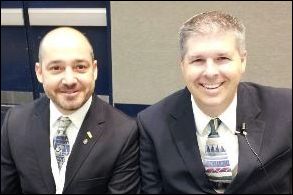
Joe Minicozzi (left) and Chuck Marohn

Joe Minicozzi and Chuck Marohn, principals with Strong Towns and Urban3 respectively, travel the country telling cities, towns and counties how to build better communities while remaining fiscally solvent. I have borrowed heavily from both Chuck and Joe in my writing about land use, transportation and community building, and it’s reassuring to see that as their own thinking evolves, it has moved in concert with mine. Most recently, Chuck has blogged about the paucity of useful information cities have to guide them in make zoning and capital spending decisions. He makes many of the same points I did in my recent post, “How Planners Can Rescue Virginia from the Fiscal Abyss.” Writes Chuck:

Despite running corporations (most cities are “incorporated” municipalities) that have billions of dollars in assets and liabilities and annual cash flows in the tens, and sometimes hundreds, of millions of dollars, few ever ponder some shockingly simple questions.

      • What are our total assets, the value of the tax base that constitutes our community’s wealth?

      Continue reading

      From the Department of Worst Practices: Vanishing Medians

      (cross-posted from cnu.org)

      One thing that can make suburban roads less intolerable for pedestrians is a large median, so that the pedestrian can cross a huge road two or three lanes at a time, instead of having to cross an entire six- or eight-lane highway in one mad dash.

      I recently saw an excellent example of how not to design a median: instead of being parallel with the sidewalk and ending at an intersection, the median ended 20 feet or so south of the intersection, thus forcing pedestrians to choose between using the median (but having to jaywalk to do so) and crossing at the intersection and accompanying traffic light.  Obviously, this sort of design makes the median less useful to pedestrians.

      Mission Accomplished? Not Yet.

      (cross-posted from planetizen.com)

      Over the past few years, I’ve read a lot of articles and blog posts proclaiming that cities are back: that millenials want to drive less and live in cities, and that suburbs as we know them may even be dying.

      I agree that many consumers demand more walkable development, both in cities and in suburbs. But even in relatively prosperous, safe cities, the political obstacles to meeting this demand are enormous. To name a few:

      *Zoning. The increased desirability of urban life means that in many central cities and walkable inner suburbs, there is simply not enough housing to go around. But zoning law is generally designed to limit density (i.e. neighborhood population), which means that if a landowner wants to build new housing, it will usually have to apply to the city for a rezoning. However, rezonings tend to be politically difficult, because people who live in a neighborhood tend to like it the way it is- otherwise they would be living somewhere else. So as long as zoning is designed to limit density and accommodate present residents at the expense of future residents, urban cores will never be able to accommodate consumer demand. (I note that this is equally true for already built-out suburbs- so in many regions, the only easy place to build new housing is at the fringe of suburbia).

      *Transit. Many Americans may wish they could drive less- but if their residences and jobs aren’t in places with good public transit, they may never get the chance. The highway lobby of road-builders and suburban developers has plenty of money to give to politicians, while there isn’t really much of a transit lobby (beyond bureaucrats who can’t give campaign contributions, and environmentalists who are more interested in other issues). So whenever economic growth flattens, public transit is one of the first things to be cut back; after the 2008-10 financial crisis, nearly every American city areduced transit service. (To see a few examples, just google ‘transit cutbacks.’) And even in relatively good times, transit is politically vulnerable because, unlike highways, transit often lacks a reliable source of funding.  For example,Seattle plans to eliminate 28 bus routes this fall to make up for weak sales tax revenues, and to eliminate even more routes in 2015.

      *Street design. Many commercial streets are designed for high-speed traffic– for example, the eight-lane street near my former apartment in Jacksonville, Florida. Because a pedestrian is more likely to be killed by a car going 40 mph than by one going 20 mph, such streets are not particularly safe for pedestrians. In theory, these streets could be retrofitted. For example, a city could effectively slow traffic by widening sidewalks and medians, thus reducing the number of traffic lanes. However, these changes would cost money and be politically controversial.

      Continue reading

      Union Presbyterian and the Parable of the Buried Talent

      union_presby James A. Bacon

      Union Presbyterian Seminary settled into its current location off Brook Road in northside Richmond in 1898, when industrialist Lewis Ginter donated land to the educational institution from the streetcar suburb he was developing. The seminary has been a good neighbor ever since, leaving a large tract of the land vacant as a park open to the public. Now the seminary needs some of that land to build new housing for seminary students and their families in place of antiquated housing that it provides at present.

      The neighbors are up in arms. Many people who live nearby, it appears, are worried about the loss of open space, traffic and the impact on property values, according to the Times-Dispatch. A “crowd of hundreds” packed a meeting in the seminary auditorium when the institution unveiled a proposal to build 349 housing units. At one point, some in the crowd erupted in loud boos.

      I find this extraordinary. Who do these people think they are? It’s one thing if the City of Richmond decided to sell a public park to a developer. It’s quite another when a private institution, which has been a foundation of the community for more than a century, wants to sell the land in order to preserve the viability of that institution. The seminary owns the land — not the neighbors! Continue reading