
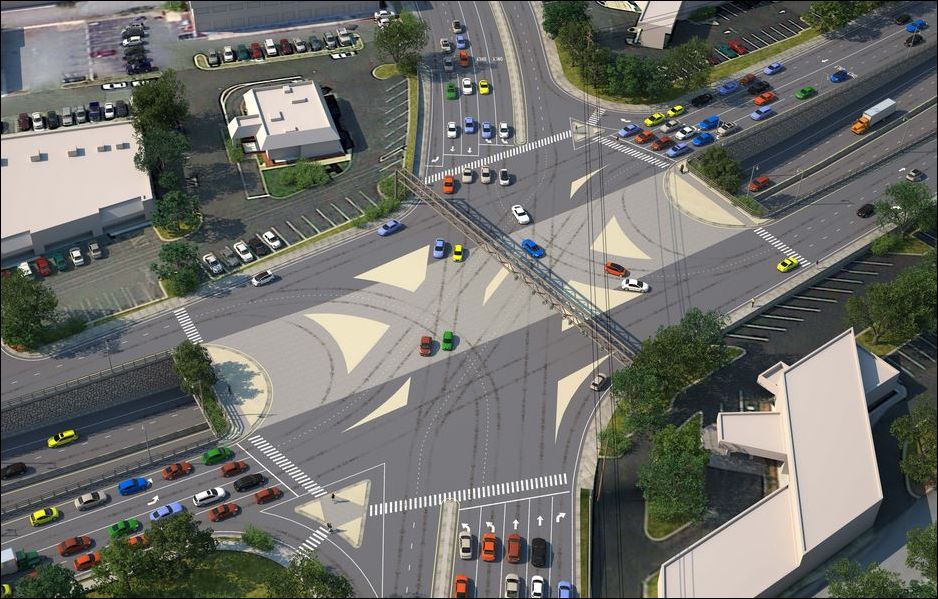
VDOT rendering of proposed Rio Road interchange
The battle over the Charlottesville Bypass may be over, but the battle over what to do instead is heating up. After pulling the plug on the super-controversial, $240 million bypass early last year, the McAuliffe administration dusted off a plan to upgrade the U.S. 29 commercial corridor north of Charlottesville by investing in a series of spot improvements, parallel roads and grade-separated interchanges. Now the community is up in arms over the proposal to put an $81 million grade-separated interchange at the intersection with Rio Road.
Last week, “hundreds” of citizens attended an open house meeting to voice their opposition to the interchange, which would eliminate a major bottleneck along the clogged commercial corridor, which also serves as a U.S. highway. (See WVIR’s coverage from last week.)
The most steadfast opposition comes from businesses located near the proposed interchange, whose access to major thoroughfares would be diminished by the new configuration of the Rio Road/U.S. 29 intersection. The businesses have been joined by citizens who worry that construction will cause detours and other inconveniences.
Clearly, there are no perfect, painless solutions. The concerns of those who will be negatively impacted by the project are legitimate. The question is whether those concerns should outweigh the general good stemming from the proposed package of improvements. U.S. 29 is, after all, a U.S. highway, whose primary function is to provide connectivity between cities, not to serve as a local main street.
From what I can glean from local media accounts, pieces of the $200 million corridor improvement package are uncontroversial — a $54 million extension of Berkmar Drive parallel to U.S. 29 and a $51 million widening of U.S. 29 between Hollymeade Town center and Polo Grounds Road. Both projects offer tangible benefits and should go forward.
Here’s the question: Could the $81 million allotted to the Rio Road interchange be invested usefully in other improvements? If so, would the economic return on investment — as measured by congestion mitigated and traffic accidents reduced — come close to the benefits of the Rio Road interchange? If so, perhaps the Virginia Department of Transportation should consider reallocating the funds to other projects. However, if the Rio Road project offers a demonstrably superior return on investment, then VDOT officials should not be dissuaded by the public opposition.
I don’t know the numbers, so I can’t make a judgment. But I do have faith in Philip Shucet, the former VDOT commissioner drafted by the McAuliffe administration to devise a reasonable solution to an intractable problem. If opponents want to make the case that the interchange shouldn’t be built, they should demonstrate how $81 million could be invested to greater effect elsewhere.
– JAB