Housing Affordability for Millennials

millennial_affordability

by James A. Bacon

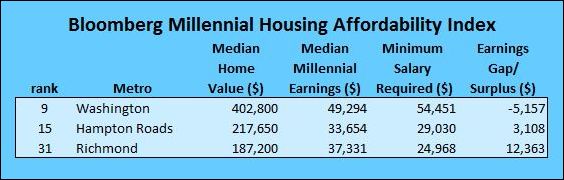
As the global epicenter of technology innovation, Silicon Valley creates a massive amount of wealth — but the housing supply, hemmed in by geography and zoning regulations, is incredibly restricted. The resulting housing crunch is so severe that Millennials are hard pressed to live there. The median income for Millennials in the San Jose metropolitan area is the highest of any of the 50 largest metropolitan regions in the country — $53,000. But the median home value of $925,000 requires an income of $133,000 to pay a mortgage (not to mention a 20% down payment). The earnings gap, according to a new housing index published by Bloomberg, is $80,000!

If Millennials are the life-blood of creativity and innovation for metropolitan economies, the cost of housing could be Silicon Valley’s Achilles heel. The housing supply is so out of whack, as it is in neighboring San Francisco, that, as much as Millennials are drawn to the excitement and glamour of working at companies like Apple and Google, they simply can’t afford it unless they’re willing to live five or six to an apartment.

According to Bloomberg, housing is unaffordable for thirteen of the 50 largest U.S. metros. The biggest affordability gaps are on the West Coast, but Boston, Washington and New York are on the list as well. Young people are willing to tolerate sub-par living conditions for a while, especially while they are single. One of my daughters shared a tiny rental apartment with four roommates while living in Jackson,Wyoming, which, due to its awesomeness, has similar affordability issues. But she rented her own place when she moved back to Richmond. And now that she is getting married, she and her fiance have no trouble affording a comfortable starter home in a nice neighborhood near the University of Richmond. When educated Millennials are ready to get married and start families, the idea of sharing a house with four or five roommates is not a serious option. Continue reading

Airbnb and affordable housing

by Michael Lewyn

Over the past few years, the growth of Airbnb.com has made it much easier for people to rent out rooms in their houses and apartments. Before Airbnb, a traveler who wanted an alternative to hotels (which tend to be (a) quite expensive or (b) located in desolate-looking suburban arterials), would most easily be able to find a room through a temporary listing on Craigslist. However, these travelers had no way of knowing anything about their hosts, and would-be hosts had no way of knowing anything about their renters. By contrast, Airbnb, by providing a forum for hosts to review guests and vice versa, does allow some screening to take place.*

However, Airbnb has become politically controversial in high-priced, regulation-obsessed cities like Los Angeles and New York. Hotels and hotel unions quite understandably see Airbnb as competition in the short-term lodging industry, and wish to regulate it intensively (if not to destroy it). One common anti-Airbnb argument** is that Airbnb, by making short-term lodging more affordable, actually reduces the supply of traditional apartments—that is, apartments leased for a month or more at a time. The argument runs as follows: units that are on Airbnb for a few days at a time would, in the absence of Airbnb, be rented out as traditional apartments. Thus, Airbnb reduces the housing supply and raises rents.

This argument rests on an essentially unprovable claim: that Airbnb units would otherwise be rented out as traditional apartments. More importantly, the argument proves too much. If Airbnb hosts reduce the supply of apartments by not using their houses and spare rooms as traditional apartments, why isn’t this equally true of hotels who are not using their rooms as apartments, or homeowners who are not renting out every spare room? And if homeowners and hotels are reducing the rental housing supply, why shoudn’t they be forced to rent out their units as traditional apartments? Continue reading

Cars Are Expensive (And Other Things The Census Taught Me)

by Michael Lewyn

I just learned that national tables from the 2013 American Household Survey (AHS) are public. These tables contained a variety of information that I thought was at least mildly interesting. To name a few items:

  • Cars are really expensive—even when gas is cheap. The average household spent $800 per month on car-related costs. (Table S-04C). Only $200 of this sum was on gasoline—which means that even if gas was free, cars would still cost $600 per month. About half of household spending was for car payments, 15 percent was for insurance, and the rest was split between parking and maintenance.
  • Single family housing dominates the landscape. Sixty-four percent of all occupied housing units (and 62 percent of units built over the last several years) are detached single-family houses (Table C-01). This is especially true for owner-occupied units: even in central cities, 79 percent of owner-occupied units are detached houses (Table C-01-00).
  • Most single-family housing is not dense enough to support public transit. The average owner-occupied housing unit takes up 0.3 acres, as does the average housing unit built in the last several years. Thus, most blocks probably contain about three or four units per acre; basic bus service requires at least seven units per acre to be economically viable. (Table C-02). Continue reading

Suburban Multifamily: Smart Growth or Smart Sprawl?

In a recent article in the Columbia Journal of Environmental Law, law student Paige Pavone criticizes suburban apartments and condominiums as “green sprawl” because they “merely add density to suburban sprawl and exacerbate the very problems smart growth seeks to correct.” She explains that without public infrastructure to support walking and biking, these developments merely entice more people into car-dependent suburbia, and therefore should not be entitled to density bonuses and other incentives that a state might use to encourage smart growth. In particular, she claims that such “High-Density Islands” are cut off from “communities, local governments, nature, public transportation, and sidewalks.”

Is this critique fair? Somewhat.

Pavone examined a variety of suburban multifamily developments, but focuses on Reading Woods, in Reading, Massachusetts, a suburb of Boston. She claims that Reading Woods residents “cannot walk to the public library, a bank, or a grocery store” and would have to cross I-95 to reach a chain restaurant. So I decided to look at Reading Woods on Google Street View and see how horrible it is.

First of all, I looked for sidewalks. The main street serving Reading Woods is Jacob Way. Jacob Way generally has sidewalks, as does Augustus Court (the main street serving the part of Reading Woods further away from South). So it seems to me that a resident of Reading Woods can use sidewalks for most visits to South Street and other neighborhood streets. To reach Main Street (the neighborhood’s main commercial street) you must walk briefly on South Street, which also has a sidewalk (though it only serves one side of the street, and looks pretty narrow). Continue reading

Supply and Demand Denialism

Progressives often argue that conservatives are anti-science because many conservatives deny the reality and seriousness of climate change, and some religious conservatives reject the theory of evolution.

But some progressives are as skeptical of the conventional wisdom of economics as conservatives are of evolutionary biology or climate science. In particular, one basic tenet of economics is the law of supply and demand: if you raise the supply of X enough, the prices go down. If you lower the supply, the prices go up.

But some progressives seem to believe that this law does not apply to housing. For example, an article some months ago in the New York Times (probably the most leftist among major U.S. news sources) quoted an official at an affordable housing advocacy group as follows: “Increasing the supply is not going to increase the number of affordable units; that is a complete and utter fallacy.” The Times then supplied absolutely no rebuttal or response to this point of view, implicitly treating it as gospel.* Similarly, numerous leftist housing advocates in San Francisco are supply-and-demand denialists.

In reality, cities where lots of housing gets built tend to have lower housing prices than cities where it is hard to build. (See for example the “Home Prices and New Construction” chart in this article). So why is denialism so widespread? Denialists make several major arguments. Continue reading

High-Rises and Streetlife

One common argument against tall residential buildings is that high-rises reduce a neighborhood’s livability by reducing its streetlife. For example, a few months ago I read a blog post claiming that “people who live in the high floors of a high-rise are less likely to leave their homes.” I have lived in elevator buildings for the past couple of years, and can verify from personal experience that high-rise residents leave their homes for the same reasons that homeowners do: to go to work, to get groceries, and to perform all the other little functions that are necessary for a normal life. To be sure, a few people do work at home and get groceries delivered, but the overwhelming majority of people need to leave their homes on a regular basis, whether they live in a single-family house, a small multifamily building, or a high-rise.

Moreover, this argument doesn’t seem to be supported by what I have actually seen with my own eyes. New York City neighborhoods like Times Square and the Upper West Side certainly have plenty of elevator buildings, but these places have far more street life than many low-density suburbs or quiet rowhouse neighborhoods. Why? Because even if a few shut-ins are less likely to go outside than in a low-rise neighborhood, any negative results of this phenomenon are outweighed by the positive effects of density. So many people live, work and play near Times Square that its streets are far busier than those of a less dense rowhouse area such as Washington’s Capitol Hill (or even of higher-density rowhouse areas such as New York’s West Village). By contrast, my current neighborhood in Kansas City is not particularly lively—but my block (dominated by a 10-story building) seems no more lifeless than the street a block away dominated by three-story buildings, or the single-family home blocks west of my building.

In fact, high-rises may sometimes increase street life by increasing the popularity of city life and thereby increasing urban density. The “streetlife” argument against urban high-rises assumes that people who don’t live in high-rises would be happy to live in low-rise apartment buildings. In other words, it assumes that consumer preferences are: (1) highrises, (2) lowrises, and (3) suburbia. But some consumers may prefer (1) highrises, (2) suburbia, (3) lowrises, because they are only willing to live in the city if they can get the amenities that come with (1) for example, doormen to enhance security (which are more common in high-rises than in smaller buildings) or elevators to reduce stress on aging knees and hips. In turn, these consumers are more likely to walk on city streets than if they lived in suburbia, thus increasing urban streetlife. And if they are business owners or executives, they are more likely to place their businesses in the city than if they lived in suburbia, thus causing even more people to walk on city streets. Continue reading

Learning From London’s Comeback

A recent post on Citymetric.com suggests that after losing population for decades, London will soon reach its pre-World War II peak of 8.6 million people. London last achieved this population level in 1939, and lost nearly two million people after World War II, bottoming out at 6.7 million in 1988. Can we learn anything from this? Why, yes we can. To name a few things:

1.  One common pro-sprawl argument has always been that sprawl exists in Europe and is thus inevitable. But the recent growth of London reminds us that in Europe as well as the U.S., cities can rebuild and become more desirable again.

2.  But this growth comes with a cost. London’s rebirth has been accompanied by exploding housing costs, perhaps because more people creates more demand for housing. (Or to put the matter another way: it does not seem to be the case that foreign rich people buying condos are the primary cause of high housing costs).

3.  The common anti-market solution to high housing costs is to limit construction, on the theory that new construction creates more demand. But London seems to have more or less tried this solution; according to the Citymetric article, “Since 1992, when London started to grow again, housebuilding has been barely a quarter of the 1930s rate.”

(Cross-posted from cnu.org)