Henrico Still Building Schlock

west_broad_marketplace

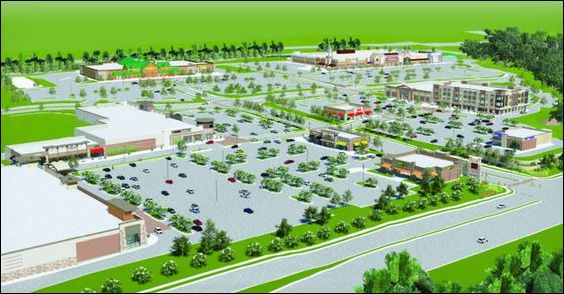
Artist’s rendering of West Broad Marketplace

by James A. Bacon

The developer of the West Broad Marketplace, which will bring a Wegmans grocery store and outdoor gear retailer Cabela’s to western Henrico County, promises Richmonders a shopping treat that “I don’t think you’ve experienced before.” That may be true. Unfortunately, Jack Waghorn, president of Vienna-based NVRetail, will replicate the experience of driving through traffic-clogged thoroughfares and parking in vast, open-air parking lots that Richmonders will find all too familiar.

The Henrico Wegman’s is scheduled to open in mid-2016, with a counterpart in Chesterfield County opening around the same time. Henrico County officials were on hand for a ground-breaking yesterday. No doubt county leaders are pleased that Henrico citizens will have access to the popular, high-end grocery store, not to mention the tax revenues generated by the store and the 550 to 600 full- and part-time jobs created.

As can be seen in the artist’s rendering above, however, West Broad Marketplace will perpetuate the dysfunctional low-density land use patterns of post World War II sprawl that has already made the Short Pump area a congested hell hole. I avoid going there if at all possible, and others do, too, although sometimes they have no choice because that’s where the region’s upscale stores are concentrated. Driving in and around Short Pump is always a dismal experience. When I visited one time last month to do some Christmas shopping, traffic was so gridlocked that cars were backed up onto I-64, causing a slowdown on the Interstate. That may sound banal to Northern Virginians but it’s unprecedented for the Richmond region.

The traffic congestion in Short Pump is the foreseeable consequence of zoning for mile after mile of single-use shopping-center development around the intersection of Interstates 64 and 295. Planners allowed for no other connectivity: shopping centers don’t connect with each other, much less with nearby residential neighborhoods. There are no side streets to divert traffic. All cars pile onto West Broad Street. The area is utterly unwalkable — visitors have no choice but to drive their cars from destination to destination, adding to the congestion — and there is no mass transit.

The county will never have enough money to build its way out of this mess. Indeed, the problem is so bad that congestion is radiating out from the Short Pump area to places, like the Innsbrook commercial park, where traffic conditions once were tolerable. At some point, I predict, conditions will become so atrocious that — Wegmans or no Wegmans — affluent households, corporate offices and high-end retailers will seek somewhere else in the Richmond region to locate. When the 30-year amortization of all those commercial buildings expires, retailers will pack up and follow. Once the newness wears off, there’s nothing to keep anyone there.

(Cross posted from Bacon’s Rebellion.)
Atlas Sprawled

Libertarians dream of a laissez-faire capitalist nation, one with minimal government regulation and lots of entrepreneurs. There are many reasons why this goal is difficult to achieve; however, one reason is inherent in capitalism itself. As soon as a business gets large enough to have some spare cash, it might use that spare cash to obtain favors from government.

Of course, I am not the first person to discover this. For example, the plot of Ayn Rand’s Atlas Shrugged focuses less on the evils of the welfare state than on the efforts of a well-connected steel company (Orren Boyle’s Associated Steel) to use government to squash competition from Rearden Steel.

Peter Norton’s book Fighting Traffic shows how automobile-oriented street rules are at least partially a result of similar special interest manipulation. In the early 1920s, auto sales suffered because of urban traffic congestion and bad public relations related to the death toll from automobiles running over pedestrians. The auto industry and related groups such as road-builders and tire companies (or as Norton calls these groups, “motordom”) responded in three ways.

First, motordom hijacked the safety issue by blaming the victim. Car companies claimed that pedestrian deaths were the result of something called “jaywalking” (i.e., pedestrians using the streets as they had always used them, rather than waiting for automobile traffic to take its turn). In addition to financing a public relations campaign against jaywalking, motordom encouraged cities to enact anti-jaywalking ordinances.

Second, motordom lobbied government to reconstruct American streets in ways that favored fast car traffic, and even created its own “experts” to lobby city officials. A Los Angeles auto club hired Miller McClintock, a Harvard graduate student, as a consultant. Before being hired by the car lobby, McClintock wrote that widening streets would merely attract more traffic. After going on the motordom payroll, McClintock endorsed wider streets and fining jaywalkers. Car companies then hired McClintock to establish a foundation that taught engineers how to design cities for cars. The motordom-subsidized engineers then went to work in cities throughout the country, creating the sort of streets that infest cities today: wide streets where traffic flows at speeds fatal to pedestrians. Continue reading

Learning From London’s Comeback

A recent post on Citymetric.com suggests that after losing population for decades, London will soon reach its pre-World War II peak of 8.6 million people. London last achieved this population level in 1939, and lost nearly two million people after World War II, bottoming out at 6.7 million in 1988. Can we learn anything from this? Why, yes we can. To name a few things:

1.  One common pro-sprawl argument has always been that sprawl exists in Europe and is thus inevitable. But the recent growth of London reminds us that in Europe as well as the U.S., cities can rebuild and become more desirable again.

2.  But this growth comes with a cost. London’s rebirth has been accompanied by exploding housing costs, perhaps because more people creates more demand for housing. (Or to put the matter another way: it does not seem to be the case that foreign rich people buying condos are the primary cause of high housing costs).

3.  The common anti-market solution to high housing costs is to limit construction, on the theory that new construction creates more demand. But London seems to have more or less tried this solution; according to the Citymetric article, “Since 1992, when London started to grow again, housebuilding has been barely a quarter of the 1930s rate.”

(Cross-posted from cnu.org)

Rents Can Go Down, Even In High-Cost Markets

One common argument often used to frustrate infill development is that in high-cost markets, the law of supply and demand simply does not apply, and that new housing will somehow fail to increase rents.  But a recent Washington Post news story shows otherwise: in Washington, DC (undoubtedly a high-cost market) a recent construction boom has increased apartment inventory and caused rents to go down. 

(Cross-posted from cnu.org)

Highway Robbery

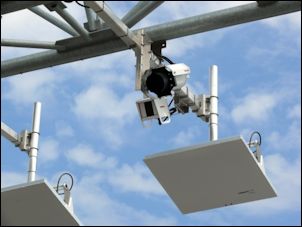
express_lane_camerasby James A. Bacon

I’ve always considered Transurban, operator of the express lanes on the Interstate 495 and Interstate 95, to be a pretty savvy outfit. The company may have over-estimated traffic demand for its express lanes when deciding back in the mid-2000s to build the Northern Virginia toll operations, but corporate executives seemed highly professional in the way they designed, constructed, promoted and managed the business.

At least, they did until now…  Fox News reports that Transurban has filed 26,000 cases against I-495 express lane users for non-payment. It’s one thing to dun people for $10, $20 or even $100. But Transurban is slapping some drivers with thousands of dollars in fees and fines for a single offense. Reports Fox News:

Luis Viera used to take the Express Lanes from Clinton, Md., to his job in Tysons Corner. His E-ZPass was automatically deducting tolls from his credit card. Then one day, Luis was slapped with a summons to Fairfax County Court. Transurban was suing him for $4,500 in fees and fines for exactly $7.70 in missed tolls.

Luis went to court the first time without a lawyer. “I was nervous,” Luis said. “I didn’t get any sleep. I wasn’t eating. It was a bad week leading up to it.”

In the courtroom, a woman who said she represented Transurban approached Luis before the judge entered. She said the company would settle for $2,488.

“How does $10 turn into $2,000?”

Darn good question. How does $10 turn into $2,000? Transurban responded as follows: “Although less than 0.1% of all 495 Express Lane trips end up in court, we continue to do all we can to minimize any traveler going to court, this is why we have the First-Time Forgiveness program which has helped nearly 800 travelers. Additionally, we do not profit from the fines or penalties. As defined by Virginia law, any and all revenue collected from toll fines and penalties are cost recovery only to fund the enforcement program and we currently we do not even recover costs.” Continue reading