Show us your Stroad! Crowdsourcing the Stroads of America

by Gracen Johnson

Friends of Strong Towns, we have a request for you. We are gathering footage of the many stroads outside our front doors.

As a refresher,

Urban Dictionary definition of Stroad

For example, here is a trip down a massively stroad-y stroad.

  Continue reading

Podcast Show 179: Ben Hamilton-Baillie

ben-hamilton-baillieby Charles Marohn

Ben Hamilton-Baillie, street designer and shared space advocate, joins the podcast from CNU 22 in Buffalo to talk about shared space, his memories of Hans Monderman and hopes for American transportation. This is a very special podcast you are not going to want to miss.

You can follow Ben Hamilton-Baillie on Twitter, see more of his work on his firm’s website and watch the video, Poyton Regenerated, that was discussed in the podcast.

Show 179: Ben Hamilton-Baillie

(Cross posted from Strong Towns)

Coming up: Car-Lite Burbs

David Grannis

David Grannis

A California developer is teaming with Daimler AG to bring buses, shuttles and ride sharing to an Orange County community — with no government subsidies.

by James A. Bacon

Rancho Mission Viejo south of Los Angeles is developing a 23,000-acre planned development with all the amenities one would expect from an affluent California community: parks, hiking/biking trails, yoga and fitness studios, community gardens and a hacienda-style clubhouse. But the biggest selling proposition may be the potential to slash living expenses by thousands of dollars yearly by living a car-lite lifestyle.

Working in partnership with Daimler AG’s Business Innovation group, Rancho Mission Viejo will introduce to its Ladera Ranch community in July a service that provides residents access to scooters, cars, circulator buses, destination shuttles, Car2Share carpooling and other bundled transportation services, all accessible through a smartphone app. Those services will be provided as well to the neighboring Sendero project, with an expected 14,000 new residents and workers in five million square feet of commercial space, now under development.

David Grannis, a partner with pointC Partners, who is leading the initiative for the developer, says the goal is to cut the cost of mobility in half from the $14,000 or more it takes to own and operate an automobile today in south Orange County, California. Households in the target demographic typically own two or three cars. “I’m not telling you to get out of your car,” he told attendees of the 2014 LOCUS conference in Washington, D.C., earlier this month. “I’m telling you to get out of your third car.” Continue reading

Converted Garage Becomes Income

by Charles Marohn

Strong Towns contributor Johnny Sanphillippo films stories about urbanism, adaptation, and resilience for granolashotgun.com. His videos are edited by Kirsten Dirksen of Faircompanies.com.

(Cross posted from Strong Towns)

Historic Preservation

brewery

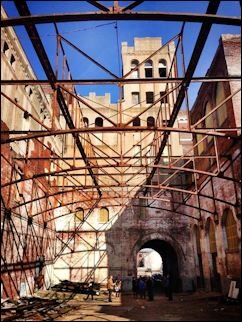
The historic Tennessee Brewery in Memphis.

by Charles Marohn

.I’m agnostic when it comes to historic preservation. I’m going to start with that because, for some people, historic preservation is a near religious belief. For others, it matters not at all. I don’t see this issue so black and white, which often puts me in the dangerous and confusing middle, a place where insight intersects with reason to form thoughts that are, unfortunately, often incoherent, if not totally offensive, to those that care about this issue far more than I do.

Let’s start with two observations that I find to be quite obvious. First, the United States has built very little that is either historic or worth saving. This becomes all the more true the further west one travels. Not only are we a young country – at least the western building-style portion – and thus have not had a lot of opportunity to build things that a laymen today would consider “historic” — but most of what we built that would potentially be historic was built out of non-enduring materials, generally wood. It is tough to “preserve” something quite prone to deterioration.

My second observation is a reaction to the first: because we have so few historic buildings, it should be a priority to maintain and restore those we have. I don’t believe this out of a sense of sentimentality – although I don’t fault people who do – but from an understanding of what these buildings mean to the health of a community. A city without historic buildings is like a family with no parents or grandparents; the children aren’t doomed, but there is a lot there to overcome. Continue reading

More Evidence of Virginia’s Urban Renaissance

urban_growth

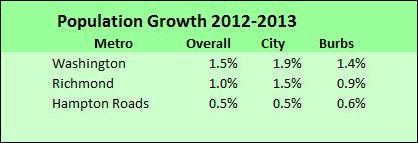
Urban geographer Richard Florida has published a map comparing population growth of “primary cities” (core jurisdictions) with growth in outlying localities in the United States’ 51 largest metropolitan regions. The map at left, extracted from Florida’s map published in CityLab, hones in on the metropolitan regions in the northeastern quadrant of the country. The Washington and Richmond metros were among the 19 where primary cities grew faster than their suburbs between 2012 and 2013. (To see the national map, click here.)

pop_details

While Hampton Roads did not number among the metros showing stronger city growth, city growth fall short of suburban growth by a narrow margin. Without doubt, 2013 was the year of the city for Virginia’s major metros.

 — JAB

(Cross posted from Bacon’s Rebellion)

Does Low Congestion Mean Urban Failure?

low_congestionby Michael Lewyn

Wendell Cox just wrote an essay trying to correlate density and congestion*, asserting that density means congestion and congestion is really, really bad (or in his words, “less traffic congestion benefits a metropolitan area’s competitiveness.”)

So logically, the high-congestion cities should be declining, and the low-congestion places should be attracting Americans at a rapid rate. Right? Wrong.

In fact, the lowest-congestion cities tend to be a very mixed bag, while the high-congestion cities are doing relatively well. Cox lists ten high-congestion regions: Los Angeles, Houston, Austin, San Francisco, New York, Seattle, San Jose, Washington, Boston, and Portland. In all ten, the central city of the relevant region gained population between 2000 and 2010. These cities tend to be larger, relatively wealthy, high-cost cities, cities where keeping housing affordable is a bigger problem than demolition of worthless vacant lots.

And in all but two of these ten regions (all excepting Boston and Washington) the central city is more populous than in 1970. In these regions, there’s enough growth for city and suburb alike. Although some of these regions experienced regional population growth of 0-10 percent, not one of them shrunk, and two (Houston and Austin) grew by over 20 percent. Continue reading