

America, we are told, is involved in a “love affair with the car.” If so, then this love affair has created a strange kind of lovechild, one that has had major implications for the way we go about our daily lives and build our communities. Its name is parking.
But that should really come as no surprise. Land use policies have elevated the status of the car by separating residences from offices and commercial centers. This separation leads to a greater need to drive from one place to another. Connecting these separated areas requires billions of dollars of investment, primarily into expanding road networks. When drivers travel through this network, and finally arrive at their location – whether it’s home or work or a store – they’ll need a place to park.
Building and maintaining this network is expensive, yet how aware are we of parking’s real costs? Do we fully understand how parking regulations influence the land use and development market?
Initially, local parking requirements made sense: they were responding to the need to keep traffic and parking problems from clogging up local thoroughfares. It was a much-needed step to create order in a world that was embracing the car and putting tremendous resources behind a soon-to-be-world-renowned Interstate Highway System.
 But today’s reality is that parking affects the land use and development market in ways that were not originally anticipated. More communities are growing concerned as they begin to see how excessive parking requirements stand in the way of bringing infill and mixed use projects to life. Due to its expense, design considerations and land requirements, today’s parking requirements present a burden to the development community, stifling their ability to create walkable, mixed-use development.
In terms of design, there’s a hurdle to overcome. Architects and developers are essentially required to design parking lots first, and incorporate buildings, public places, parks, workplaces, and communities after. Parking lots are designed principally for the car, often without considering the pedestrians that must also navigate these spaces, even if it’s only to get to their car. They can end up being sterile, unattractive places, which reflects many people’s experience and understanding of parking lots.
There are also expenses in terms of overall development costs. Local codes almost always require a minimum number of parking spaces for any kind of development, even if many of these spaces aren’t necessary, or will go unused. This drives up project costs and borrows from finances that could otherwise be used on design improvements and other features that would improve walkability and diminish reliance on driving.
These issues result in developments that consume large amounts of land, often underutilized, that could be developed more efficiently – and has left most of America’s cities with greatly expanded urban footprints.
Is all of this really worth it? To answer this, let’s take a closer look at what parking really costs a development, and how important parking has become in today’s society.

:: PARKING UP THE WRONG TREE ::
Car culture exploded between 1950 through 1970, with the percentage of drivers rising from about 40 percent to about 54 percent. Only ten years later, in 1980, about 64 percent of America’s population counted as a driver (according to the Office of Highway Policy Information, FHWA).
But driving percentages have flattened out in the past 20 years and more. In fact, there’s evidence that car use is on the decline, especially among young people. In 1983, eight in 10 Americans age 17-19 had a driver’s license. Today, it’s six in 10. An entire generation of Americans seem to be moving away from the car, or at the very least, depending on it less and less.
Moreover, walkable neighborhoods, where cars are not a necessity, are currently selling at a premium. The National Association of Realtors 2013 preference survey showed that Americans prefer to live in walkable communities. So, in simple economic terms, it’s clear that demand is up for walkability, and demand is down for drivability. While Americans are voicing their preference for walkable neighborhoods, supply for this type of neighborhood, studies show, hasn’t quite caught up to demand. Local governments prolong this deficit by continuing to require developments with excessively large parking lots, which complicates developers’ ability to respond to consumer trends.
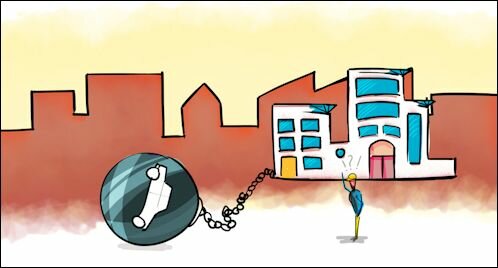 For many developers, the hurdles created by parking are often too big to clear. Great community and building designs – the kinds that look great, work great, foster a sense of neighborhood and help build a strong local economy – often remain on the drawing board because they simply cannot solve the parking dilemma. Maybe they can’t design the building they want due to the constrained space left for a building after designing for parking, maybe the cost of accommodating parking would simply be too high. Even with everything else in place, parking is often the one item that burdens an otherwise beneficial community development.
There are two main reasons why.
One is cost. For surface parking, construction runs about $1,500 to $2,000 per space. Make it about $20,000 per space in parking structures or underground parking. Add in land cost and maintenance costs, and you’re starting to get the picture. In some areas, according to Nelson-Nygaard, a leading transportation planning firm, for a typical multifamily development with two spaces per unit, parking can account for more than 20 percent of the total development costs. Reducing parking provision to one space per unit can reduce these costs to 11 percent.
The other is land. Todd Litman prepared a revealing study showing that the typical surface parking space is 8-10 feet wide and 18-20 feet deep, for a total of 144 to 200 square feet per space. Off-street parking requires about twice this amount to accommodate driveways and access lanes. This means that an additional 144 to 300 square feet of land, per space, must be calculated into the land costs to accommodate parking. Parking regulations specify that a typical commercial development generally requires 2.5 parking spots per 1,000 square feet of commercial area. Housing requires one to two spots per unit. In many places, more than fifty percent of a commercial development’s space is designated for parking.
In downtowns and town centers, where land is at a premium, this problem is particularly pronounced. Not only are land costs higher in downtown areas, but there are greater site constraints due to adjacent buildings. Since parking requirements ask that large areas of valuable land be designated as parking, infill development and compact development can be thwarted.
Developers, then, have a strong incentive to seek land on the outer edges of town where cheaper, more abundant land can be found. Choosing to build on the urban fringe can more easily accommodate large swaths of land for parking spaces and the parcels themselves are more likely to be easy to access and affordable. This activity has the paradoxical side effect of increasing parking demand. As Donald Shoup relates in his book, “The High Cost of Free Parking,” free parking leads to increased driving because the expectation is that there will be free parking spaces available when the driver arrives at her destination. Shoup goes on to show how this cyclical process leads to costs in the hundreds of billions, annually, spent on parking. This cost isn’t borne by the driver, who parks free for 99 percent of car trips, but by the public at large.
While we recognize the challenge attendant with determining the “right” amount of parking with every development, we also recognize that every un-used parking space represents a lost opportunity of a development that could have been.
What does all this mean?
Shoup sums up the issue this way: “Minimum parking requirements increase the supply and reduce the price – but not the cost – of parking. They bundle the cost of parking spaces into the cost of development, and thereby increase the prices of all the goods and services sold at the sites that offer free parking”.
In short: Minimum parking requirements result in a market that churns out large lots and simple development. Were it not for excessive parking requirements, developers would be freer to design innovative projects and have a greater opportunity to create high-value projects in town centers. Were it not for excessive parking, developers could better respond to changing demographic and economic conditions.
It’s clear that communities need parking. But it’s time to re-think how parking is accommodated in new developments to better meet the needs of communities, developers and users.
:: WALK, SHOP, (DEREGULATE) AND BE MERRY ::

The good news is that many communities now recognize the impact of restrictive parking standards on quality development and are beginning to rethink their parking mandates to level the land use and development playing fields. This new trend is occurring across the country. A recent project in Cincinnati, for example, eliminated city center parking requirements. This bold move may not be the end of parking problems in Cincinnati, and it may not be the right approach for every town and city, but it sheds a positive light on what the future of parking may look like for new development projects.
Communities interested in encouraging more walkable, mixed-use development should consider the following strategies:
Charging for Parking
Charging for parking includes a wide variety of strategies. These can include differential parking pricing strategies to prioritize some types of trips over others (shoppers vs. commuters), residential parking pricing (commonly referred to as unbundled parking) and parking benefit districts which allow revenue from meters and residential permits to be returned to local neighborhoods. Unbundled parking can separate the price for rent from the parking cost (e.g. an apartment for $800 per month, plus $100 per month for each parking space) to reduce demand for parking in residential developments. In Austin, Texas a parking benefit district was created in a pilot program in the West Campus area of the University of Texas to dedicate a portion of the revenue raised from a metered area to street and sidewalk improvements within a defined boundary.
Parking Maximums and Area-wide Parking Caps
Parking maximums restrict the total number of parking spaces that can be constructed at a particular development site. For example, the Portland City Code has implemented parking maximums to complement parking minimums in areas outside the Central City district. Glenwood Springs, Colo. uses its downtown General Improvement District (GID) to limit parking for new downtown development, stipulating that any new development project in the GID is not required to provide parking and that it will be provided by city parking lots. In nearby Grand Junction, Colo. a greater downtown overlay district is used to allow parking reductions for development.
Shared Parking
A particularly effective approach for managing parking in a mixed-use development is shared parking. Shared parking allows one parking spot to be used for multiple uses (e.g. a residence, office and restaurant use the same parking spot at different times of the day). For example, Mt. Pleasant, Mont. outlines shared parking in their Downtown Parking Study.
Car Sharing
Car sharing is a neighborhood-based, short-term vehicle rental service that makes cars available to people on a pay-per-use basis. Members have access to a common fleet of vehicles on an as-needed basis, gaining most of the benefits of a private car without the costs and responsibilities of ownership. A group interested in car sharing in Missoula, Montana has made the news recently with their attempts to get a car-share started in a medium-sized community.
Transit-based Parking Incentives
A growing number of cities use Transit Pass Purchase Programs which allow for discounted rates for employers and consumers through transit agencies for multiple-use transit passes. The EcoPass in Denver and Boulder, Colo. is a transit pass purchased by a company for their employees. Providing this type of employment benefit allows employees to readily use transit – leaving their car at home and freeing up parking demand.
Existing parking requirements can be a disincentive to creating walkable, mixed-use developments because they drive up the overall costs of development and limit the amount of space that can be effectively used. Implementing one or more of these parking management strategies can help balance the land use and development market. The balance between having too many or too few parking spaces will remain a struggle, but with the correct tools in place a community can be better prepared to allow for developments that respond to market demands. As communities around the country continue to face skyrocketing land costs coupled with less available open land, parking deregulation and reform is of the utmost importance.
(Cross posted from Community Builders)
Further reading and other sources:
1. The High Cost of Free Parking, by Donald Shoup. http://www.uctc.net/papers/351.pdf
2. http://shoup.bol.ucla.edu/Trouble.pdf
3. http://www.its.ucla.edu/research/rpubs/manville_aro_dec_2010.pdf
4. http://contextsensitivesolutions.org/content/reading/parking_md/resources/parking_paper_md
5. http://www.sandag.org/uploads/publicationid/publicationid_1499_11603.pdf
6. Todd Litman, Victoria Transport Policy Institute, “Parking Evaluation: Evaluating Parking Problems, Solutions, Costs, and Benefits”, Online TDM Encyclopedia, http://www.vtpi.org/tdm/tdm73.htm#_Toc18599156.