
by James A. Bacon
Luke Juday, writing in his personal blog, “Mapping the Commonwealth,” picks up the cudgel against a recent Wendell Cox essay that I inveighed against in, “Subsidize It, and They Will Come.” While I focused on the idea that a metropolitan strategy of building your way out of congestion is fiscal folly, Luke bores in on an even more important point: Cox confuses mobility (lack of congestion) with access. I’ll let Luke take it from here:
Most people perceive the inconvenience of traffic in terms of how fast they can drive on a road, which is ridiculous. They ought to evaluate it in terms of their increased or decreased access to possible destinations. So yes, ten minutes of driving in Manhattan might barely get you a mile. But that mile driving radius gets you access to a million people, several million jobs, and tens of thousands of retail stores and restaurants. Contrast that with suburban Richmond. Ten minutes of driving in Chesterfield County might get you geographically farther in any one direction (including time on side streets to get to destinations), but that only gives you access to less than a hundred thousand people, and not nearly the concentration of jobs or amenities.
Now, dig this. Luke applies a mapping algorithm to show how much territory you can cover in a 10-minute drive in Manhattan’s congested city streets versus a 10-minute drive in Chesterfield. Using the same tool to display Manhattan and Chesterfield on the same scale (I think Luke’s maps were on different scales), I generated the following. Here’s how far a ten-minute drive in Manhattan gets you: 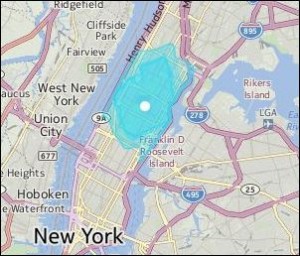
 No question, you can cover a lot more ground in Chesterfield. You’re flying along, top down on your car, wind flying through your hair, no crazed yellow taxis cutting you off, no crowds of pedestrians to wade through at every intersection. But at the end of the ride, you have access to a small fraction of the number of people, businesses and amenities that you would get in New York. (Admittedly, parking is a nightmare in New York compared to Chesterfield. On the other hand, Manhattan provides transportation options — walking, biking, buses and the subway — that are either impractical or do not exist in Chesterfield.) Cox dwells on the fact that density creates congestion. He is quite correct about that. But he ignores the fact that density also creates access. It’s access, not mobility, that is critical to economic growth and quality of life.
Having lived in both environments, I read this with interest. You left out several factors:
The stress level
Many of the thousands of people you could “access” might be people you don’t want to access. Ever.
The eventual lack of return for the “stuff” you can consume.
And finally, in the event of a singularity, a less-than-salubrious mass event, how do you leave the city when mass transit isn’t working or surface streets are gridlocked?
I never have understood why city folks aren’t gung-ho to get some kind of hardening of any utility crucial to their daily functioning. A state acting on its own, can secure against EMP strikes, for instance. Which is why Maine is going ahead with its own plans.
I totally agree. There are many reasons other than congestion/access/travel times for wanting or not wanting to live in New York City. Personally, I really enjoy visiting NYC, though never for more than a few days at a time, and I never would want to live there. (I live in Henrico County, a sister suburb to Chesterfield County.) I could have chosen different examples — Washington, D.C., San Francisco, Chicago… the point would have been the same: Mobility is not the same as access. Access increases with density. Many other things, some good and some bad, also increase with density. But I’m just focusing on the relationship with mobility and access.