
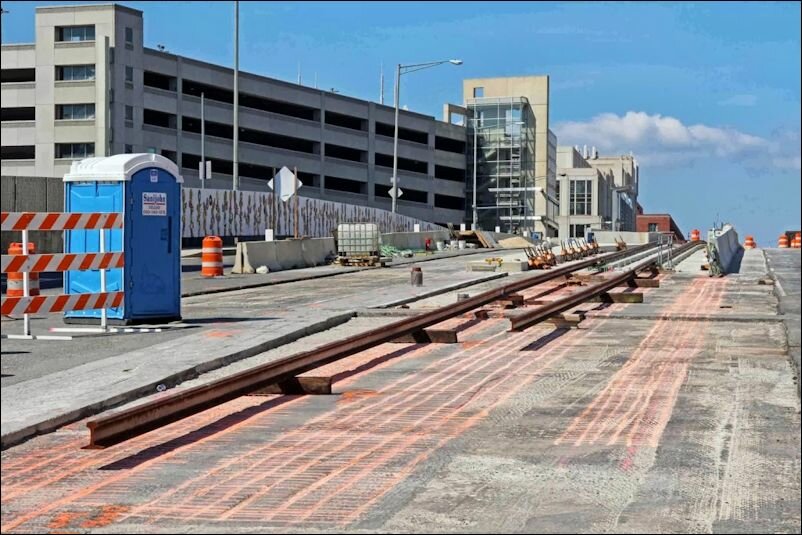
Passengers coming from Union Station will board the streetcar on an overpass next to a parking garage. Image via Fullertography.
by Emily Washington
On Tuesday, DC’s city council passed a tax reform package that will cut funding for future streetcar construction. These cuts come as the H Street streetcar delays continue to mount, and much of the commentary supporting the streetcar has shifted from touting its transportation benefits to its economic development role. As Stephen has explained, the benefits of streetcar over bus depend heavily on streetcars having dedicated lanes, which most of DC’s streetcars wouldn’t have.
Earlier this spring, I was in a bike accident that cemented my opposition to DC’s streetcar. Because the streetcar tracks cover the right two-thirds of H Street’s right-hand lanes, bicyclists typically ride between the two tracks. This creates a situation in which the sudden need to swerve or a brief loss of concentration puts cyclists at a risk of catching their front tire in the track, causing an over-the-handlebars accident when the front wheel comes to a sudden stop. In Toronto, streetcar tracks are a factor in nearly one-third of serious bicycle accidents. While I can say I’ll now go to great lengths to avoid riding on H Street, DC’s lack of good east-west bike routes make it unrealistic to expect all cyclists to avoid the streetcar tracks. Avoiding tracks will be much more difficult for cyclists under DDOT’s plan to eventually construct 22 miles of tracks.
Aside from creating a hazard for cyclists, this streetcar will provide effective transportation only for people visiting H Street retail destinations from the adjacent residential neighborhoods. It does not connect residential neighborhoods to job centers. While some have argued that it’s designed to serve tourists rather than District residents, the streetcar line doesn’t pass by any sightseeing, I don’t think that H Street’s retail is a common destination for tourists. Passengers using the streetcar to travel east from Union Station have to navigate a large parking garage to board the streetcar in the middle of a pedestrian-hostile overpass.
Its poorly planned route will, however, cause delays for bus riders and drivers as the streetcar comes to a stop behind cars turning right, cars that don’t park close enough to the curb, or inevitable breakdowns. The H Street corridor has the one of the city’s busiest bus routes with an average of over 15,000 riders each weekday. Unlike the streetcar, the X1, X2, and X9 buses actually connect residential neighborhoods to job centers and they serve passengers who live farther east in Anacostia. The streetcar will reduce the effectiveness of these valuable routes by adding to delays and reducing frequency as a result.
While streetcar construction has coincided with rapid-fire gentrification on the H Street corridor, those who attribute these changes to the streetcar’s presence discount other policies and trends that happened simultaneously. In 2006, then mayor Fenty implemented the Great Streets Initiative, a grant program that provides up to $85,000 to small businesses renovating space on corridors designated for the program. H Street was the first corridor designated as part of the Great Streets Initiative and the only corridor eligible for small business grants until 2013 when the program was expanded to include several additional corridors. Hstreet.org explains:
DMPED [Office of the Deputy Mayor for Planning and Economic Development] received an initial capital authorization of $16.6 million to provide development assistance, multiple property owner grants, technical assistance, loans and credit enhancements to projects like those happening on H Street. DC Council also authorized DMPED to issue up to $95 million in tax increment finance (“TIF”) notes or bonds to support retail projects within six retail priority areas along the initial GSI corridors. Up to $25 million out of the $95 million was authorized on H Street NE.
Staff at DMPED were not able to provide data on grant recipients before 2012, but for 2012 to the present, they provided data for each grant issued. Since 2012, H Street businesses have received nearly $2 million in grants for facade improvements and renovations. This is about a third of all of the grant money that the program has awarded in that time period. It’s clear that between 2006 and 2012 H Street businesses received millions of economic development spending, including a $5 million subsidy for Giant supermarket. These grants factored into dozens of entrepreneurs’ decisions to open businesses on the H Street corridor rather than another neighborhood in the city.
Furthermore, the pattern of redevelopment in the Atlas District suggests that these grants may have played a more important role than the streetcar. Typically, neighborhoods experience residential gentrification first, and the commercial gentrification bringing new shops and restaurants follows. As developers sometimes say, “retail follows rooftops.” However, the Atlas District experienced the reverse order. The bars and restaurants on H Street didn’t spring up to serve a new affluent neighborhood population or people moving to live near the streetcar line; rather a dedicated shuttle bus from Chinatown brought bar patrons from other neighborhoods in the city out to H Street for the first years that new bars were opened their doors on the corridor. In the 20002 zip code, home values held fairly steady from 2009 to 2012, indicating that demand for residential property didn’t surge until well after the commercial corridor began to gentrify. Home values in this zip code closely follow the city’s trend from 2005 to the present, whereas other zip codes, like 20009, show home price spikes that can more likely be attributed to a change in the neighborhood’s desirability, rather than the city’s general growth.
Of course, H Street’s gentrification is far from an objective policy success. The Great Streets Initiative grants that encouraged building renovations were tailored to benefit new businesses coming to the neighborhood, rather than existing businesses that served long-time residents. But even given the questionable policy goal of gentrification, it’s unclear that the streetcar can take credit for economic development. The streetcar will make commuting more difficult for X bus riders, and if tourists want to take the streetcar, they’ll have a difficult time reaching its western terminus from Union Station. Still not carrying passengers five years after construction began, the streetcar is a very expensive bike trap.
I wholeheartedly agree that bike riders (and drivers) should avoid getting stuck on the streetcar tracks. And, while I agree that the new streetcar line doesn’t deliver many benefits for the cost, everyone should acknowledge that this first operational streetcar line in DC is about much more than the H Street Atlas District. The H Street route is supposed to be phase one. Route selection and environmental analysis are in process for an extension to Georgetown. Arguments against the streetcar because of its minimal service area, or inconvenient current terminus, are faulty in that they ignore the larger context of these overall plans.
The streetcar is meant to build transportation capacity along a corridor. The logical progression is a road with single occupant vehicles, to a road with bus routes, to enhanced bus service with larger vehicles (X line) or frequent service (Circulator on K Street form Union Station to Georgetown). What’s the next step, now that the X2 bus route is packed and busy?
Personally, I think the next logical steps to increase capacity would have been to implement Bus Rapid Transit techniques like pre-paid boarding, and dedicated lanes. DC decided to leap-frog ahead by putting in a streetcar. I’m sure they considered the situation more thoroughly than my occasional review of web posts. So I’ll give DDoT the benefit of the doubt on the logic of their decision to upgrade to streetcars.
I do think that transit capacity needs upgrading along the Georgia Avenue, M L King Drive, and Rhode Island Avenue corridors. Long Range, light rail or streetcars are probably warranted there also.