
by James A. Bacon
The debate still rages over the extent to which young Americans, especially members of the Millennial generation, are moving back to the urban core. Data published by Luke Juday on the StatChat blog should settle that question once and for all. The only questions worth pondering is why they are moving, and how many will move back to the burbs.
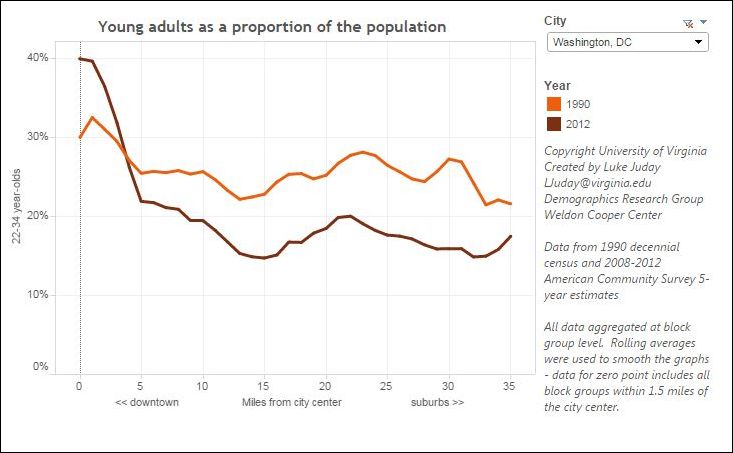
The chart above shows the proportion of Millennials living at varying distances from downtown Washington, D.C. In 1990, there was a weak tendency for young adults (defined as 22- to 34-year-olds) to live in the urban core but it was not pronounced. By 2012, however, the next generation of post-college young people had shifted markedly to the urban core.
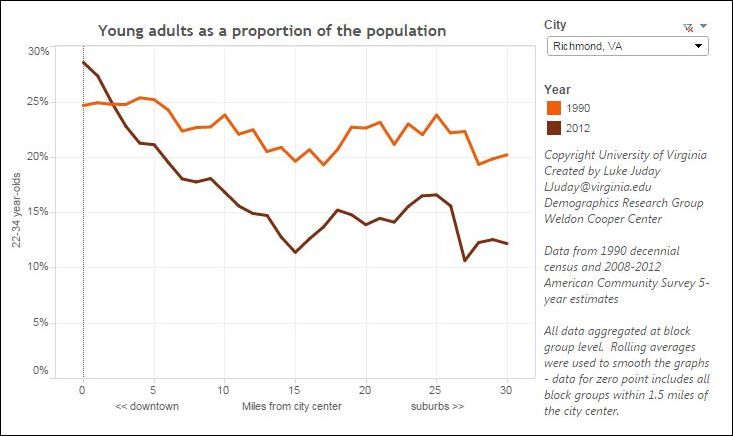
The chart below shows Richmond.
In Norfolk, where the distribution of young military-age people in military facilities is determined largely by the location of military bases, the shift is less evident.
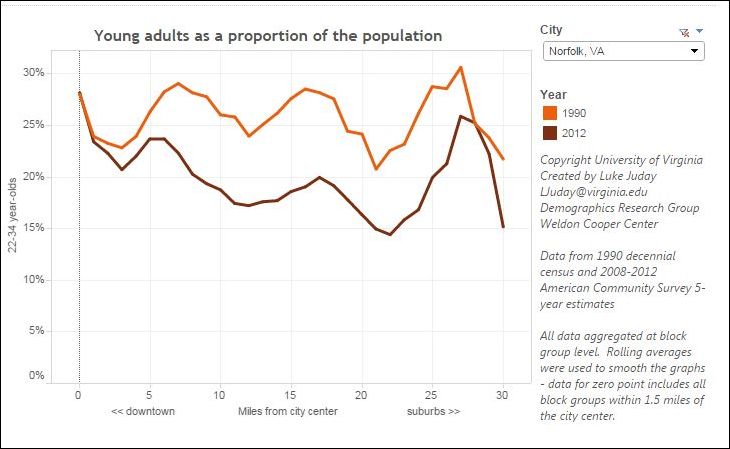
While the change is preference is dramatic, it is important to note that a large number of young people still resided miles from the city center in 2012. It’s not as if the suburbs are emptying of young adults. But even a modest shift in locational preference can drive the demand for new construction.
Juday, a Millenial himself, suggests a couple of reasons for the shift. Millennials have worse job prospects than previous generations at the same age and are saddled with greater student loan debt. As a consequence, they are less likely to take on mortgages for single-family dwellings in the suburbs. They’re also postponing marriage and child-bearing, which diminishes the incentives to move to suburban school jurisdictions with better schools. In keeping with their more modest economic prospects, Millennials place less emphasis on home ownership, automobile ownership and driving; they prefer walkable urban neighborhoods.
Interesting data, but the question it prompted in me was ‘what percentage of the overall population are the 22-34 year olds and has this percentage changed significantly since 1990?’
Pingback: Today’s Headlines | Streetsblog USA
I do a lot of Independent Green Party petition gathering door to door, out on the street, and in the community. Collecting signatures to to put Independent Green Party candidates on the ballot for state legislature: House of Delegates, and State Senate. This year, I am an Independent candidate in a nonpartisan race for Fairfax County Board of Supervisors in Braddock District. It is a great opportunity for thousands of conversations. Folk in their twenties tell me they want to live where they can walk, ride a bike, or take a train to go where they want to go. Many who grew up in the suburbs detest the traffic, and waste of time and money sitting in an auto. 80% of all new businesses started in the DC metro area open near a Rail stop. 61% of all DC commuters walk, bike, or ride metrorail between work and home. Every real estate agent knows property near rail is at a premium. You own property near rail, your property value climbs, and even in real estate crashes held solid in places like north Arlington along metrorail. This age group is also frugal, fiscally conservative by necessity with high student debt and low paying employment. They save loads of cash avoiding the financial drain of an auto. Walkability is a standard rating on Zilliow. A walkability rating means your house brings more money. Young folk making smart economic choice mean living where walking, biking, taking the train saves money, and is vastly safer.