
by Charles Marohn
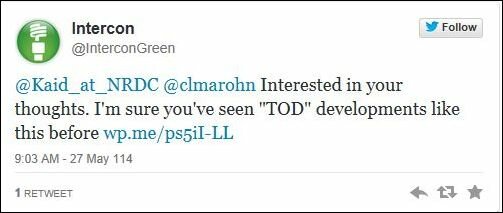
Today I received a tweet asking me about a transit oriented development (TOD). … In light of last week’s podcast on transit, I thought I should add a couple of thoughts on TOD.
Build-it-and-they-will-come transit is no better than build-it-and-they-will-come highways. Both are a risky gamble with sketchy results, particularly for local governments. Transit oriented development is the transit-advocate’s response to highway strip development in the same way that Seaside and early New Urbanism was a response to greenfield suburban development. I’m sympathetic, but this isn’t the answer.
Instead of transit oriented development, we should have development oriented transit. Identify places where things are happening now and then connect them with the lowest level of viable transit possible. Make sure those places allow the next increment of development by right (without extensive permitting). This will ensure that the transit is viable AND that it supports that next level of growth and expansion.
When that next level of growth and expansion happens, everything moves up a notch. Upgrade the transit to the next level – from jitney to shuttle bus, from shuttle bus to city bus, from city bus to streetcar, from streetcar to light rail, from light rail to subway – and repeat.
Yes, this is less “efficient” than getting out there and building the light rail to the parking lot now, but only if we judge efficiency on the project level. It would be cheaper on a unit cost basis if we just built everything right now and let the development fill in afterwards, thank you Peter Calthorpe. If we judge efficiency on a macro-financial level, however, it is more efficient to allocate scarce resources to endeavors that are proving their success than to those that may be successful but, thus far, are unproven.
This isn’t to say you won’t find a successful TOD out there. You will, and they serve as a cherry-picked template for what other TOD advocates strive to achieve. The article referenced in the tweet acknowledges the drawbacks of a “successful” TOD – the homogenous demographic and instant construction create a countdown on the viability of the place. The post suggests this is somehow an architectural problem, one that can be solved with a different regulatory mix. Unfortunately it is not that simple.
Like most post World War II development, the affluence of the United States created a development approach where we could transform our places to “perfection” overnight without the difficult, iterative process that has always shaped healthy, strong places. What we gain in instant gratification we lose in strength and resiliency.
Great places need a train less than a train needs a great place. Build the place first and transit becomes the logical, inevitable next step. No more transit oriented development schemes. What we need is development oriented transit.
Transit -Oriented Development are Government Waste. Utah Transit Authority has Destroyed the Bus System, too Help Pay for Trax, FrontRunner & StreetCar increasing Poverty & Crime in the Suburbs. UTA has receive Subsidizes to Build Transit-Oriented Development, Subsidize to Pay for Fares to Help Increase Ridership on Trax & FrontRunner the Majority of the Riders have Subsidies Pass & People that do not have a Car, Majority of People are not going to Pay $2.50 to ride Bus or Trax went UTA has a very Poor Commute. UTA only goes after the Subsidies Grants that Helps UTA Executives reach there goals so they can receive their Excessive Bonuses at Taxpayers Expense. UTA has very Poor Customer Service.