
 by James A. Bacon
As I have endeavored to develop a conservative vision for Smart Growth, I have relied primarily upon conservative principles with a libertarian slant — limited government, fiscal conservatism, free markets and the like. But there is a vast realm of conservative thinking that I have neglected, which William S. Lind, director of the Arlington-based American Ideas Institute, has reminded me of in today’s post on the Center for Public Transportation blog.
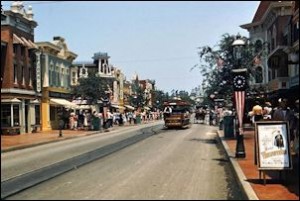
In that post, Lind has kind words to say about Bacon’s Rebellion and our offshoot blog, Smart Growth for Conservatives. But he also expands the case for Smart Growth beyond the one that I have made: He appeals to the idea of conservatism that favors institutions that have grown up over time, as embodied in customs, traditions and habits. In the realm of land use planning, he invokes the golden age of American urbanism that reached its apex in the street car era before zoning codes mandated separation of where people lived from where they shopped or worked by distances too great to walk.
Traditional neighborhood development, Lind contends, fostered a sense of community — and community is a core conservative value. Community refers to informal arrangements in which citizens interact in the civic sphere, building bonds of trust, collaborating to achieve goals of mutual benefit and enforcing community norms without the need for government intervention. He writes:
Why do we desire community? Because traditional morals are better enforced by community pressure than by the clumsy and intrusive instrument of the law. But community pressure only works where there is community. If you do not know your neighbors, what do you care what they think? We want people to care what their neighbors think.
Lind then observes that a conservative view of Smart Growth differs from a liberal view in preferring free-market mechanisms and a level playing field (the arguments that I have articulated) and in rejecting the Left’s celebration of “diversity, or the mixing of races, ethnic groups, income levels, and cultures in ways where everyone must live cheek-by-jowl.” When “diversity” occurs as a result of social engineering, rather than the natural coming of people together, it undermines community. “Community, for us,” writes Lind, “is far more important than any putative benefits from ‘diversity,’ benefits that seem entirely ideological in nature.”
I would elaborate that the Left tends to worship diversity as an abstract concept with little heed for its actual consequences. In the real world, as I have blogged recently, some of the most segregated places in the United States are the most politically liberal. Liberal policies (such as giving government more power to control land use) are associated with the most illiberal results. Ironically, while a conservative version of smart growth would eschew “diversity” as a goal, by eliminating exclusionary zoning and building communities based on shared values and trust, Smart Growth conservatism could do more to erode racial and ethnic segregation than all the judicial decrees and government programs favored by liberals.
Lind, who co-authored a study with Paul Weyrich and New Urbanism guru Andres Duany that explored commonalities of conservative and the New Urbanism, has tapped a rich new vein of thought and commentary on why conservatives should embrace Smart Growth. Let’s hope he continues to develop this line of thinking.
I agree that some of the most segregated places in this country are politically liberal-and very wealthy. However, to say that diversity isn’t a worthy goal ignores the centuries of segregation that has occurred in this country. Primarily it was based on race but in some of the older urban areas the segregation was also based on ethnicity. And this was even in the golden age that you mention. I’m sure you’re thinking that this was a result of exclusionary zoning, whether bylaw or convention, but it still doesn’t erase the fact that for most of our history we kept people out of our communities or neighborhoods that we didn’t like based on baseless prejudice.
Mike, I’d like to see a society in which people are judged by the content of their character (or their behavior) not the color of their skin. Before we enact programs to push people together, why don’t we start by dismantling the government structures that keep them apart? Why not start by getting rid of exclusionary zoning?
James,
As I was writing my comment I thought how the exclusionary zoning was the cause of historical segregation but modern day segregation is more a result of people wanting to live with like minded people, economically segregate or racially segregate. So while I agree that any exclusionary zoning of the last type have been eliminated (I think), we haven’t done much to counteract the first two. As you, and many other urbanists have mentioned, when we prevent a type of housing we prevent a certain type of person living there. I’m on the planning commission in my town and I consistently hear from staff and Council members that we can’t allow a type of housing because of neighborhood uproar. (They also seem to go along with the homeowners’ belief that off-street parking for at least two vehicles is either in Hammurabi’s Code or the Constitution.) So re-integrating a neighborhood is a multi-pronged approach. But someone could argue that allowing different types of housing in the same neighborhood is enacting a program to pouch people together. I don’t, but I expect to hear that argument.
Zoning that excludes people on the basis of race, ethnicity, religion, etc. is no long legal and no longer practiced. But zoning that restricts development along income lines is very much alive. In most cases, it is motivated by the desire of existing homeowners who believe that higher density will undermine their property values. Go read some of Daniel K. Hertz’s posts on Chicago and New York, which are replicated on this blog.